Aptitude Tests: What They Measure, Example Questions and How to Prepare
An aptitude test measures how readily you learn a job's skills. General ability predicts job performance at .31 in the latest revision, down from .51.

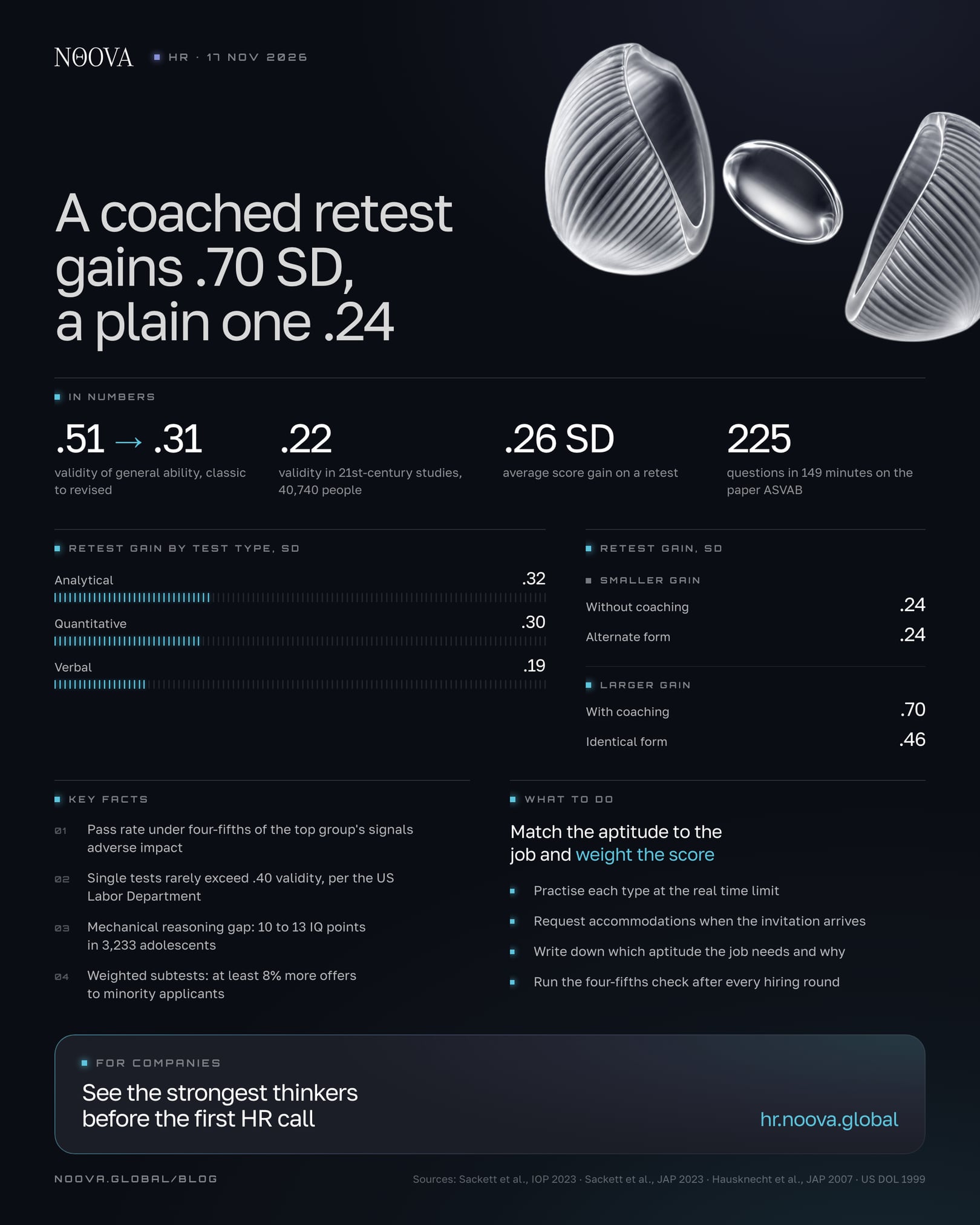
An aptitude test is a timed set of problems that estimates how readily you will learn the skills a job needs, usually through numerical, verbal, abstract or mechanical reasoning. Scores do predict job performance, though less than HR was taught: the latest revision of the evidence puts the validity of general ability at .31, down from the classic .51, and 21st-century data give .22. This guide shows what each type measures, with example questions and answers, what the research says, how to prepare, and how employers should use these tests fairly.
What an aptitude test measures
An aptitude test measures potential, not current knowledge. The APA Dictionary of Psychology defines it as "any assessment instrument designed to measure potential for acquiring knowledge or skill". A licensing exam asks what you know. An aptitude test asks how quickly you could learn it.
The US Department of Labor's guide to employment testing separates general ability tests, covering broad verbal, mathematical and reasoning skills, from specific ones such as mechanical ability, which it says may matter for auto mechanic and engineering jobs. Aptitude tests are one family of psychometric tests; personality questionnaires and situational judgement tests are others.
| Type | What it measures | A typical item |
|---|---|---|
| Numerical | Working with percentages, ratios, rates and tables | A price before a discount |
| Verbal | Precise reading, and only the conclusions a text supports | True, false or cannot say |
| Abstract | Finding a rule in shapes or symbols with no meaning | The missing figure in a grid |
| Mechanical | Applying everyday physics to a new picture | Which way a gear turns |
A well-documented public example is the US military's ASVAB. Its paper version has 225 questions in 149 minutes across nine subtests, from arithmetic reasoning and word knowledge to mechanical comprehension and assembling objects. The questions below were written for this guide, three per type, each with its answer and the reasoning.
Numerical aptitude test questions with answers
Numerical items test whether you can set up a calculation quickly, not whether you remember formulas.
Question 1. A jacket costs 80 after a 20% discount. What was the original price? (a) 96 (b) 100 (c) 104 (d) 120
Answer: (b) 100. The sale price is 80% of the original, so 80 ÷ 0.8 = 100. The trap is adding 20% to 80, which gives 96.
Question 2. A support team closed 1,200 tickets in March and 1,500 in April. By what percentage did the number rise? (a) 20% (b) 25% (c) 30% (d) 300%
Answer: (b) 25%. The rise is 300 tickets, and 300 ÷ 1,200 = 0.25. Dividing by the April figure gives the wrong base and 20%.
Question 3. Two printers together print 600 pages in 10 minutes. Printer A alone prints 600 pages in 15 minutes. How long does printer B need alone? (a) 5 minutes (b) 20 minutes (c) 25 minutes (d) 30 minutes
Answer: (d) 30 minutes. Together they print 60 pages a minute and A prints 40, so B prints 20 a minute.

Verbal reasoning questions with answers
Verbal items test whether you read precisely and can separate what a text proves from what it only suggests.
Question 4. Thermometer is to temperature as odometer is to: (a) speed (b) distance (c) fuel (d) time
Answer: (b) distance. An odometer records distance travelled. Speed is the speedometer's job.
Question 5. Which word is closest in meaning to provisional? (a) supplied (b) official (c) temporary (d) careful
Answer: (c) temporary. A provisional plan holds until a final one replaces it. "Supplied" is the trap, because the word looks like provisions.
Question 6. "Every office that opened before 2020 still runs the old booking system. No office runs both systems. The Lisbon office runs the new system, and the Madrid office runs the old one." True, false or cannot say: (A) the Lisbon office opened in 2020 or later; (B) the Madrid office opened before 2020.
Answer: (A) true, (B) cannot say. Lisbon runs only the new system, so it cannot have opened before 2020. The text never says that only older offices run the old system, so Madrid could be newer.
Abstract reasoning questions with answers
Abstract reasoning items remove words and numbers and leave a rule to find. Real tests show pictures; here the figures are described in words.
Question 7. Each figure is a circle with one clock hand and some dots. Figure 1: hand at 12, one dot. Figure 2: hand at 3, two dots. Figure 3: hand at 6, three dots. What is figure 4?
Answer: hand at 9, four dots. Two rules run at once: the hand turns a quarter clockwise each step, and the dots go up by one.
Question 8. A 3 by 3 grid. Row 1: black circle, white square, grey triangle. Row 2: grey square, black triangle, white circle. Row 3: white triangle, grey circle, and a gap. What fills the gap?
Answer: a black square. Every row and every column holds each shape once and each shade once.
Question 9. In a code, MATE is written NBUF. How is ROAD written? (a) SPBE (b) QNZC (c) SPBD (d) TQCF
Answer: (a) SPBE. Each letter moves one place forward in the alphabet.
Mechanical aptitude test questions with answers
Mechanical items test whether you can apply everyday physics, such as levers, gears and pulleys, to a situation you have not seen before.
Question 10. Gear A turns clockwise. It meshes with gear B, and gear B meshes with gear C. Which way does gear C turn?
Answer: clockwise. Two meshing gears turn in opposite directions, so B turns anticlockwise and C clockwise again.
Question 11. A 30 kg box sits 1 metre from the pivot of a plank. How far from the pivot, on the other side, must a 20 kg box sit to keep the plank level?
Answer: 1.5 metres. The turning effect is weight times distance: 30 × 1 = 20 × 1.5.
Question 12. A load of 200 newtons hangs from a single movable pulley. Ignoring friction and the pulley's own weight, what force holds it?
Answer: 100 newtons. Two lengths of rope share the load, so each carries half. You pay in distance: you pull twice as much rope as the load rises.
How well aptitude tests predict job performance
Aptitude tests predict job performance moderately: about .31 for general ability in the latest revision. Validity here is the correlation between test scores and later job performance ratings, on a scale from 0 to 1.
For two decades the reference figure was .51, from Schmidt and Hunter's 1998 review. Sackett, Zhang, Berry and Lievens re-examined the statistical corrections behind such estimates, and their 2023 summary puts cognitive ability at .31, behind structured interviews at .42. In their words, it is "no longer the stand-out predictor that it was in the prior work". A 2023 meta-analysis of 21st-century studies, 153 samples and 40,740 people, found .22.
Two findings keep aptitude tests in the toolkit. For training outcomes, the same authors write that cognitive ability "remains the best available predictor", though that link has not been re-examined. And tests work better in combination: their composites of several predictors average .47 with the revised numbers.
For scale, the Department of Labor guide calls validities of .21 to .35 typical for a single test and "likely to be useful", and says single tests rarely exceed .40. Our cognitive ability test guide covers the validity debate in depth.
General ability or specific aptitudes
For predicting overall job performance a general score is hard to beat; specific aptitudes earn their place when the job leans on one ability. Scores on numerical, verbal and abstract items correlate with each other, and that shared part is called general cognitive ability, or g.
In a 2017 review, Kevin Murphy revisits the "not much more than g" studies, which found specific abilities adding little to a general score, and calls that consensus premature. Broad outcomes such as overall performance favour general measures, he argues, while specific abilities show more value when the outcome is specific and closely tied to them.
Separate scores can also make a test fairer. Wee, Newman and Joseph (2014) used two large validation studies covering 15 job families. Weighting subtests differently, instead of adding them up equally, could lead to at least 8% more job offers to minority applicants, and in their example twice as many, with no expected loss in selection quality.
The practical rule: match the aptitude to the job. A mechanical test makes sense for a maintenance technician, not for an account manager.
How to prepare for an aptitude test
Practice raises aptitude test scores, and coached practice raises them most. A meta-analysis by Hausknecht and colleagues of 50 studies and 134,436 people found that scores rise by .26 standard deviations on a retest. With coaching the gain was .70, against .24 without it. To practise the format, try our free aptitude test practice: 12 timed questions with worked answers.
Gains were bigger on the identical test (.46) than on a different version of it (.24), so memorising items helps less when the employer uses alternate forms. Gains were similar across types: .32 for analytical, .30 for quantitative and .19 for verbal tests, differences the authors could not separate statistically.
A routine that follows from this:
- Learn the formats. Ask which types the test covers and how long it runs, and use official practice items where they exist.
- Practise at the real pace. The paper ASVAB allows 149 minutes for 225 questions, under 40 seconds each.
- Sort your errors. Mark each miss as misread, miscalculated or rule not found. Noticing your own error patterns is metacognition at work.
- Move past stubborn items on tests that let you skip, so one hard question does not cost three easy ones.
- Ask for accommodations. The DOL guide names extra time for dyslexia or another learning disability, larger print and a reader as reasonable accommodations.
Leaked answer banks and stand-in test takers are cheating, and alternate forms make memorised answers worth little anyway. If something goes wrong on the day, say so: the DOL guide tells employers that a candidate's health or noisy test conditions can invalidate a result and that a retest should be considered.
How employers can use an aptitude test fairly
Use an aptitude test only for an ability the job needs, and check what it does to each group of applicants. The DOL guide's example: a bank testing for numerical aptitude must show that the test measures the trait and that the trait corresponds to success on the job. Ask for reliability: the guide rates .80 to .89 as good.
Run the four-fifths check. Adverse impact means a step screens out a protected group at a far higher rate, whatever the intent. Under the Uniform Guidelines, a pass rate for any race, sex or ethnic group below four-fifths of the highest group's rate is generally treated as evidence of it. An EEOC rule to rescind those guidelines has been under White House review since October 16, 2026; Title VII's disparate impact rule stays either way. The EEOC records the cost: Ford paid $8.55 million to settle a case for African American applicants rejected from an apprenticeship programme after a cognitive test.
Watch speed and content. Speeded mental ability tests may adversely affect older workers, the DOL guide warns. In a study of 3,233 adolescents, Lemos and colleagues found boys ahead on mechanical reasoning by the equivalent of 10 IQ points among younger and 13 among older teenagers; general ability explained only 1 to 2 of those points. Unless the job needs mechanical reasoning, that gap buys nothing.
Weight the score, do not gate on it. Combine it with a structured interview or a work sample test, the guide's whole-person approach, rather than as a hard first cut. Our pre-employment test guide covers the ADA and other legal rules.
A score also misses how a person reasons out loud. NOOVA HR measures thinking in a 20-minute voice dialogue instead of hours of tests, and a person always makes the decision.
A checklist for candidates and hiring teams
- Ask which aptitude types the test covers, how long it runs and whether you can skip items.
- Practise each type at the real time limit, then sort your errors by kind.
- Request accommodations in writing as soon as the invitation arrives.
- Write down which aptitude the job needs and why before you choose a test.
- Ask the test provider for reliability and validity evidence for jobs like yours.
- Combine the score with a structured interview or work sample instead of a hard first cut.
- Run the four-fifths check on pass rates by group after every hiring round.
- Set a retest rule that uses an alternate form and tell candidates when they can retake.
Sources
- Aptitude test, APA Dictionary of Psychology
- Testing and Assessment: An Employer's Guide to Good Practices, U.S. Department of Labor, 1999
- ASVAB: What to Expect, Official Site of the ASVAB
- Revisiting the design of selection systems in light of new findings regarding the validity of widely used predictors, Sackett et al., Industrial and Organizational Psychology, 2023
- A Contemporary Look at the Relationship Between General Cognitive Ability and Job Performance, Sackett et al., Journal of Applied Psychology, 2023
- What Can We Learn from "Not Much More than g"?, Murphy, Journal of Intelligence, 2017
- More Than g: Selection Quality and Adverse Impact Implications of Considering Second-Stratum Cognitive Abilities, Wee, Newman and Joseph, Journal of Applied Psychology, 2014
- Retesting in Selection: A Meta-Analysis of Practice Effects for Tests of Cognitive Ability, Hausknecht et al., Journal of Applied Psychology, 2007
- Sex differences on g and non-g intellectual performance reveal potential sources of STEM discrepancies, Lemos et al., Intelligence, 2013
- 29 CFR 1607.4, Uniform Guidelines on Employee Selection Procedures, Legal Information Institute
- EO 12866 review: Rescission of Uniform Guidelines on Employee Selection Procedures, RIN 3046-AB43, OIRA
- Employment Tests and Selection Procedures, U.S. Equal Employment Opportunity Commission


