Pre Employment Tests: Which Types Predict Job Performance, and How to Use One Fairly
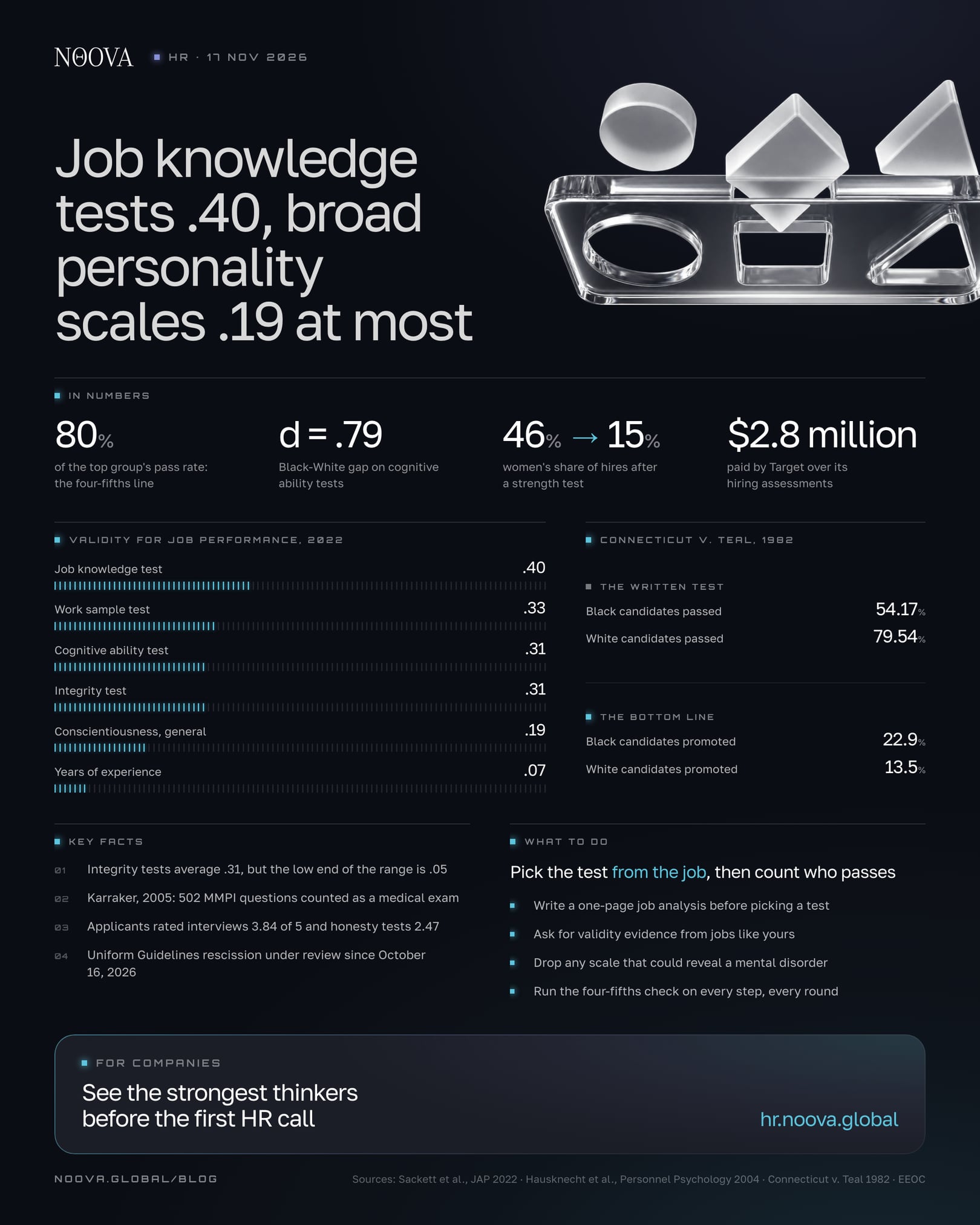
A pre employment test can predict performance or add legal risk. In a 2022 re-analysis, job knowledge tests scored .40, broad personality scales .19 at most.

A pre employment test is a standard task or questionnaire that every candidate completes before a hiring decision, and the type you choose matters more than the brand on it. In the most careful recent review of selection research, Sackett and colleagues (2022) put the validity of job knowledge tests at .40 and of cognitive ability and integrity tests at .31, while broad personality scales reached .19 or less. This guide is for employers. It covers the main types of test, what those numbers mean, adverse impact and the four-fifths rule, the ADA and accommodations, and how to choose and run a test you can defend.
What counts as a pre employment test
A pre employment test is any standardised measure you use to decide who moves forward. The EEOC treats all of them as selection procedures under the same anti-discrimination rules, and it holds the employer responsible for a test's validity even when a vendor built it. The types you will meet most often:
- Cognitive ability tests: timed problems in reasoning, numbers, words and patterns (see our guides to cognitive ability tests and aptitude tests).
- Job knowledge tests: what a candidate already knows, such as accounting rules or a programming language.
- Work sample and skills tests: a small piece of the real job, scored against a key (work sample tests).
- Personality questionnaires: typical behaviour, such as how dependable or cooperative someone tends to be.
- Integrity tests: attitudes and traits that predict conduct such as theft or absenteeism.
- Situational judgement tests (SJTs): realistic work dilemmas with possible responses to choose or rate.
- Physical ability tests: strength, stamina or a physical task taken from the job.
How ability, personality and judgement tests differ as instruments is the subject of our psychometric test guide. Drug screens and background checks follow their own rules and are left out here.
How well each type of pre employment test predicts performance
Job-specific tests predict best, broad personality scales worst, and most estimates are lower than the figures many HR guides still print. Validity here is the correlation between test scores and later job performance ratings, on a scale from 0 to 1.
The old reference table came from Schmidt and Hunter (1998). In 2022 Paul Sackett, Charlene Zhang, Christopher Berry and Filip Lievens showed in the Journal of Applied Psychology that its correction for range restriction (only higher scorers get hired, which hides part of the relationship) had been far too large. Their revised estimates, with the Black-White score gap for each method:
| Method | Validity, 1998 | Validity, 2022 | Black-White gap (d) |
|---|---|---|---|
| Structured interview, for comparison | .51 | .42 | .23 |
| Job knowledge test | .48 | .40 | .54 |
| Empirically keyed biodata | .35 | .38 | .33 |
| Work sample test | .54 | .33 | .67 |
| Cognitive ability test | .51 | .31 | .79 |
| Integrity test | .41 | .31 | .10 |
| Assessment centre | .37 | .29 | .52 |
| Situational judgement test | n/a | .26 | .34 to .39 |
| Conscientiousness, framed at work | n/a | .25 | -.07 |
| Conscientiousness, general | .31 | .19 | -.07 |
| Unstructured interview, for comparison | .38 | .19 | .32 |
| Years of job experience | .18 | .07 | .49 |
As the authors put it in a follow-up article, the predictors at the top "are those specific to individual jobs".
An average also hides the spread. Integrity tests average .31, but their lower 80% credibility value is .05: in some settings they barely predict anything. Ranked by that cautious low end, the top five are empirically keyed biodata, work-framed conscientiousness, job knowledge, work samples and structured interviews.
Framing matters too. Conscientiousness asked about at work reached .25; measured in general, .19. Years of experience, at .07, is close to useless as a screen.

Adverse impact: which tests screen out which groups
Adverse impact is the legal term for a selection step that passes a protected group at a much lower rate than another, whatever anyone intended. Tests differ sharply in how much of it they create.
The last column of the table shows the average Black-White difference in standard deviations. Cognitive ability tests carry the largest gap, d = .79, followed by work samples (.67), job knowledge tests (.54) and assessment centres (.52). Integrity tests (.10) and conscientiousness scales (-.07) show almost none. Some gaps come from employee or mixed samples rather than applicants, so treat them as approximate.
The 2023 follow-up warns that "a system relying solely on cognitive ability will generally produce substantial adverse impact". In the authors' model of a multi-test system, dropping cognitive ability cost .20 of validity under the old estimates and only .05 under the new ones.
Physical tests create gaps by sex. In a case the EEOC described in 2007 testimony, an Iowa meat plant made applicants lift and carry a 35-pound bar between a table and frames at 35 and 67 inches for seven minutes. About 97% of men passed; about 62% of women failed. Women's share of new hires fell from about 46% to about 15%. The EEOC showed the test was considerably harder than the job itself, the court found no business necessity, and the judgment came to about $3.6 million for 53 women.
The four-fifths rule, worked through
The four-fifths rule is the federal rule of thumb for spotting adverse impact: if one group's selection rate is below 80% of the highest group's rate, that is generally treated as evidence of adverse impact. It comes from section 1607.4(D) of the Uniform Guidelines on Employee Selection Procedures.
The arithmetic takes a minute. Say 200 men and 100 women sit your test. If 120 men pass, their rate is 60%. If 45 women pass, their rate is 45%. Divide the lower rate by the higher: 45 ÷ 60 = 0.75, or 75%. That is below four-fifths, so this step is flagged.
The rule is a screen, not a verdict. The same section says smaller differences can still count when they are significant in both statistical and practical terms, and larger ones may not when they rest on small numbers. If you kept no records, agencies may infer adverse impact from that.
Every step counts on its own. In Connecticut v. Teal (1982), a written test for promotion passed 54.17% of Black candidates and 79.54% of white candidates. The final promotions favoured Black candidates, 22.9% against 13.5%. The Supreme Court held that the balanced "bottom line" was no defence for the test.
What the law adds beyond the four-fifths rule
Once a test shows adverse impact, Title VII puts the burden on you. Under 42 U.S.C. 2000e-2(k) you must show the test is "job related for the position in question" and consistent with business necessity. You can still lose if a less discriminatory alternative exists and you refuse to adopt it.
Two shortcuts are closed. Subsection (l) of the same statute forbids adjusting scores or using different cut-off scores by race, colour, religion, sex or national origin. And you cannot simply discard results you dislike. In Ricci v. DeStefano (2009), New Haven threw out firefighter promotion exams after white candidates outperformed minority candidates. The Court ruled 5-4 that this violated Title VII, because the city lacked a strong basis in evidence that it would have been liable. "Fear of litigation alone" was not enough. The practical lesson: do the validity and adverse impact work before the test goes live.
The federal guidance is in flux. Since October 16, 2026, the White House regulatory office has been reviewing an EEOC final rule that rescinds the Uniform Guidelines, as we covered in our post on EEO-1 reporting. The statute above does not change with it, so keep running the check.
Pre employment tests and the ADA
The Americans with Disabilities Act adds a hard line: before a job offer, you may not give a medical examination or ask about disability (42 U.S.C. 12112). Some psychological tests cross that line.
The EEOC's guidance draws the boundary by purpose. A test is medical if it provides evidence that would lead to identifying a mental disorder. A test "designed and used to measure only things such as honesty, tastes, and habits" is not. Check every scale against that line: a clinical inventory built to detect disorders sits on the wrong side of it.
Two cases show where employers slipped. In Karraker v. Rent-A-Center (2005), a promotion battery of nine tests included 502 questions from the MMPI, a clinical personality inventory. The Seventh Circuit held the MMPI was "best categorized as a medical examination", however the company used or scored it (case summary). In 2015 Target agreed to pay $2.8 million after the EEOC found that an assessment performed by psychologists before an offer was a medical exam. The EEOC also found that three assessments screened out applicants for professional roles by race and sex, and that Target had not kept the records needed to check its own hiring steps.
Physical tests follow the same logic. An agility test of job tasks, or a fitness test of running or lifting, is not medical. Measuring heart rate or blood pressure during it makes it one.
Accommodations: adjusting a test without breaking it
The ADA also requires that a test measure the skill, not the disability. Under section 12112(b)(7), results for a candidate with impaired sensory, manual or speaking skills must reflect the ability being tested, unless that impaired skill is what the test measures.
The EEOC's guidance lets you describe the process to every applicant and ask whether they will need a reasonable accommodation for it, then request reasonable documentation if the need is not obvious. Its page on tests cites a settlement where applicants with learning disabilities needed a reader for the written parts, or an audio version of the test.
The SIOP Principles, the professional standard for selection testing, list typical accommodations: a different environment (a higher desk), a different medium (Braille, a text reader) and more time. Changes to test content are rare, because they change what the test measures. The Principles ask for standard, documented rules on three things: who is eligible, how to request an accommodation and how requests are judged. Candidates should be told the process and that their disability status stays confidential.
How to choose a pre employment test
Start from the job, not from the catalogue. Five questions do most of the work.
What does the job require? Write a short job analysis naming the tasks and the knowledge, skills and traits they need. It is your answer when anyone asks why this test.
Is there evidence for jobs like yours? A validity study done elsewhere carries over only when the jobs are alike. The SIOP Principles call this transportability and ask you to compare job content, job context and, where possible, the applicant group. The EEOC is blunt about vendors: their validity documentation may help, but "the employer is still responsible for ensuring that its tests are valid".
What gaps will it create? Ask for subgroup differences and pass rates, then compare them with the table above. In the 2022 figures, a job knowledge test and a structured interview each beat a general ability test on validity and on gap size.
Could any scale reveal a mental disorder? If yes, it cannot be used before an offer.
How will candidates react? In a meta-analysis by Hausknecht, Day and Thomas of 86 samples and 48,750 people, applicants rated interviews 3.84 out of 5 and work samples 3.63. Cognitive ability tests scored 3.14, personality tests 2.88, honesty tests 2.47 and graphology 1.76. Applicants who liked the process thought better of the employer and reported stronger intentions to accept an offer and recommend it. Face validity, how job-related a test looks, was a strong driver of those perceptions.
Some teams now look at reasoning in conversation rather than on a timed sheet. NOOVA HR, for example, runs a 20-minute voice dialogue instead of hours of tests, and a person always makes the decision.
How to run the test once it is chosen
Running a test fairly is mostly decided before the first candidate starts. Fix the rules in writing, then count what happens.
Decide how scores are used. The SIOP Principles describe a cut-off score, rank order from the top down, or bands of scores treated alike, and tests can be separate hurdles or one combined total. Some organisations pick a cut-off over rank order to increase workforce diversity, accepting a possible loss of predicted performance. Whatever you pick, document why. As we argue for cognitive ability tests, a hard cut-off at the first step applies the full group gap to everyone who follows.
Count pass rates by group at every step. Target's settlement required exactly this: applicant tracking that collects enough data to assess adverse impact, predictive validity studies, and adverse impact monitoring with a yearly summary to the EEOC. Our post on hiring bias shows how stubborn unequal treatment is, which is why the counting has to be routine.
Protect the test online. For unproctored internet testing, the Principles ask for measures that reduce leaked content and cheating and confirm who is taking the test. Alternate forms help if their scores are comparable.
Tell candidates what to expect. Say what the test measures, why the job needs it, what happens with the score and how to ask for an accommodation.
Review it when the job changes. The EEOC asks employers to keep abreast of changes in job requirements and update their tests to match.
A checklist for choosing and running a pre employment test
- Write a one-page job analysis before you look at any test.
- Ask each provider for validity evidence from jobs like yours and for pass rates by group.
- Remove any scale that could reveal a mental disorder from the pre-offer stage.
- Put the accommodation route in the test invitation and name who approves requests.
- Fix the cut-off, ranking or banding rule in writing before the first candidate sits the test.
- Run the four-fifths check on every step after each hiring round, as well as on final hires.
- Keep applicant records by group so you can show what each step did.
- Review the test whenever the job's tasks change.
Sources
- Revisiting meta-analytic estimates of validity in personnel selection: Addressing systematic overcorrection for restriction of range, Sackett, Zhang, Berry and Lievens, Journal of Applied Psychology, 2022
- Revisiting the design of selection systems in light of new findings regarding the validity of widely used predictors, Sackett et al., Industrial and Organizational Psychology, 2023
- Employment Tests and Selection Procedures, U.S. Equal Employment Opportunity Commission
- 29 CFR 1607.4, Uniform Guidelines on Employee Selection Procedures, Legal Information Institute
- Connecticut v. Teal, 457 U.S. 440 (1982), Legal Information Institute
- Ricci v. DeStefano, 557 U.S. 557 (2009), Legal Information Institute
- 42 U.S.C. 2000e-2, Unlawful employment practices, Legal Information Institute
- EO 12866 review: Rescission of Uniform Guidelines on Employee Selection Procedures, RIN 3046-AB43, OIRA
- 42 U.S.C. 12112, Discrimination (Americans with Disabilities Act), Legal Information Institute
- Enforcement Guidance: Preemployment Disability-Related Questions and Medical Examinations, EEOC, 1995
- ADA and Medical Examinations (Karraker v. Rent-A-Center), Tinwalla and Ciccone, Journal of the American Academy of Psychiatry and the Law, 2006
- Target Corporation to Pay $2.8 Million to Resolve EEOC Discrimination Finding, EEOC, 2015
- Testimony of Jean P. Kamp on EEOC v. Dial Corp., EEOC meeting on employment testing and screening, 2007
- Applicant Reactions to Selection Procedures: An Updated Model and Meta-Analysis, Hausknecht, Day and Thomas, Personnel Psychology, 2004
- Principles for the Validation and Use of Personnel Selection Procedures, fifth edition, SIOP, 2018


