EEO-1 Reporting Is Set to End: The EEOC Final Rule Is at the White House
EEO-1 reporting may end: on November 9 the EEOC sent the White House a final rule to scrap the reports that about 110,000 employers file every year.

EEO-1 reporting, the yearly count of employees by race, ethnicity, sex and job category that large US employers have filed since 1966, is close to its end. On November 9, 2026, the EEOC sent a final rule rescinding the EEO-1 and four related reports to the White House regulatory office, which lists it as economically significant. The agency's July proposal counted about 110,000 private employers that file. Below: what was sent, what the reports did, what changes for employers and what does not, and a second hiring rule waiting at the same desk.
What the EEOC sent to the White House on EEO-1 reporting
The document is a final rule, not another proposal. The review page of the Office of Information and Regulatory Affairs (OIRA), RIN 3046-AB37, shows the title "Rescission of EEO-1, EEO-2, EEO-3, EEO-4. EEO-5, And Reporting Requirement Under Title VII, the ADA, GINA, and the PWFA", stage Final Rule, received November 9, 2026. OIRA uses the "economically significant" label for rules with an annual effect on the economy of $100 million or more, among other tests. Bloomberg Law reported the submission on November 10.
The final text is not public yet. It appears in the Federal Register after OIRA clears it, and only then will employers see the effective date and any changes from the proposal.
That proposal was published on July 23, 2026. It would remove the EEO-1 through EEO-6 reports, and the recordkeeping tied to them, from the EEOC's regulations. The commission voted for it 2-1 on July 21, with Commissioner Kalpana Kotagal dissenting, according to Barnes & Thornburg. Comments closed on August 24, after a public hearing on August 11.
What EEO-1 reporting is and who files
The EEO-1 is the federal government's routine view of who works where. Private employers with 100 or more employees, and federal contractors with 50 or more that meet certain criteria, report headcounts by race or ethnicity and sex across job categories. The EEOC's data page calls it "a mandatory annual data collection". The related reports cover local unions (EEO-3), state and local governments (EEO-4) and public school systems (EEO-5).
The form is 60 years old. The EEOC adopted it in 1966, shortly after it opened, for joint use with the Labor Department's federal contractor office. The first version asked for employees "broken down by sex, in each of nine occupational categories".
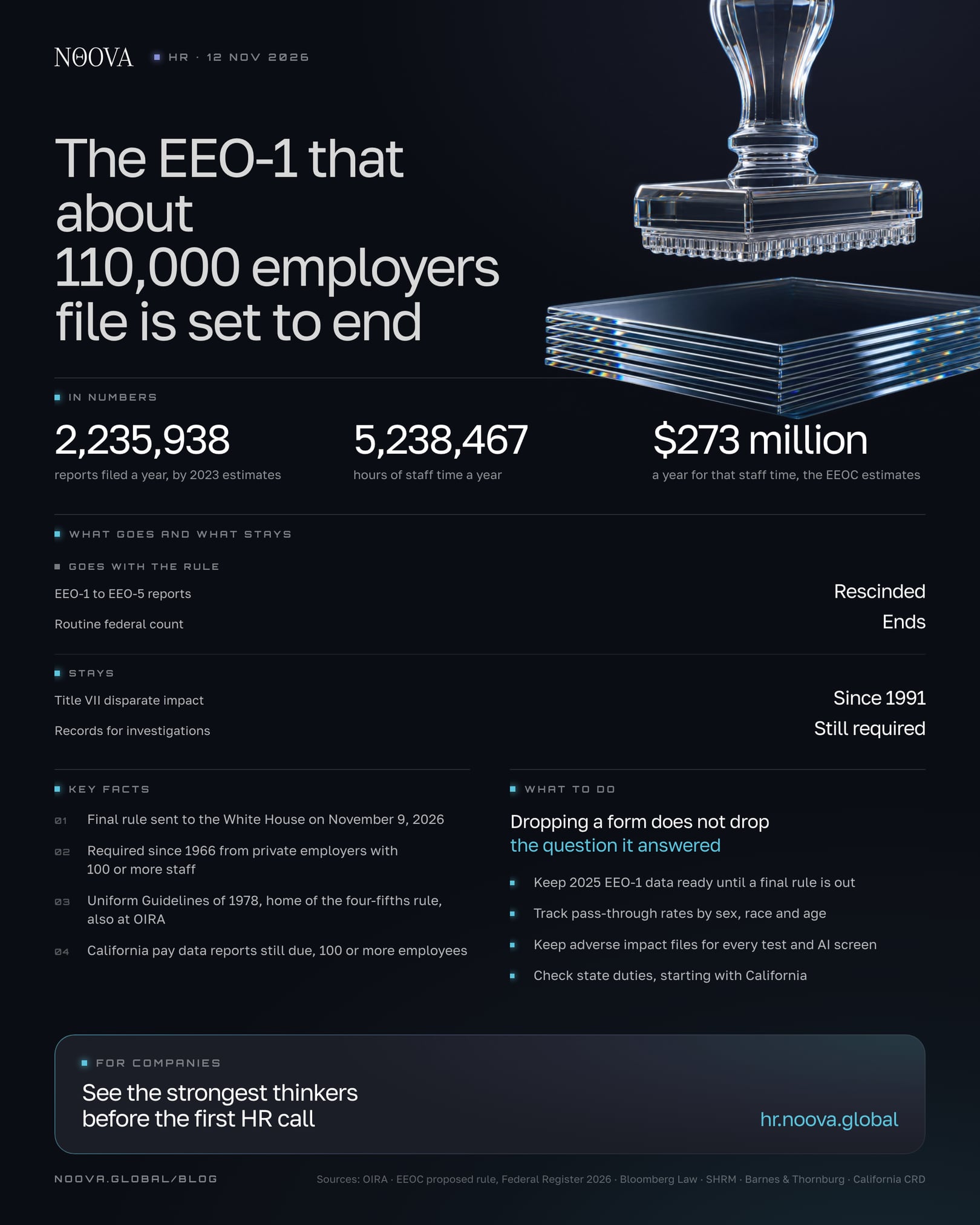
The paperwork is not small. Using its 2023 estimates, the EEOC counts about 110,000 filers sending 2,235,938 reports a year. That takes 5,238,467 hours of staff time, which the agency prices at $273,137,678. About 60% of filers report on more than one establishment. Running the collection costs the EEOC itself about $3.9 million a year.
One timing detail matters this autumn. The 2025 collection has not opened: the EEOC's page says the 2024 collection is closed and that "updates regarding the 2025 EEO-1 Component 1 data collection will be posted to this page as they become available."

Why the EEOC wants to end EEO-1 reporting
The commission's case is legal first and practical second. The proposal says the EEOC "has preliminarily determined that the reports are inconsistent with equal employment opportunity law and potentially unconstitutional". It calls the data "not narrowly tailored" and "unnecessary to enforce anti-discrimination laws", and cites the Supreme Court's 2023 decision on race-conscious college admissions.
Chair Andrea Lucas has said the EEO-1 categories "don't reflect the modern workforce" and that the annual reports risk "encouraging companies to justify discriminatory practices to diversify their workforce". She also said the EEOC would keep requesting data during individual investigations, as Barnes & Thornburg reports.
The practical argument is cost. Employers file every year "regardless of any specific allegation or indication of a potential violation", in the proposal's words, and the agency says the marginal benefit does not justify that burden. Kotagal's dissent pointed the other way: the proposal would "kneecap" the agency's ability to investigate discrimination at a time when the EEOC is "chronically understaffed" and "underfunded". She also warned that future leadership could bring the collection back.
What changes for employers, and what does not
Until the final rule is published and takes effect, the existing EEO-1 regulation stands. After that, the federal form goes. The duties behind it stay.
- Title VII. Disparate impact liability has been written into Title VII since the 1991 amendments. A neutral-looking practice that screens out a protected group can still be challenged by private plaintiffs and by states, as attorneys told SHRM.
- Investigations. Title VII still requires employers to make and keep records relevant to discrimination investigations, and the EEOC keeps its power to ask for workforce data in a case, as Barnes & Thornburg points out.
- State reports. California requires private employers with 100 or more payroll employees to file annual reports with "pay, demographic, and other workforce data"; reports for 2025 were due May 13, 2026, under the California Civil Rights Department rules. Illinois, Massachusetts, New Jersey and New York City have their own reporting rules, per the same Barnes & Thornburg note.
The other hiring rule at the White House: the Uniform Guidelines
EEO-1 reporting is not the only rule in the queue. Since October 16, 2026, OIRA has also been reviewing a final rule titled "Rescission of Uniform Guidelines on Employee Selection Procedures" (RIN 3046-AB43).
The Uniform Guidelines, adopted in 1978, are the federal manual for checking tests, interviews and other selection methods for adverse impact, and for showing that a method is job-related. They hold the four-fifths rule: a group's selection rate below 80% of the highest group's rate is a warning sign. According to SHRM, the EEOC plans a partial rescission, starting with the interpretive portions.
Lawyers quoted by SHRM agree the law underneath does not move. "If an assessment or AI screen produces adverse impact, the employer still has to show it is job-related," said Camille Olson of Seyfarth.
Put together, the two rules remove the routine federal count of who works where and the federal manual for checking how people were picked. The duty not to discriminate, by intent or by effect, stays.
What we think
Dropping a form does not drop the question it answered. For many large employers, the EEO-1 was the one moment each year when someone had to compile those numbers. Without the form, the data you hold is the data you chose to keep, and a plaintiff, a state agency or a court will still ask for it.
AI screening raises the stakes. In Mobley v Workday the central question is whether a screening tool shut out older applicants. Connecticut now says using AI is no defence to a discrimination claim, as we covered in our post on the Connecticut AI hiring law.
We built NOOVA HR on the rule that a person always decides, with no automated verdicts, and that rule does not depend on a federal form. Whatever tools you use, keep counting who passes each step. That count is how you catch a biased method before someone else does.
A checklist for employers as EEO-1 reporting ends
- Keep your 2025 EEO-1 data ready until a final rule is published with an effective date.
- Track pass-through rates by sex, race and age at every hiring step, form or no form.
- Check state duties on their own, starting with California pay data reports.
- Keep adverse impact analyses and validation files for every test and AI screen you use.
- Hold historical EEO-1 and applicant records until counsel signs off on any deletion.
- Ask each screening and assessment vendor for its adverse impact data by group.
- Watch the Federal Register for both final rules, EEO-1 and the Uniform Guidelines.
Sources
- EO 12866 review: Rescission of EEO-1, EEO-2, EEO-3, EEO-4, EEO-5 reporting requirements, RIN 3046-AB37, received 9 November 2026, OIRA
- EO 12866 review: Rescission of Uniform Guidelines on Employee Selection Procedures, RIN 3046-AB43, received 16 October 2026, OIRA
- Removal of Reporting Requirements, proposed rule, EEOC, Federal Register, 23 July 2026
- EEO Data Collections, U.S. Equal Employment Opportunity Commission
- EEOC Plan Under White House Review to End Race, Sex Data Reports, Bloomberg Law, 10 November 2026
- EEOC Moves to Roll Back Longstanding Hiring Guidelines, SHRM, 30 October 2026
- End of an Era? EEOC Votes to Scrap 60-Year-Old Workforce Demographic Reporting Requirements, Barnes & Thornburg via The National Law Review, 3 August 2026
- EEOC Puts EEO-1 Rescission in Writing, DirectEmployers Association, 23 July 2026
- Pay Data Reporting, California Civil Rights Department