PwC Critical Thinking Certificate: What It Means That 85,000 People Will Be Trained in Judgment
PwC critical thinking certificate: the US firm will train and assess 85,000+ partners and staff in judgment by June 2027 as AI takes over routine work.

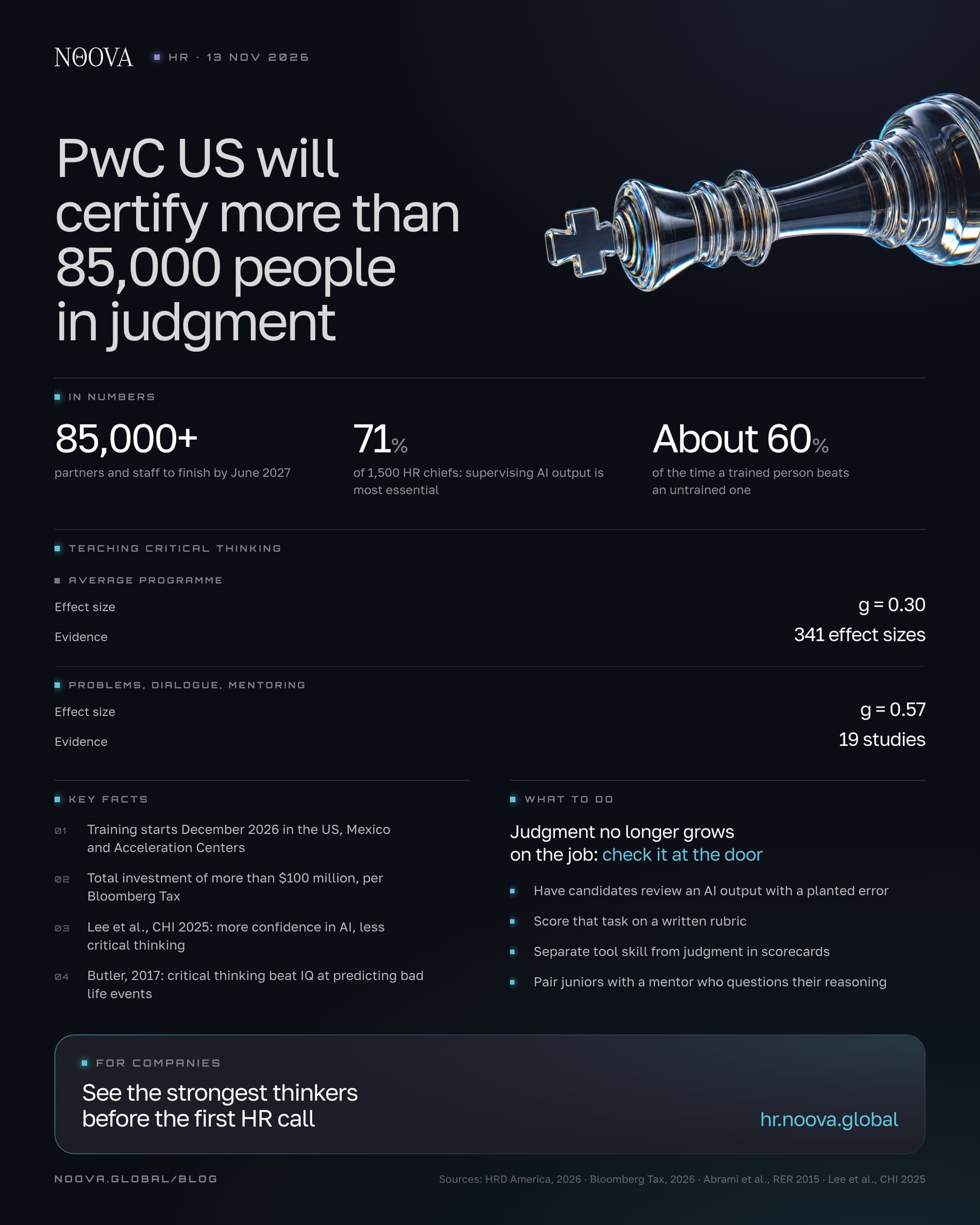
PwC US will certify more than 85,000 partners and staff in critical thinking and judgment by June 2027, according to HRD America. The PwC critical thinking programme starts in December with a diagnostic scenario and moves on to simulations in which people challenge AI output. The reason is plain: AI now does much of the routine work through which junior accountants used to learn judgment. This post covers what PwC announced, what research says about teaching and measuring critical thinking, and what it means if you hire people who will work next to AI.
PwC critical thinking certificate: what was announced
PwC US announced a Critical Thinking & Judgment Certificate on 9 November 2026 for partners and employees across the US, Mexico and its Acceleration Centers. Training starts in December 2026 and everyone is expected to complete it by June 2027, the end of the firm's fiscal year, per the International Accounting Bulletin.
The programme has four parts, as the firm describes it:
- A diagnostic scenario that shows each person's thinking preferences, strengths and gaps.
- The framework itself, applied to practical situations: establish context, test information and assumptions, communicate a recommendation clearly and accountably.
- Masterclass videos from PwC leaders and outside experts.
- Personalised simulations tied to each person's role.
The simulations are the interesting part. Bloomberg Tax gives the assurance example: review an AI-generated assessment of a company's internal controls, find the deficiencies and challenge the tool's conclusions. HRD America gives a tax version: an AI analysis of a complex tax position, where the participant must question the sources, consider other readings and spot what is missing.
PwC also plans an AI coach trained on the framework, a final assessment of how people apply it, and a role for everyday observation and performance feedback. From early 2027 it will offer the framework to universities and fund selected ones to build introductory courses. Bloomberg Tax puts the total investment, including that university funding, at more than $100 million.
Why PwC critical thinking training starts now
The firm's own explanation is that AI took away the practice. "AI can help us complete tasks faster than ever before, but it's still up to us to question those outputs, think critically, and apply sound judgment," Margaret Burke, PwC US Talent Acquisition and Development Leader, told HRD America.
For decades, professional services firms built judgment through volume. A first-year auditor ticked thousands of items, saw which ones looked wrong and slowly learned why. When a tool produces the first draft, the new hire skips the repetitions and lands straight in the reviewer's chair. Reviewing well is the harder skill.
Research on AI at work shows why that chair is risky. In a CHI 2025 survey of 319 knowledge workers who shared 936 examples of using generative AI, Lee and colleagues at Microsoft Research and Carnegie Mellon found that higher confidence in the AI went with less critical thinking. Higher confidence in themselves went with more. It is self-report and correlation, but the direction matches PwC's worry: the more you trust the tool, the less you check it. If you want the mechanism behind that, our post on what metacognition is covers how people misjudge their own performance with AI help.
PwC is not alone in this concern. HRD America cites an IBM survey of 1,500 chief HR officers in which 71% named the ability to supervise, validate and override AI output as the workforce's most essential skill.

Teaching critical thinking: what the evidence says
Critical thinking can be taught, modestly, and the design matters more than the label. The largest meta-analysis, Abrami and colleagues (2015) in Review of Educational Research, pooled 341 effect sizes from experimental and quasi-experimental studies that used standardised critical thinking tests. The average effect was g = 0.30, a small effect. In plain terms, a trained person beats an untrained one about 60% of the time, per the Clearing House Unterricht summary of the paper.
Three ingredients helped: dialogue, authentic or situated problems, and mentoring. Combined, they reached g = 0.57 across 19 studies. Teaching abstract principles explicitly and then applying them to concrete material worked best.
Read against that, the PwC design looks sensible. Role-based simulations are authentic problems. An AI coach and team scenarios are a form of dialogue. Masterclass videos are the weakest ingredient on this evidence, since watching an expert is not the same as being questioned by one.
The bigger open question is transfer. A certificate shows that someone completed a programme. Whether they question the next AI output on a live client file, under deadline, is a different thing, which is why PwC's plan to watch everyday work matters more than the final test.
Why critical thinking is worth measuring at all
Critical thinking predicts outcomes that intelligence alone does not. Heather Butler and colleagues gave adults the Halpern Critical Thinking Assessment, an IQ test and an inventory of negative life events, from arriving late to work to quitting a job after a week. As Butler summarised in Scientific American, both measures went with fewer bad outcomes, but critical thinkers did better. The 2017 paper in Thinking Skills and Creativity found critical thinking was the stronger predictor. The design is correlational, so it shows association, not cause.
The concept itself is well defined. A 1990 Delphi study led by Peter Facione for the American Philosophical Association gathered 46 experts and reached a consensus that critical thinking has a skill side and a disposition side. PwC's diagnostic of "thinking preferences" reads like an attempt to capture the second one: the habit of checking an assumption, beside the ability to do it.
What the PwC critical thinking move means for hiring
The lesson for employers is that judgment can no longer be assumed to grow on the job, so it has to be checked at the door. If the largest firms now spend more than $100 million to rebuild judgment that routine work used to teach, a hiring process that screens only for credentials and tool skills is testing the wrong thing.
The PwC simulation format translates directly into an interview task. Hand a candidate an AI-generated memo with one planted error and one unstated assumption, and ask what they would check before signing it. It is a short work sample test, and it shows the reviewing skill PwC is now training. Our explainer on what critical thinking is covers the definitions and the main tests if you want to go further.
Conversation is another way in. How a person explains, doubts and corrects their reasoning out loud says a lot about how they will review an AI draft. That is the idea behind NOOVA HR, a 20-minute voice dialogue that maps how candidates for middle and senior roles think, with a person always making the decision.
A checklist for hiring managers after the PwC announcement
- Add one task to your process where the candidate reviews an AI output with a planted error.
- Score that task on a written rubric: what they checked, what they missed, what they concluded.
- Ask candidates to state the assumption they are least sure about in their own answer.
- Separate tool skill from judgment in your scorecards, so a fluent prompter is not read as a careful reviewer.
- Give new hires deliberate review practice with feedback, since AI removed the routine repetitions.
- Pair juniors with a mentor who questions their reasoning, the ingredient with the strongest training evidence.
- Track judgment on the job through observed reviews rather than course completion alone.
Sources
- Can judgment be taught? PwC is putting 85,000 people to the test, HRD America, 9 November 2026
- PwC US to train 85,000 staff in critical thinking as AI reshapes work, International Accounting Bulletin, 10 November 2026
- PwC US to Roll Out Certification on Critical Thinking in AI Era, Bloomberg Tax, 9 November 2026
- The Impact of Generative AI on Critical Thinking, Lee et al., CHI 2025
- Strategies for Teaching Students to Think Critically: A Meta-Analysis, Abrami et al., Review of Educational Research, 2015
- Critical thinking as an instructional goal, Clearing House Unterricht, Technical University of Munich
- Why Do Smart People Do Foolish Things?, Heather A. Butler, Scientific American, 2017
- Critical thinking skills are more useful than IQ while making real-life decisions, University of Groningen
- Critical Thinking: A Statement of Expert Consensus, Peter A. Facione, American Philosophical Association, 1990 (ERIC)