What Is Critical Thinking, How It Is Measured and What AI Does to It
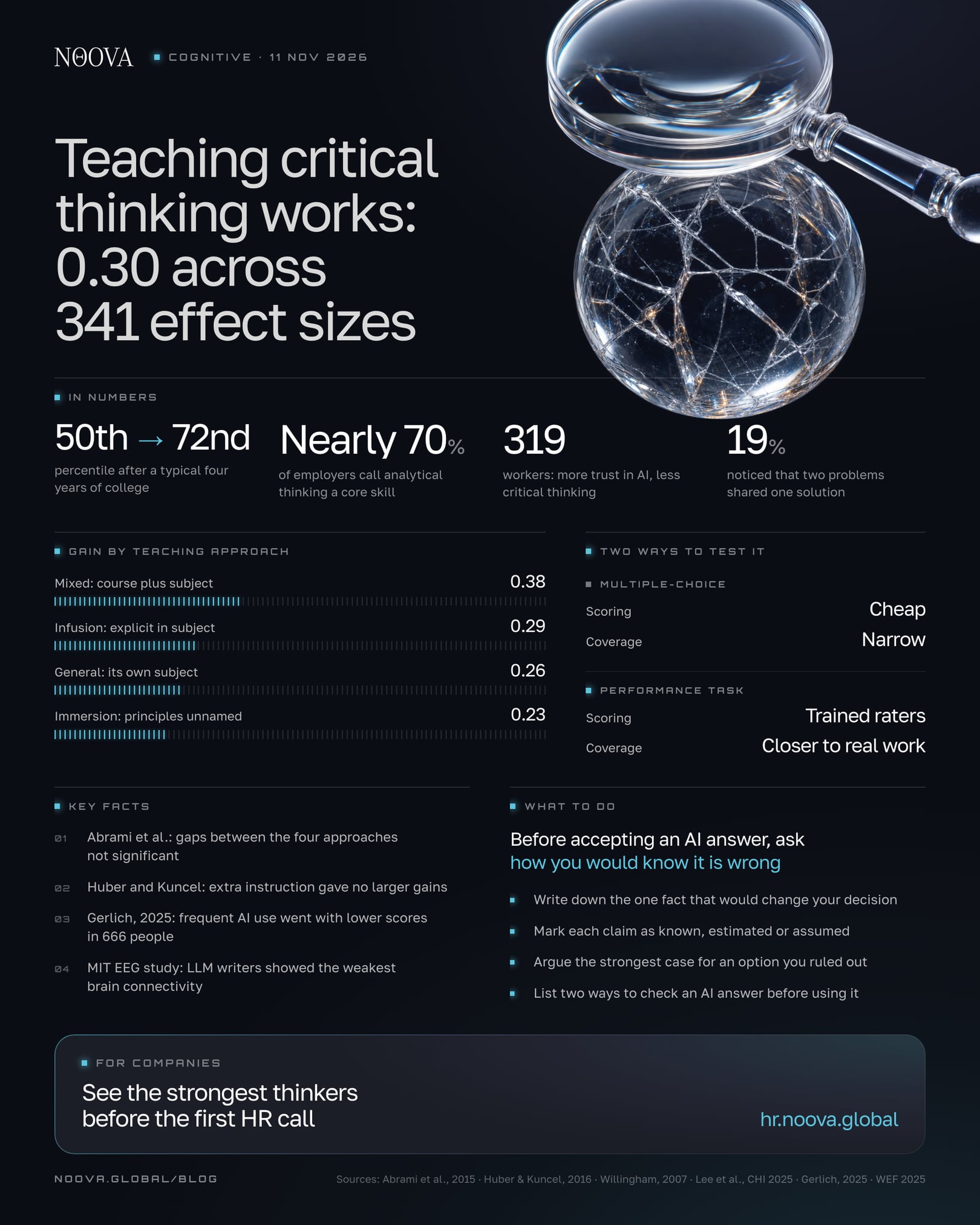
What is critical thinking: careful judgment about what to believe or do. It can be taught, with an average effect of 0.30 across 341 effect sizes.

Critical thinking is careful judgment about what to believe or what to do: weighing evidence, testing arguments, and noticing when your own conclusion runs ahead of the facts. It can be taught. A meta-analysis of 341 effect sizes from controlled studies found an average gain of 0.30 standard deviations from instruction, modest but real. This post covers what the term means in research, how it is measured, what the teaching evidence shows, and what the first studies say about AI and critical thinking.
What is critical thinking: the working definition
Critical thinking is reasoned judgment with a standard attached. You reach a conclusion, then check whether the route there holds up.
The idea is older than the phrase. John Dewey wrote in 1910 about "reflective thinking", which he defined as active, persistent and careful consideration of any belief or supposed form of knowledge. Every later definition keeps that core: a belief has to earn its place.
The definition most often quoted today came out of a consensus exercise. In 1990 Peter Facione ran a Delphi study for the American Philosophical Association: 46 critical thinking experts, about half of them philosophers, traded opinions over several rounds until they converged. Their statement calls critical thinking "purposeful, self-regulatory judgment" that results in interpretation, analysis, evaluation and inference, plus the ability to explain the reasoning behind it.
Philosophers and psychologists still argue at the edges. Philosophers tend to stress the norms of good argument. Psychologists tend to stress problem solving and the biases that derail it. For practical purposes the overlap is enough: interpret what you are given, analyse the argument, evaluate the evidence, infer only what follows.
Skills plus the habit of using them
Critical thinking has two halves, and the second is the one people forget. The Delphi experts described a set of cognitive skills and a set of dispositions, the inclination to use those skills when it matters.
Their portrait of the ideal critical thinker reads like a character sketch, starting with "habitually inquisitive, well-informed, trustful of reason, open minded, flexible". None of these is a technique. They describe what a person does when nobody asks them to check.
The split matters because skill without disposition is common. A sharp analyst can take apart a rival's plan in minutes and wave through their own with no checks at all. If you have read about cognitive biases, this is the same pattern from another side: knowing the bias exists does not mean you will catch yourself in it.
Critical thinking also overlaps with metacognition, your ability to monitor and steer your own thinking. Self-regulation sits inside the Delphi definition for that reason. Questioning a claim is the outward half. Questioning your confidence in your own reading of it is the inward half.

How critical thinking is measured
Most critical thinking tests are short reasoning items with one right answer. The Stanford Encyclopedia of Philosophy lists the standard ones: the Cornell Critical Thinking Tests, the Watson-Glaser Critical Thinking Appraisal, the California Critical Thinking Skills Test, the California Critical Thinking Disposition Inventory and the Collegiate Learning Assessment (CLA+).
They are cheap to score and reliable, and they miss a lot. A 2020 review in Frontiers in Education by Braun, Shavelson and colleagues says forced-choice and short-answer formats suffer from "moderate to severe construct underrepresentation". In plain words, construct underrepresentation means the test measures only a slice of the skill it is named after. Perspective-taking and explaining your reasoning, for example, barely appear.
The alternative is a performance task. The reviewers describe a design with a storyline, a challenge, a document library and a scoring rubric. The documents vary on purpose: some trustworthy, some irrelevant, some biased. The test taker has to sort them and write a reasoned recommendation, much as an analyst would at work.
Performance tasks pay for that realism. Scoring needs trained raters. In one study cited in the review, a 23-indicator scoring scheme reached a reliability coefficient of about 0.74 with two raters and 0.84 with four. In field trials, 60 minutes was often too little time to work through the documents and write a full answer. More than one task is usually needed for a dependable score.
So the honest summary is a trade. Multiple-choice tests are efficient and narrow. Realistic tasks are closer to the thing itself and expensive to run.
Teaching critical thinking: what the meta-analyses show
Teaching critical thinking works, by a modest margin. The first experimental test came in 1941, when Edward Glaser showed that high school students' critical thinking could be improved. The large modern answer comes from Philip Abrami and colleagues.
Their 2015 meta-analysis in Review of Educational Research pooled experimental and quasi-experimental studies published before 2010 that used standardised critical thinking tests, with at least three hours of instruction. Across 341 effect sizes the weighted mean was 0.30, a small effect by Cohen's conventions. It also compared four ways of teaching:
- Mixed: a separate critical thinking course combined with subject teaching, +0.38.
- Infusion: subject teaching with the principles made explicit, +0.29.
- General: critical thinking taught as its own subject, +0.26.
- Immersion: subject teaching that aims at critical thinking without naming the principles, +0.23.
The mixed approach came out on top, but the differences were not statistically significant. The clearer signal was in the methods. Three strategies each raised effectiveness, and they worked best together: dialogue (discussing and arguing a question), anchored instruction (problems that feel meaningful, such as simulations or dilemmas) and mentoring. Most studies had no long-term follow-up, so how long the gains last is still open.
College adds its own slow gain. Huber and Kuncel's 2016 meta-analysis of 71 research reports spanning 48 years estimates that a typical four years of college moves a student from the 50th to the 72nd percentile. The surprise was that extra, dedicated critical thinking instruction did not produce larger long-term gains than an ordinary degree. Nursing programmes, which stress critical thinking heavily, did no better than others. Gains also shrank in more recent cohorts, which the authors say does not prove colleges got worse.
Why knowledge matters more than tricks
Critical thinking travels badly from one subject to another, because spotting what a problem is really about depends on knowing the field. Cognitive scientist Daniel Willingham made this case in an essay for American Educator in 2007.
His example is a word problem about a marching band that can only be solved with a least common multiple. Shortly before, participants had studied a garden problem with the same solution. Only 19% noticed the link. When told outright that the two problems were similar, 35% solved it. Knowing what to do did not mean knowing how to do it.
This is an old debate. In 1981 philosopher John McPeck argued that there are no general thinking skills, since thinking is always about something. Critics answered that some abilities, such as structuring an argument, do generalise. Willingham's middle position fits the meta-analytic data: general strategies such as "look for the deep structure" or "consider the other side" help, but only as far as your knowledge of the domain lets you act on them.
The practical lesson is the reverse of the poster on the classroom wall. Practise critical thinking on material you know, then on material you are learning, and expect the skill to be thinner wherever your knowledge is.
Critical thinking and AI: the early evidence
The first studies suggest generative AI shifts critical thinking from producing answers to checking them, and that many people do less of it when they trust the tool. All of the evidence so far is early, and most of it is correlational.
The clearest workplace data comes from a CHI 2025 survey by Lee and colleagues at Microsoft Research and Carnegie Mellon. 319 knowledge workers described 936 real tasks done with AI. Higher confidence in the AI went with less critical thinking. Higher confidence in their own ability went with more. The work itself moved toward verifying information, integrating the AI's response, and what the authors call task stewardship: owning the result rather than producing every part of it.
A 2025 study by Michael Gerlich surveyed 666 people and interviewed 50. Frequent AI use went with lower critical thinking scores, and cognitive offloading (handing mental work to a tool) explained part of the link. Participants aged 17 to 25 relied on AI most and scored lowest. Gerlich stresses that the study shows correlation, not cause. People who think less critically may simply reach for AI more often.
A lab study at MIT went a step further and put EEG caps on people writing essays. In Kosmyna and colleagues' preprint, 54 participants wrote with an LLM, a search engine or nothing. The LLM group showed the weakest brain connectivity, felt the least ownership of their essays and struggled to quote their own work. It is a small, not yet peer-reviewed study of one task, with only 18 people in the final session.
Read together, the studies point to one habit worth keeping. Before you accept an AI answer, decide how you would know it is wrong.
What critical thinking looks like at work
At work, critical thinking shows up as small, checkable moves rather than grand scepticism. Employers rank the broader family highly: in the WEF Future of Jobs Report 2025, nearly 70% of employers call analytical thinking a core skill, the top spot. The difference between the two is the subject of our post on analytical thinking.
Three moves are easy to spot. The first is asking what would change the decision: which number, if it were 20% off, would flip the call. The second is separating what is known from what is assumed, out loud, in the meeting. The third is steelmanning the option you are about to reject, so you reject its best version rather than a caricature.
These moves are visible in how someone talks through a problem, which is why conversational assessment has become an option. If you want to see your own reasoning in numbers, NOOVA runs it as a 20-minute voice dialogue instead of hours of tests.
A checklist for practising critical thinking this week
- Write down the one fact that would change your next big decision before you make it.
- Mark each claim in your next proposal as known, estimated or assumed.
- Argue the strongest case for an option you have already ruled out.
- Ask an AI tool for an answer, then list two ways you could check it before using it.
- Discuss one open question with a colleague who disagrees, and summarise their view until they accept it.
- Practise on a problem in your own field first, where your knowledge can carry the strategy.
- Note one conclusion this week that turned out wrong, and which step of the reasoning failed.
Sources
- Critical Thinking, Stanford Encyclopedia of Philosophy, revised 2022
- Critical Thinking, supplement on educational methods, Stanford Encyclopedia of Philosophy
- Critical Thinking: a tangible construct?, Research Matters, Cambridge Assessment, 2007
- Expert consensus statement (Facione, 1990), Penn State College of Earth and Mineral Sciences
- Performance Assessment of Critical Thinking: Conceptualization, Design, and Implementation, Braun et al., Frontiers in Education, 2020
- Study Snapshot: Does College Teach Critical Thinking? (Huber and Kuncel, 2016), American Educational Research Association
- Does College Teach Critical Thinking? A Meta-Analysis, Huber and Kuncel, Review of Educational Research, University of Minnesota
- Critical Thinking: Why Is It So Hard to Teach?, Daniel T. Willingham, American Educator, 2007
- The Impact of Generative AI on Critical Thinking, Lee et al., CHI 2025
- AI tools may weaken critical thinking skills by encouraging cognitive offloading (Gerlich, Societies, 2025), PsyPost
- Your Brain on ChatGPT, Kosmyna et al., arXiv preprint, 2025
- Analytical thinking remains top core skill for employers (WEF Future of Jobs Report 2025), FM Magazine