Cognitive Load: What It Is, How It Is Measured and What It Means for Work
Cognitive load is the demand a task puts on working memory, which holds only about four chunks at once. What the theory says and how to cut load.
Cognitive load is the amount of work a task demands from your working memory, the small mental space where you hold and combine information while you think. That space is tiny: young adults keep about three to five meaningful items in it at once. When a task, a lesson or a meeting asks for more, people stop learning and start dropping things. This post explains cognitive load theory, what the research found, how load is measured, where the theory is weak, and what it means for your working day.
What cognitive load is: the short definition
Cognitive load is the demand a task places on working memory at a given moment. The idea is simple. The consequences for teaching and work design are not.
The theory comes from educational psychologist John Sweller and colleagues in the late 1980s, starting with a 1988 paper in Cognitive Science. As Ton de Jong puts it in his 2010 review, the basic claim is that working memory capacity is limited, "so that if a learning task requires too much capacity, learning will be hampered". The remedy follows directly: design the task so the limited space goes to what matters.
The NSW Centre for Education Statistics and Evaluation (CESE) gives the cleanest summary in its literature review. The theory rests on two ideas. There is a limit to how much new information the brain can process at once. There is no known limit to how much stored information it can use at once. Everything else in the theory is about moving knowledge from the first state to the second.
Working memory limits: four chunks, not seven
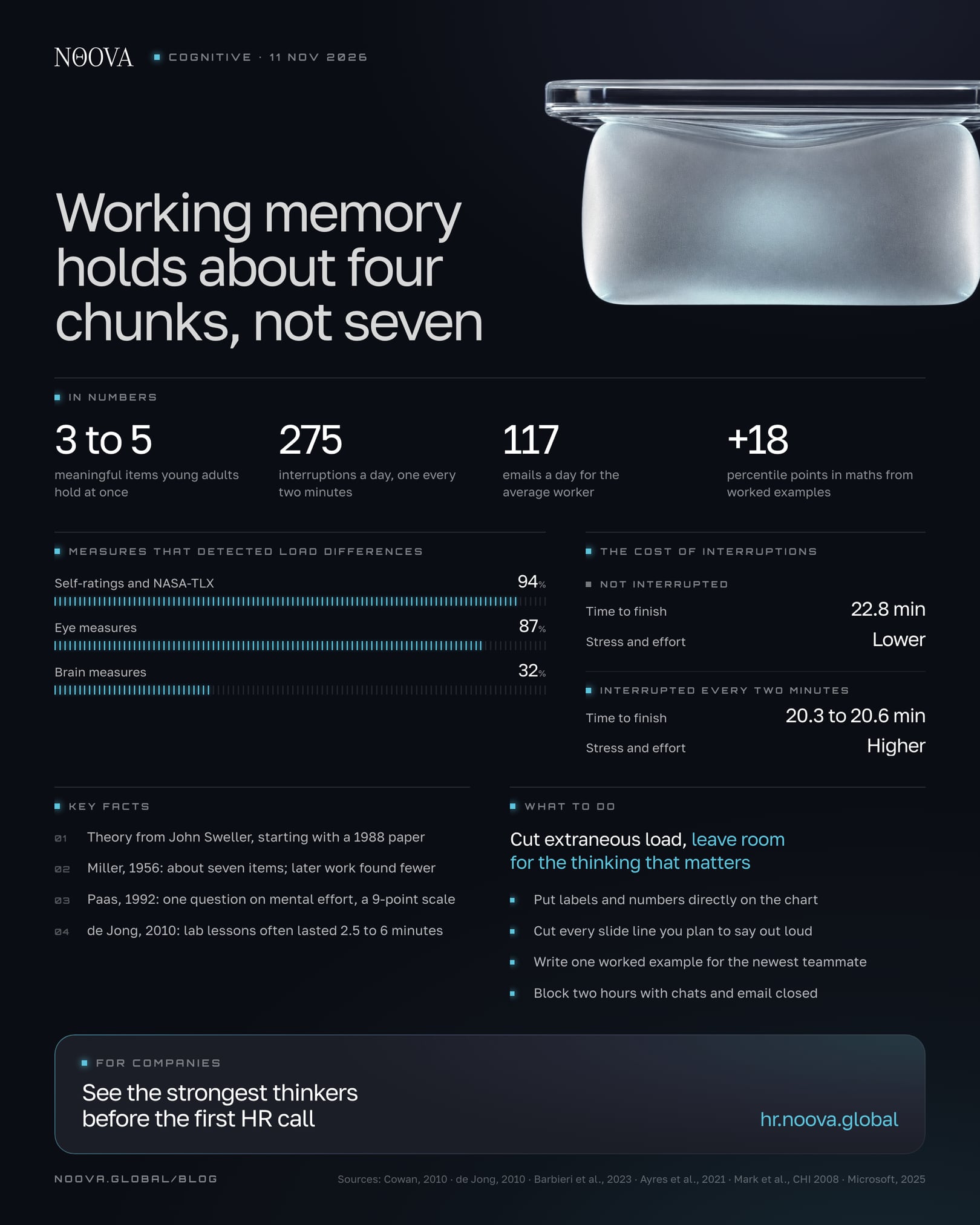
Working memory holds about four chunks, not the seven most people remember. George Miller's 1956 paper reported that people repeat back "no more than about seven" items. Later work found lower numbers once people could not rehearse or group items.
Nelson Cowan's 2010 review in Current Directions in Psychological Science puts the limit at 3 to 5 meaningful items in young adults, with his own models settling near 4. When participants were stopped from rehearsing by repeating the word "the", they remembered only about 3 units. Seven-year-olds held about 1.5 items against about 3 for older children and adults.
A chunk is a unit that already means something to you. "FBICIA" is six letters for a child and two chunks for most adults. This is why experts seem to have more room in their heads. They do not. Their long-term memory packs more into each chunk, so the same four slots carry far more.
That is the engine of the theory. Learning, in cognitive load terms, is building those packed units (researchers call them schemas) so that the next problem costs less working memory than the last.

The three types of cognitive load
Cognitive load theory traditionally splits load into three types: intrinsic, extraneous and germane. Only one of them is pure waste.
- Intrinsic load comes from the material itself. What drives it is element interactivity: how many pieces must be understood together. De Jong's example is vocabulary, where words can be learned one by one, against grammar or an electrical circuit, where no part makes sense alone. Intrinsic load also depends on what you already know.
- Extraneous load comes from how the material is presented: a cluttered slide, a diagram whose labels sit in a separate legend, instructions spread across three tools. It does nothing for learning.
- Germane load is the effort spent actually building understanding.
The model has since been revised. A footnote in the CESE review notes that some theorists now treat intrinsic and extraneous load as the two primary, additive types. Germane load is redefined as the working memory you devote to the intrinsic part, rather than a third pile on top. For practical purposes the rule stays the same: cut extraneous load, manage intrinsic load, and leave room for the thinking that matters.
What cognitive load research found
The strongest findings are a handful of instructional effects, each tested in many randomised experiments. CESE says the theory is supported by "a significant number of randomised controlled trials", without giving a count.
The worked example effect. Novices who study fully solved problems learn more than novices who solve the same problems themselves. In early experiments by Cooper and Sweller, school students taught algebra with many worked examples learned faster and did better on transfer problems. The explanation: solving from scratch fills working memory with the search, leaving little for noticing the rule. A 2023 meta-analysis of 55 studies by Barbieri and colleagues found worked examples raised maths performance by an average of 18 percentile points. Correct examples worked better than incorrect ones.
The split-attention effect. When you must hold a diagram and a separate block of text in mind to understand either, you pay twice. Putting the labels on the diagram removes the cost.
The redundancy effect. Extra information is not harmless. Saying aloud exactly what is printed on the slide, or repeating the same content as text and as a diagram, makes learners process it twice.
The expertise reversal effect. The same support that helps novices can slow down experts. Worked examples become less useful as skill grows and can end up redundant. Guidance should fade as the learner improves.
That last effect is the one most often missed in companies. Onboarding built for the newest hire is extraneous load for the experienced one.
How cognitive load is measured
Most studies measure cognitive load with a single self-rating, and that simple tool holds up better than its reputation. The workhorse is Fred Paas's 1992 scale: one question asking learners to rate their "perceived amount of mental effort" on a 9-point scale. De Jong calls it the most frequently used self-report scale in educational science.
Other methods exist:
- Multi-item questionnaires, such as NASA-TLX, developed at NASA Ames over a three-year effort of more than 40 laboratory, simulation and in-flight experiments. It rates mental demand, effort, frustration and related dimensions.
- Secondary tasks, where people do a simple extra task alongside the main one; worse performance on the extra task signals higher load.
- Physiological measures: heart rate, pupil size, blinks, skin conductance, EEG.
Ayres, Lee, Paas and van Merriënboer (2021) compared these methods across 33 experiments from 28 studies in which task complexity was varied on purpose. Subjective measures did best: single-item ratings and NASA-TLX subscales detected differences in 94% of uses. Eye measures were the strongest physiological group, with 87%. Brain measures matched performance differences in only 32% of uses. Mean sample size per experiment was 29, so read the percentages as a rough guide.
The catch is what self-ratings cannot do. They tell you how hard a task felt overall, not which type of load caused it, and not the moment overload happened.
Where the theory is weaker
The core claim, that working memory is limited and good design respects the limit, is not seriously contested. The details are. De Jong's review lists three problems.
The first is definitions. Intrinsic, extraneous and germane load are hard to separate in practice, and the same activity can be germane for a novice and extraneous for an expert. If you cannot tell the types apart, it is hard to tell a teacher which one to cut.
The second is measurement. Many studies never measure load directly. They infer it from test scores: if the redesigned lesson produced better results, load must have been managed. That reasoning runs in a circle.
The third is realism. Real learners write things down and work in steps, which avoids momentary overload. Many experiments forbid this. Study times are often a few minutes; de Jong cites lessons of 2.5, 3, 4, 5 and 6 minutes, frequently given to psychology students with no interest in the subject. The theory clearly applies to time-critical tasks such as flying a fighter jet. How far its lab effects stretch to a semester or a job is less settled.
None of this overturns the main effects. It means you should treat cognitive load theory as a strong guide for novices and complex material, not as a law that predicts every case.
Cognitive load at work
At work, the biggest source of extraneous cognitive load is fragmentation. Microsoft's 2025 Work Trend Index report, based on Microsoft 365 telemetry, found employees interrupted every two minutes during core work hours, 275 times a day, by meetings, emails or chats. The average worker received 117 emails a day.
Each interruption forces you to drop what you were holding and rebuild it later. A lab study by Mark, Gudith and Klocke (CHI 2008) shows the price. 48 participants answered work emails while being interrupted by phone or instant message every two minutes. Interrupted participants actually finished faster, about 20.3 to 20.6 minutes against 22.8 without interruptions, with no more errors. They also reported significantly more stress, frustration, time pressure and effort on a modified NASA-TLX. People compensate for interruptions by speeding up, and pay for it in strain.
The same principles that help learners help teams:
- A decision memo with the numbers next to the claims removes split attention.
- A meeting that reads the slides aloud adds redundancy.
- A new manager's onboarding should start with worked examples of past decisions and fade them, while a senior hire needs the problem, not the tutorial.
- Breaking a complex problem into stages, as real learners do with a notepad, keeps intrinsic load within reach.
Cognitive load is also why reasoning quality is easier to judge when the problem has several moving parts. Holding three constraints in mind at once, and noticing when one is slipping, is a different skill from recalling facts. It overlaps with metacognition, knowing when your own thinking is overloaded, and with cognitive flexibility, switching approach without losing the thread. If you want to see how your own reasoning holds up, NOOVA runs it as a 20-minute voice dialogue instead of hours of tests.
A checklist for lowering cognitive load this week
- Put labels, numbers and explanations directly on the chart or diagram they describe.
- Cut every slide line you plan to say out loud anyway.
- Write one worked example of a recurring task for the newest person on your team.
- Remove that example from the material for people who already do the task well.
- Block one two-hour stretch with chats and email closed, and compare what you finish.
- Split your hardest open problem into stages and write down intermediate results.
- Rate your mental effort from 1 to 9 after three different tasks and see which one was really heavy.
Sources
- The Magical Mystery Four: How is Working Memory Capacity Limited, and Why?, Nelson Cowan, Current Directions in Psychological Science, 2010
- Cognitive load theory: Research that teachers really need to understand, Centre for Education Statistics and Evaluation, NSW Department of Education, 2017
- Cognitive load theory, full literature review (PDF), CESE, 2017
- Cognitive load theory, educational research, and instructional design: some food for thought, Ton de Jong, Instructional Science, 2010
- The Validity of Physiological Measures to Identify Differences in Intrinsic Cognitive Load, Ayres et al., Frontiers in Psychology, 2021
- A meta-analysis of the worked examples effect on mathematics performance, Barbieri et al., Educational Psychology Review, 2023 (University of Delaware summary)
- NASA Task Load Index (TLX): Paper and Pencil Package, Sandra G. Hart, NASA Ames Research Center
- The Cost of Interrupted Work: More Speed and Stress, Mark, Gudith and Klocke, CHI 2008
- Breaking down the infinite workday, Work Trend Index special report, Microsoft WorkLab, 2025