What Is Metacognition, and Why It Decides How Well You Learn and Think
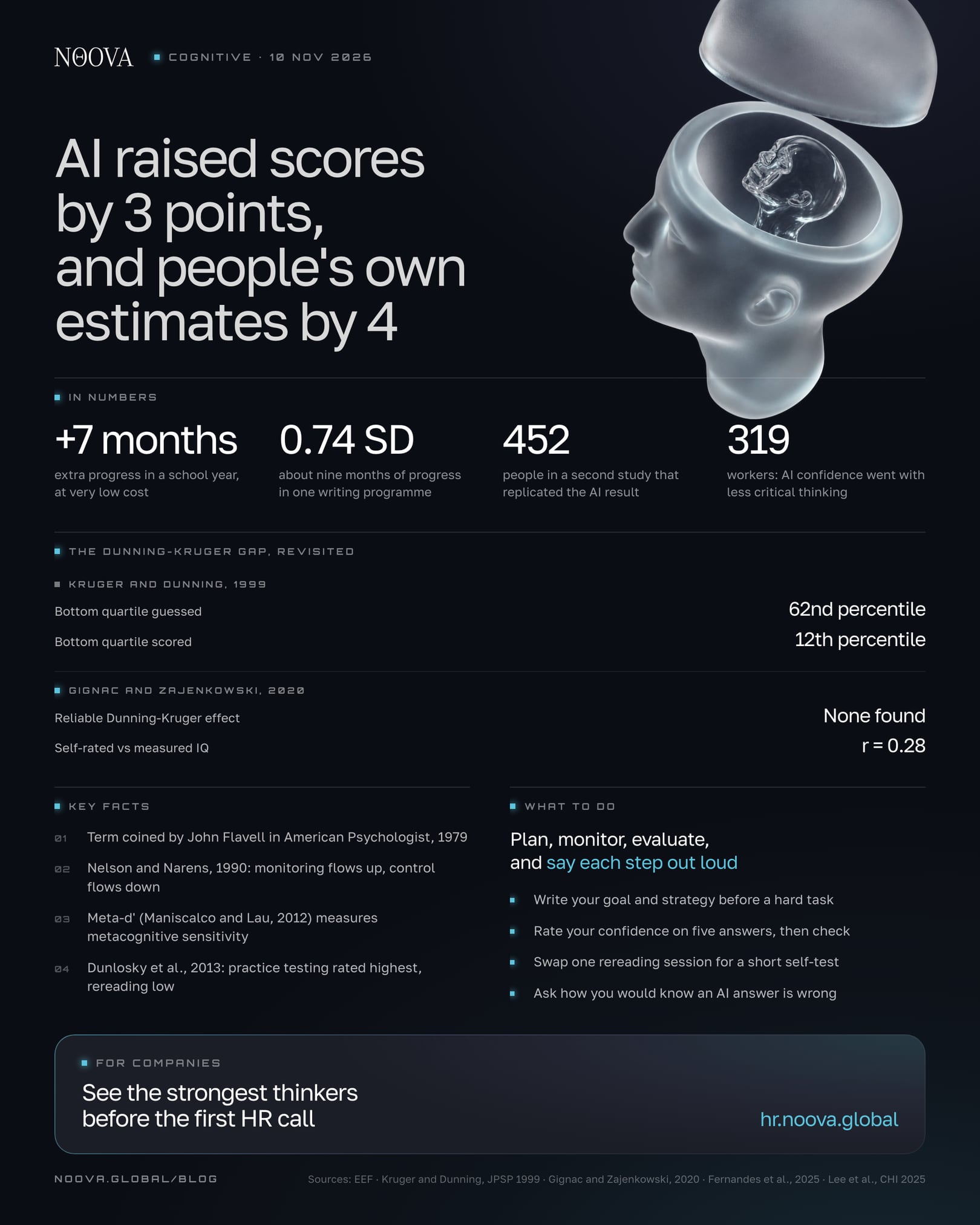
Metacognition is knowing and steering your own thinking. Taught well, it adds about 7 months of progress in a school year, per the EEF.

Metacognition is your ability to know what you know and to steer your own thinking: to notice you are confused, check an answer, change strategy. It is one of the cheapest skills to train. The Education Endowment Foundation rates teaching it at +7 months of additional progress in a school year, "very high impact for very low cost". This post explains what metacognition is, how researchers measure it, why AI makes it more important, and how to train yours this week.
What is metacognition: the short definition
Metacognition is thinking about thinking, with a job to do. It has two parts: knowing how your mind works, and using that knowledge to run it.
The word comes from developmental psychologist John Flavell. In a 1979 paper in American Psychologist he described it as "knowledge and cognition about cognitive phenomena". His starting observation still lands. Young children studied a list of items, announced they were ready to recall it perfectly, and usually were not. They could memorise. What they could not do was judge their own memorising.
Flavell split metacognitive knowledge into three kinds:
- Person: what you know about yourself as a thinker ("I lose track of numbers when I am tired").
- Task: what you know about the problem ("a proof needs every step, a summary needs only the spine").
- Strategy: what you know about the moves that work ("drawing the system helps me more than rereading").
A decade later, Thomas Nelson and Louis Narens turned this into a working model. In their 1990 framework the mind has two levels. The object level does the task. The meta level watches it. Information flows up as monitoring (how sure am I, how far along am I) and down as control (slow down, check again, try another way). They compared it to a telephone handset: you listen through one end and speak through the other.
That two-way loop is the useful definition. Knowing that you tend to rush is metacognitive knowledge. Catching yourself rushing on question 7 and going back is metacognition at work.
Metacognition is not the same as intelligence
Metacognition and raw ability are related, but you can have plenty of one and little of the other. A strong analyst can be badly calibrated about where their analysis is weak. A modest student can be very good at knowing what they have not yet understood.
The most famous evidence is also the most argued over. In Kruger and Dunning's 1999 studies on humour, grammar and logic, people in the bottom quartile estimated themselves around the 62nd percentile. Their actual scores put them at the 12th. The "Dunning-Kruger effect" became a meme from that gap.
The honest update: a large part of the pattern is a statistical artefact. Gignac and Zajenkowski (2020) tested 929 adults on Raven's matrices and asked them to rate their own intelligence. The familiar quartile chart appeared, but tests that are not fooled by regression to the mean found no reliable Dunning-Kruger effect. Self-rated and measured IQ correlated at only r = 0.28, and nearly everyone rated themselves above average.
So the lesson is not "incompetent people are blind to it". It is broader and less comfortable: almost everyone's sense of their own ability is loosely tied to the real thing. That loose tie is exactly what metacognition training tries to tighten.

How metacognition is measured
Researchers measure metacognition by asking people to do a task, then rate their confidence in each answer. Good metacognition means confidence is high when you are right and low when you are wrong.
Fleming and Lau (2014), the standard reference on the method, separate three things that often get mixed up:
- Bias: how confident you are overall. Some people say "90% sure" to everything.
- Sensitivity: how well your confidence tells your right answers from your wrong ones. This is the core of metacognition.
- Efficiency: sensitivity relative to how well you did the task itself, so a strong performer does not look metacognitive just because they are usually right.
The workhorse measure of sensitivity is meta-d' ("meta-d-prime"), introduced by Maniscalco and Lau (2012). It expresses metacognition in the same units as task performance. In their visual experiment, people's metacognition came out close to, but measurably below, the best possible for their level of performance. Fleming and Lau call meta-d' the best available measure of metacognitive sensitivity, with meta-d'/d' as efficiency and a value of 1 as the theoretical ideal.
Questionnaires exist too. They capture what people believe about their thinking, which is useful, but self-report is the weakest evidence for a skill whose whole point is that self-reports drift.
Why metacognition matters more with AI
Working with AI shifts your job from producing answers to judging them, and judging is metacognitive work. A CHI 2024 paper by Tankelevitch and colleagues argues that generative AI demands a high degree of monitoring and control: knowing what you want before you prompt, judging whether the output is right, and deciding how much to rely on it.
The early data suggests people are not yet good at this. In a 2025 study from Aalto University, 246 participants solved 20 logical reasoning problems from the LSAT with AI help. Their performance rose by 3 points against a norm group. Their estimate of their performance rose by 4. A second study with 452 people replicated it. Participants who knew more about AI were, if anything, less accurate about how well they had done.
A survey of 319 knowledge workers (Lee and colleagues, CHI 2025) points the same way. Higher confidence in the AI went with less critical thinking reported on the task; higher confidence in themselves went with more. It is self-report and correlation, not proof of cause. Still, the direction is consistent: AI lifts the answer, while your read on the answer is left behind. The skill itself is unpacked in what critical thinking is and how it is measured, and the predictable errors it guards against in cognitive biases.
How to improve metacognition: what the evidence supports
Metacognition improves fastest when it is made explicit and practised on real tasks, not taught as a separate subject. The EEF guidance report builds its seven recommendations around one cycle: plan, monitor, evaluate. Experts run it without noticing. Novices gain from saying each step out loud.
- Plan: before you start, name the goal, what you already know, and which strategy you will try.
- Monitor: during the task, check that the strategy is working and that you still understand.
- Evaluate: afterwards, compare the result with the goal and decide what you would change.
One programme in the report taught writers to plan, monitor and evaluate their own drafts. It added 0.74 standard deviations, which the EEF estimates at about nine months of extra progress.
Study habits tell the same story from another angle. Dunlosky and colleagues (2013) reviewed 10 common learning techniques. Practice testing and spreading study over time earned the highest utility rating. Rereading and highlighting came out low. The two winners share a metacognitive feature: they show you, honestly, what you cannot yet do. Rereading feels productive because the text looks familiar; a practice test removes that illusion.
What is metacognition at work: three everyday signs
At work, metacognition looks less like reflection and more like small corrections made early. Three signs are easy to spot in yourself and in others.
The first is calibrated confidence. "I'm fairly sure about the numbers, not about the churn assumption" is worth more than a uniform "looks good", because it tells the team where to look.
The second is an early course change. Good thinkers notice a stuck approach in minutes, not after a week of polishing it.
The third is a specific post-mortem. "We under-tested the pricing assumption" beats "we should communicate better". It names the thinking step that failed, so the next project can fix that step.
This is also why short, conversational assessments of thinking have become interesting. How someone explains, doubts and corrects their own reasoning out loud says a lot about the meta level. If you want to see your own thinking in numbers, NOOVA runs it as a 20-minute voice dialogue instead of hours of tests.
A checklist for training your metacognition this week
- Write one sentence of goal and one of strategy before your next hard task.
- Rate your confidence (0-100%) on five answers or decisions, then check which were right.
- Replace one rereading session with a short self-test on the same material.
- Ask "how would I know if this is wrong?" before accepting an AI answer.
- Stop halfway through a long task and check whether the approach still fits the goal.
- End one meeting by naming the single assumption you are least sure about.
- Keep a three-line log of a decision: what you expected, what happened, what you would change.
Sources
- Metacognition and Cognitive Monitoring, John H. Flavell, American Psychologist, 1979
- Metamemory: A Theoretical Framework and New Findings, Nelson and Narens, 1990
- Metacognition and self-regulation, Teaching and Learning Toolkit, Evidence for Learning / Education Endowment Foundation
- Metacognition and Self-Regulated Learning, guidance report, Education Endowment Foundation
- Unskilled and Unaware of It, Kruger and Dunning, Journal of Personality and Social Psychology, 1999
- The Dunning-Kruger effect is (mostly) a statistical artefact, Gignac and Zajenkowski, Intelligence, 2020
- How to measure metacognition, Fleming and Lau, Frontiers in Human Neuroscience, 2014
- A signal detection theoretic approach for estimating metacognitive sensitivity, Maniscalco and Lau, Consciousness and Cognition, 2012
- The Metacognitive Demands and Opportunities of Generative AI, Tankelevitch et al., CHI 2024
- AI makes you smarter but none the wiser, Fernandes et al., Computers in Human Behavior, Aalto University
- The Impact of Generative AI on Critical Thinking, Lee et al., CHI 2025
- Improving Students' Learning With Effective Learning Techniques, Dunlosky et al., Psychological Science in the Public Interest, 2013