Analytical Thinking: What It Is, How It Differs From Critical Thinking, and How to Train It
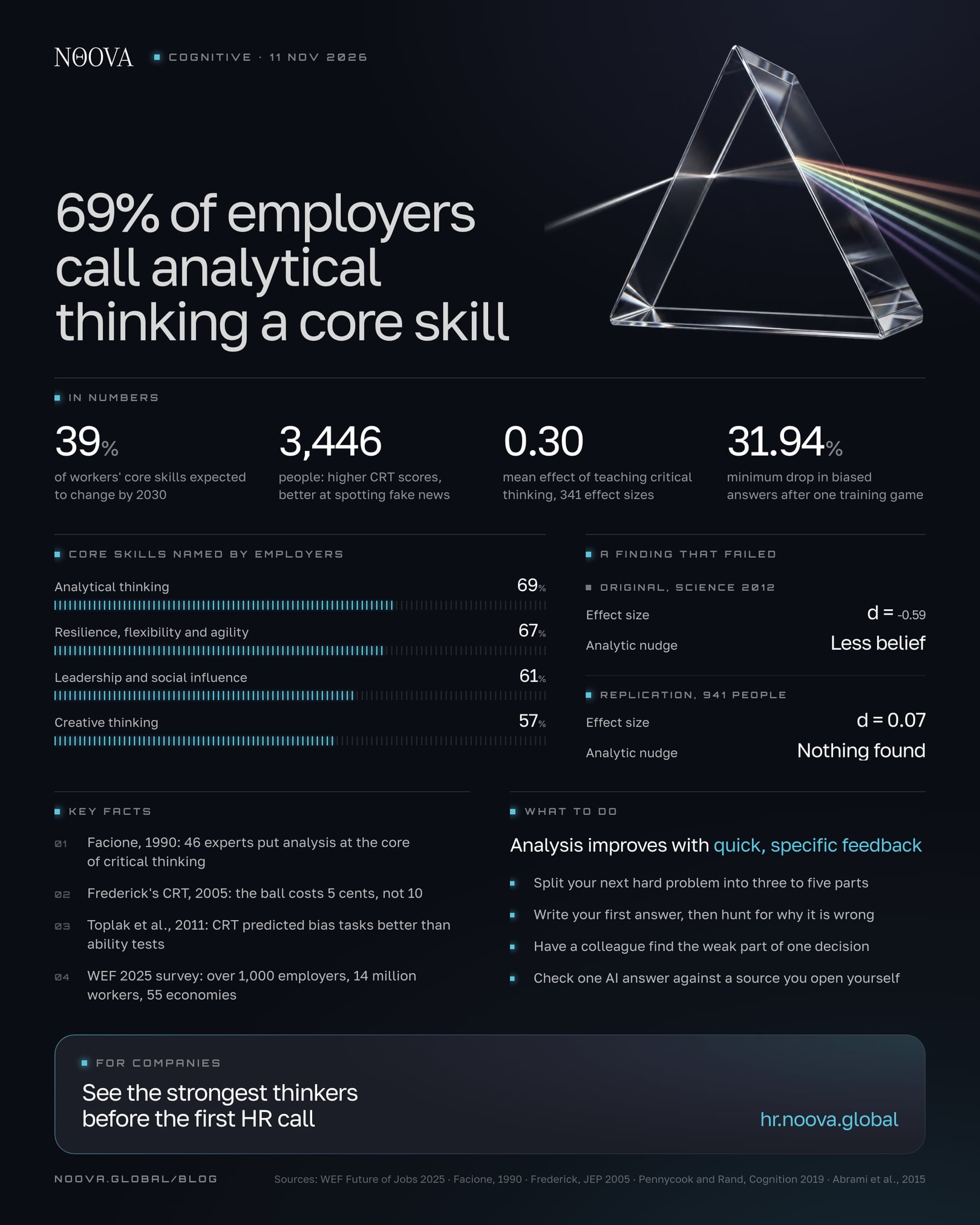
Analytical thinking is breaking a problem into parts and testing how they connect. 69% of employers call it a core skill in the WEF's 2025 survey.

Analytical thinking is the habit of breaking a problem into its parts, working out how those parts relate, and checking the first answer before trusting it. Employers rank it above every other skill: in the World Economic Forum's Future of Jobs Report 2025, 69% of more than 1,000 companies call analytical thinking a core skill for their workforce. This post explains what the skill is, how it differs from critical thinking, how researchers measure it, which famous findings did not survive replication, and how to train it.
What analytical thinking means
Analytical thinking is taking something complicated apart so you can see what drives it. A sales drop becomes price, volume and mix. A messy argument becomes claims, reasons and the assumptions that connect them.
The most careful definition comes from a study of critical thinking. In 1990 philosopher Peter Facione ran a Delphi study for the American Philosophical Association: 46 experts answered several rounds of questions and revised their views until they agreed. Their consensus report defines analysis as identifying "the intended and actual inferential relationships" among statements, questions and concepts.
Under that heading the panel listed concrete moves you would recognise at work:
- Examining ideas: defining terms, comparing proposals, splitting a problem into parts and seeing how the parts fit the whole.
- Detecting arguments: spotting whether a set of statements is trying to persuade you of something.
- Analysing arguments: finding the main claim, the reasons behind it and the premises left unsaid.
One of their examples could come from any project kick-off: given a complicated assignment, work out how to break it into smaller, manageable tasks. That is analytical thinking at its most ordinary, and most useful.
Why employers rank analytical thinking first
Analytical thinking has topped the WEF's list of core skills in three editions in a row. The 2025 report surveyed more than 1,000 employers covering over 14 million workers in 55 economies. Seven in ten named analytical thinking as essential.
The skills right behind it show the company it keeps. Resilience, flexibility and agility came second at 67%, leadership and social influence third at 61%, creative thinking fourth at 57%. The WEF reads the mix as a demand for problem-solving combined with personal resilience: take an unfamiliar problem apart, and keep your head while doing it.
The same report expects 39% of workers' core skills to change or become outdated between 2025 and 2030. It ties the rising importance of analytical thinking and systems thinking to the spread of AI and data in everyday decisions. When tools produce more numbers and more drafts, someone still has to decide which of them matter. Coverage in FM magazine put it plainly: the skill is expected to become even more important by 2030.

Analytical thinking vs critical thinking
Analytical thinking is one part of critical thinking. Analysis takes a problem apart. Critical thinking also judges the parts and decides what to believe or do.
Facione's panel put it in one sentence. Critical thinking is "purposeful, self-regulatory judgment" that results in interpretation, analysis, evaluation and inference, plus explaining the reasons behind the judgment. Analysis sits second in that list. The experts were close to unanimous that analysis, evaluation and inference belong at the centre of critical thinking.
A quick way to keep them apart:
| Question | Mostly analytical | Mostly critical |
|---|---|---|
| What are the parts of this problem? | Yes | |
| How do the parts depend on each other? | Yes | |
| Is the evidence for each part good enough? | Yes | |
| What should we do, given all that? | Yes |
In practice you need both. A beautifully decomposed problem with an untested assumption at its root is still wrong. For the wider skill, see our explainer on what critical thinking is.
How analytical thinking is measured
Researchers usually measure analytical thinking as the tendency to stop and check an intuitive answer rather than accept it. The standard short test is the Cognitive Reflection Test, introduced by Shane Frederick in a 2005 paper in the Journal of Economic Perspectives.
It has three questions. The best known: a bat and a ball cost $1.10 in total, and the bat costs $1.00 more than the ball; how much is the ball? The answer that jumps to mind is 10 cents. The right answer is 5 cents. Each item is built so that a quick, plausible answer is wrong, and only a second look catches it.
The test predicts more than puzzle scores. Toplak, West and Stanovich (2011) gave it with a wide set of classic reasoning-bias tasks. It predicted performance on those tasks better than measures of cognitive ability, thinking dispositions and executive functioning, and still added explained variance after all of them were controlled. Their reading: IQ tests measure how well you reason once you start, while the CRT captures whether you bother to start.
Two limits are worth knowing. A three-item test is easy to leak, and people who have seen the bat and the ball will not fall for it twice. And Pennycook and colleagues (2016) showed the score works as a measure of reflection but not as a reverse measure of intuition. A low score tells you someone did not check, not that they think in some special intuitive way.
What analytic thinking predicts, and a finding that failed
The strongest real-world evidence for analytic thinking is about telling true from false. In two studies with 3,446 participants, Pennycook and Rand found that people with higher CRT scores rated fake headlines as less accurate and were better at telling fake news from real news. This held even for headlines that matched their own politics. The authors' summary is memorable: susceptibility to fake news is driven more by lazy thinking than by partisan bias.
The weakest evidence is a lesson in reading headlines about thinking. In 2012 Gervais and Norenzayan reported in Science that nudging people toward analytic thinking, for instance by showing them Rodin's sculpture The Thinker, reduced religious belief. A pre-registered replication with 941 participants at four sites found nothing: the effect was d = 0.07, in the opposite direction from the original d = -0.59.
So analytic thinking as a stable habit, measured by performance, predicts useful things. Tricks that claim to switch it on for a few minutes are much less trustworthy.
How to train analytical thinking
Analytical thinking improves when it is taught explicitly and practised on real problems with feedback. The best evidence comes from research on critical thinking, of which analysis is a core part.
Abrami and colleagues (2015) pooled 341 effect sizes from experimental and quasi-experimental studies that used standardised critical thinking tests. The average effect of instruction was 0.30, small to moderate. Three ingredients made programmes work better: dialogue (arguing a problem out with others), anchored instruction (working on concrete, realistic problems) and mentoring. The combination worked best. Most studies had no long follow-up, so nobody yet knows how long the gains last.
Training on specific reasoning errors shows something similar. In two experiments by Morewedge and colleagues (2015), a single session of a training game cut biased answers by at least 31.94% right away and by at least 23.57% two months later. The game gave personal feedback and practice and beat an instructional video. The gains also showed up on problem formats the training never taught. Our post on cognitive biases covers which biases replicate and which do not.
The common thread is feedback. You get better at analysis when something shows you, quickly and specifically, where your decomposition missed a part or where your first answer was wrong.
Checking AI answers is analysis too
Generative AI shifts analytical work from producing an answer to checking one. In a CHI 2025 survey of 319 knowledge workers, Lee and colleagues collected 936 examples of AI use at work. Higher confidence in the AI went with less critical thinking reported on the task. Higher confidence in one's own ability went with more. Critical thinking moved toward verifying information and integrating the AI's response into the work.
It is self-report and correlation, so treat it as a direction, not a verdict. The direction matches the CRT research: the risk is the same quick, plausible answer, now delivered by a machine. Knowing how sure to be of your own analysis is its own skill, and our explainer on metacognition shows how to train it.
How someone takes a problem apart out loud says a lot about their analytical thinking. If you want to see yours in numbers, NOOVA runs it as a 20-minute voice dialogue instead of hours of tests.
A checklist for practising analytical thinking this week
- Split your next hard problem into three to five parts on paper before working on any of them.
- Write the first answer that comes to mind, then spend two minutes looking for why it might be wrong.
- Name the main claim, the reasons and the unstated assumption in one argument you read today.
- Argue one decision out with a colleague who has to find the weak part.
- Check one AI answer against a source you open yourself before you use it.
- Keep a short log of where your first answer was wrong and what you missed.
Sources
- The Future of Jobs Report 2025, World Economic Forum
- Analytical thinking remains top core skill for employers, FM magazine, 2025
- Critical Thinking: A Statement of Expert Consensus, Peter A. Facione, ERIC, 1990
- Critical Thinking: A Statement of Expert Consensus, full report, Facione, 1990
- Cognitive Reflection and Decision Making, Shane Frederick, Journal of Economic Perspectives, 2005
- The Cognitive Reflection Test as a predictor of performance on heuristics-and-biases tasks, Toplak, West and Stanovich, Memory and Cognition, 2011
- Is the cognitive reflection test a measure of both reflection and intuition?, Pennycook et al., Behavior Research Methods, 2016
- Lazy, not biased, Pennycook and Rand, Cognition, 2019
- Analytic thinking promotes religious disbelief, Gervais and Norenzayan, Science, 2012
- Direct replication of Gervais and Norenzayan (2012), Sanchez et al., PLOS ONE, 2017
- Critical Thinking, supplement on teaching methods incl. Abrami et al. 2015, Stanford Encyclopedia of Philosophy
- Debiasing Decisions: Improved Decision Making With a Single Training Intervention, Morewedge et al., 2015
- The Impact of Generative AI on Critical Thinking, Lee et al., CHI 2025