Mobley v Workday: Workday Moves to Decertify the Age Bias Collective
In Mobley v Workday, Workday asked the court on November 10 to decertify a collective of over 15,000 applicants over 40. What it argues and what is still open.

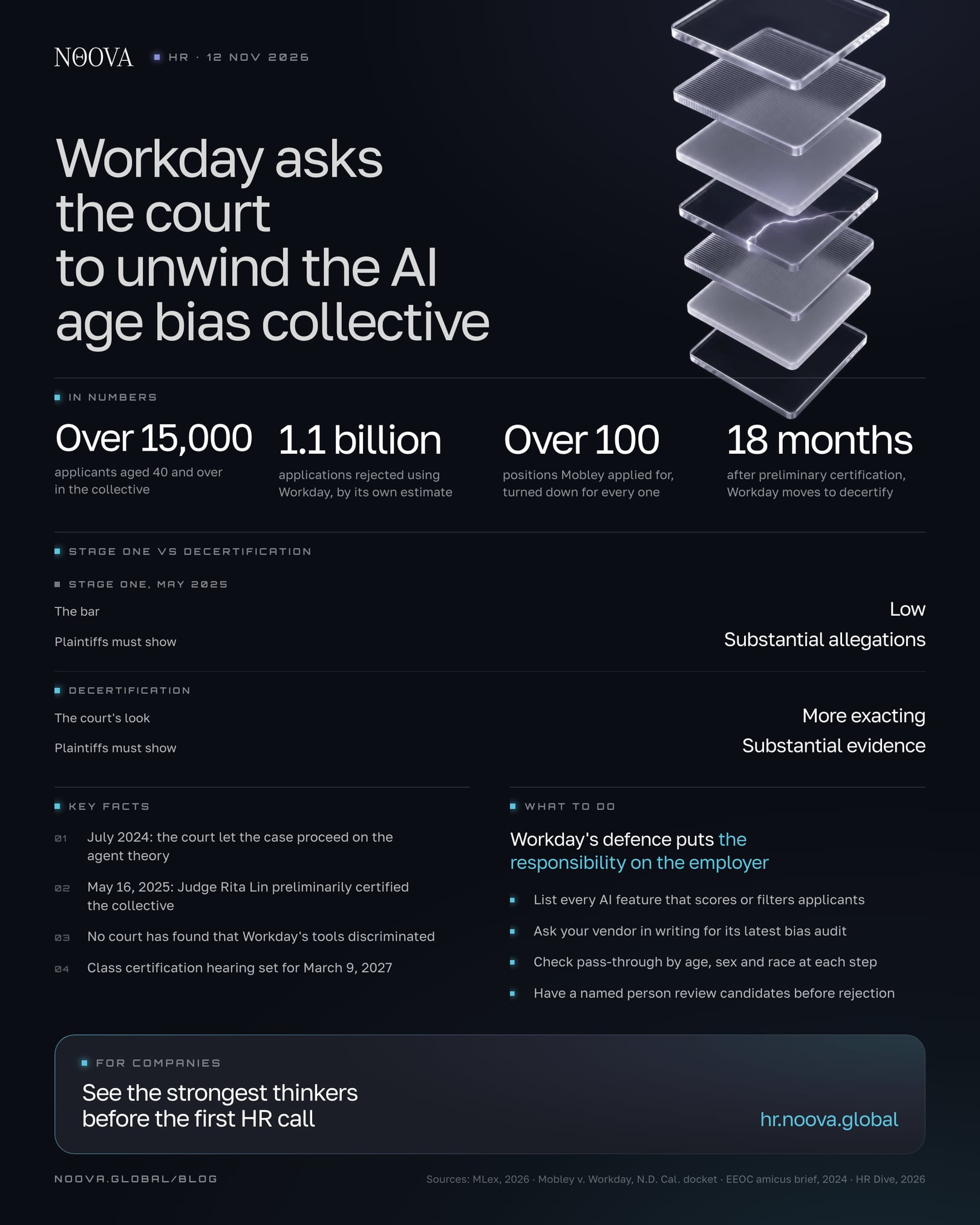
Mobley v Workday, the best-known lawsuit over AI in hiring, has reached its second gate. On November 10, 2026, Workday asked the court to decertify the nationwide age discrimination collective, a group MLex reports at more than 15,000 job applicants over 40. Workday argues its AI did not evaluate most of their applications and that each employer configures the software and makes its own decisions, so every claim needs separate review. Nothing about liability is decided yet. This post sets out what happened, how the case got here, what remains open, and what it means for anyone who buys or runs screening software.
What Workday asked for in Mobley v Workday
Workday wants the collective unwound and the opt-in claims dismissed without prejudice, which would leave each applicant free to sue separately. According to MLex, the motion makes three points:
- The applicants have not shown that Workday's AI tools unfairly screened out older candidates.
- The tools did not evaluate most of the applications at issue.
- Employers configure and use the software differently and make their own hiring decisions.
Workday also argues that, 18 months after preliminary certification, the plaintiffs carry a heavier burden. They must now show with "substantial evidence" that the people who joined are similarly situated in ways that matter to their claims.
The full brief is not yet free to read. The CourtListener docket shows more than 40 entries filed on November 10, including an opposition, a motion for relief, three motions to strike and dozens of supporting declarations. Their text is still behind PACER. The MLex and Law360 reports are paywalled, so this post states only what MLex's open summary and the court record confirm.
How the case got here
The case is nearly four years old and has already moved the law on vendor liability once. Derek Mobley filed it on February 21, 2023, in the Northern District of California. He alleged that Workday's AI-based screening rejected him because of race, age and disability. Since 2017, he says, he applied to over 100 positions at companies using Workday and was turned down for every one.
The key early question was whether a software vendor can be sued at all. The EEOC filed an amicus brief on April 9, 2024 arguing that Mobley had plausibly alleged Workday is an agent of employers, because they delegate part of hiring to it. In its July 12, 2024 order, the court agreed on the agent theory and rejected the claim that Workday is an employment agency. Judge Rita Lin wrote that drawing "an artificial distinction between software decisionmakers and human decisionmakers would potentially gut anti-discrimination laws in the modern era".
On May 16, 2025 the court preliminarily certified a collective under the Age Discrimination in Employment Act (ADEA). A collective is the opt-in version of a class action: people must sign up to join. It covers applicants aged 40 and over who, from September 24, 2020, applied through Workday's platform and were denied employment recommendations. The bar at that stage was low: substantial allegations of a "unified policy", here the use of Workday's AI to "score, sort, rank, or screen applicants". Workday had estimated that "1.1 billion applications were rejected using Workday" in the period. The judge said its size was no reason to withhold notice.
Two later orders widened and then closed the door. In July 2025 the court ruled that applicants screened by the HiredScore AI features, which Workday acquired after the complaint, were in scope for now. The December 2025 notice plan ran notice from January 6 to March 7, 2026, the last date for opt-in forms.

Why decertification is the real test in Mobley v Workday
Decertification is where the court checks the evidence behind the allegations. The May 2025 order said so in plain terms. After discovery, Workday "could then ask the Court to revisit its preliminary decision by de-certifying the collective and requiring each plaintiff to proceed individually". At that second step the court "will then take a more exacting look" at the record.
The two sides frame the same facts in opposite ways. The plaintiffs' theory is that one system, Workday's recommendation engine, puts every older applicant on unequal footing, whatever each employer does next. The court accepted that framing at stage one and called the members "alike in the central way that matters". Workday's answer is that there is no one system in practice: each employer turns features on or off, sets its own criteria and makes the final call. If the judge finds those differences material, the collective splits into thousands of individual cases. Few of those would be worth bringing alone.
Workday has also said publicly, in a statement quoted by HR Dive, that "the claims in the suit are false" and that its technology "looks only at job qualifications, not protected traits". Its Chief Responsible AI Officer, Kelly Trindel, told CIO that Workday "builds AI to support people, not replace them".
What is not yet decided
Almost everything that matters to the outcome is still open. No court has found that Workday's tools had a disparate impact on older applicants (disparate impact means a neutral-looking practice that hurts one group more, whatever the intent). The ruling on decertification has not been made, and no hearing date for it appears in open sources.
A second track runs in parallel. On September 14, 2026, the plaintiffs filed a motion for class certification under Rule 23, with race, sex, age and disability subclasses. The age subclass rests on California's Fair Employment and Housing Act. Most of those state claims survived a June 2026 ruling, as HR Dive reported. The docket set responses for November 10 and a hearing for March 9, 2027. So the court could narrow the federal age collective and still certify a state-law class, or do neither.
What the case means for employers who use AI screening
Workday's defence has a side effect for its customers. The more it argues that employers configure the tools and make their own decisions, the more the responsibility sits with the employer. The court has already said that a vendor can be liable as an agent. Neither point lets the employer off.
The legal climate is moving the same way. Connecticut now says that using AI is no defence to a discrimination claim, as we cover in our post on the Connecticut AI hiring law. The research on hiring bias shows how much unequal treatment survives in processes that look neutral.
The practical lesson is boring and useful. Know which AI features are switched on in your hiring stack, what they score, and who looks at the output. At NOOVA we built NOOVA HR on the rule that a person always decides, with no automated verdicts. Whatever tool you use, that is the line worth checking in your own process.
A checklist for employers watching Mobley v Workday
- List every AI feature that scores, ranks or filters applicants in your applicant tracking system, and who switched it on.
- Ask your vendor in writing for its latest bias audit and the data it covered.
- Check age, sex and race pass-through rates at each automated step for the last 12 months.
- Confirm that a named person reviews candidates before any rejection is sent.
- Write down the criteria you configured, so you can explain any screening decision later.
- Review vendor contracts for who bears liability if a screening tool is challenged.
- Diary March 9, 2027, the class certification hearing, and watch for the decertification ruling.
Sources
- Workday seeks to decertify age-bias collective of 15,000 job applicants, MLex, 10 November 2026
- Mobley v. Workday, Inc., 3:23-cv-00770, docket, N.D. Cal., CourtListener
- Order granting in part and denying in part motion to dismiss, Dkt. 80, 12 July 2024
- Order granting preliminary collective certification, Dkt. 128, 16 May 2025
- Order re HiredScore dispute, Dkt. 158, 29 July 2025
- Order approving notice plan, Dkt. 211, 2 December 2025
- Plaintiffs' motion for class certification, Dkt. 418, 14 September 2026
- Brief of the EEOC as amicus curiae in Mobley v. Workday, 9 April 2024
- Workday can't shake California AI discrimination claims, HR Dive, 23 June 2026
- Judge signals AI recruitment tool vendors like Workday may not escape liability for discrimination, CIO, 17 June 2026