Connecticut AI Hiring Law: What SB 5 Requires of Employers, and When
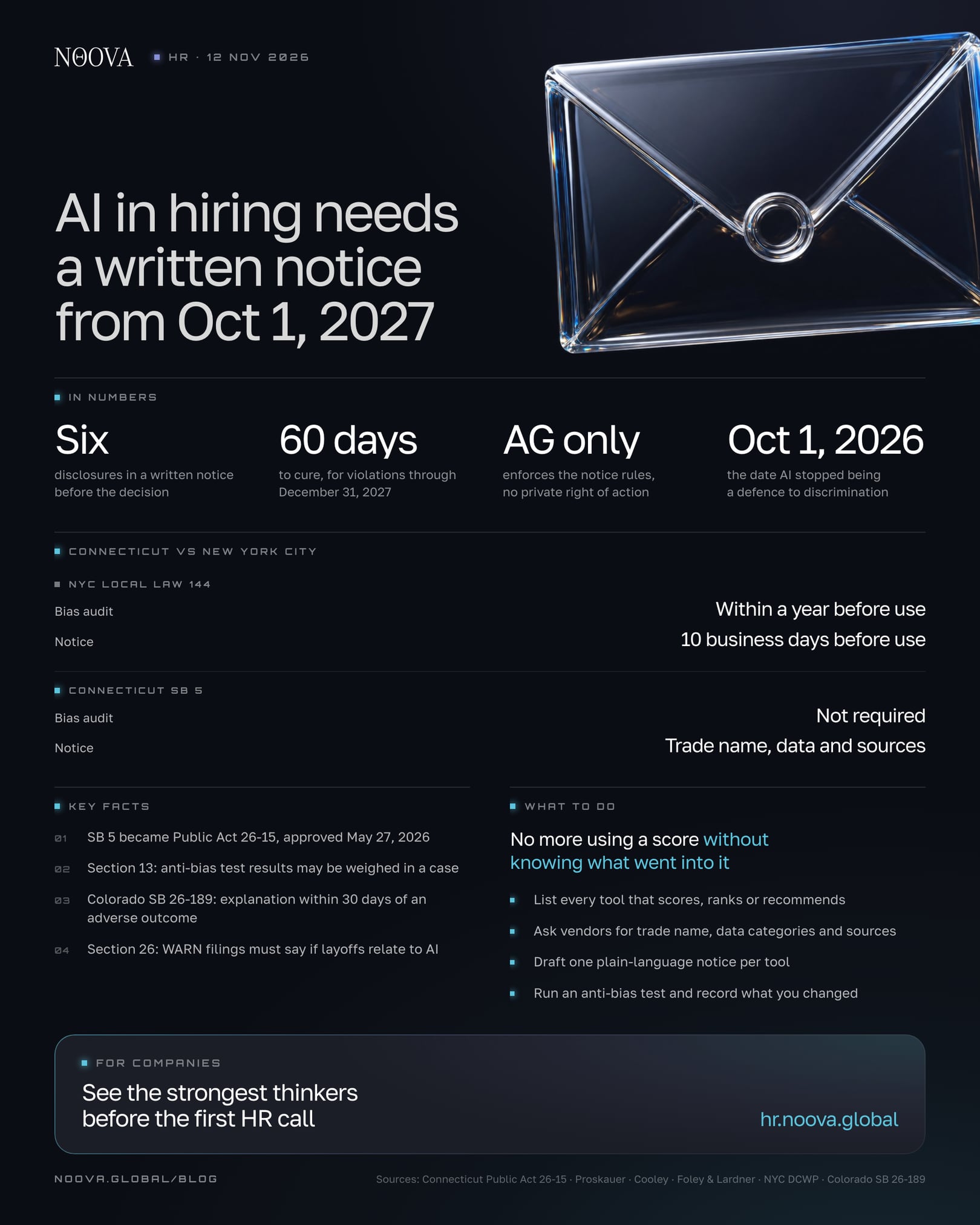
Connecticut AI hiring law: from October 1, 2027, employers must give a written notice with six disclosures before an AI tool shapes a job decision.

The Connecticut AI hiring law asks two things of employers. Since October 1, 2026, using an automated tool is no defence to a discrimination complaint. From October 1, 2027, any employer whose AI tool meaningfully shapes a hiring, promotion or firing decision must first give the person a written notice with six specific disclosures. Below: what the act says, which tools it catches, how it compares with New York City and Colorado, and what to do before 2027.
Where the Connecticut AI hiring law comes from
The rules sit in Senate Bill 5, which legislators call the Connecticut Artificial Intelligence Responsibility and Transparency Act, or CART Act. It became Public Act 26-15, approved on May 27, 2026, under the plain title "An Act Concerning Online Safety". The bill also covers AI companions and frontier-model whistleblowers; the employment part is sections 7 to 13, plus a layoff rule in section 26.
Reports of the signing date differ: May 27 in Proskauer, an announcement by Governor Ned Lamont's office on May 29 in Bloomberg Government, June 2 in DLA Piper. The act reads "Approved May 27, 2026". It is back in the news after Foley & Lardner reminded employers on November 9 that the notice rules are less than a year away.
Which tools count under the Connecticut AI hiring law
The law covers almost any software whose output changes a job decision: technology that "processes personal data and uses computation to generate any output", such as a ranking or score, used "to make or materially influence an employment-related decision".
Two definitions do most of the work:
- Substantial factor: a constraint, ranking, score, recommendation or classification that "meaningfully alters the outcome" of a decision. The act does not define "meaningfully", as Proskauer points out.
- Employment-related decision: hiring, promotion, discipline, discharge, training selection, tenure and terms of work. Health and safety, scheduling and productivity monitoring are excluded.
Spreadsheets, databases and other plain office software are excluded "insofar as" they do not make or materially influence a decision, and so is anything "purely descriptive, diagnostic or statistical" that nobody relies on. A plain dashboard is out; one that ranks a shortlist the recruiter follows is in.
Cooley calls this broader than New York City's test of tools that "substantially assist or replace" decisions.

AI is no defence to discrimination: in force since October 1, 2026
Section 13 amends Connecticut's Fair Employment Practices Act so that using an automated tool "shall not be a defense against a complaint alleging a discriminatory practice". Section 14 does the same for sexual orientation claims.
The law does not require a bias test. It rewards one. The state's rights commission or a court "may consider evidence of anti-bias testing", judged by "the quality, efficacy, recency and scope" of that testing, its results "and the response thereto". The last three words matter: a test that found a problem nobody fixed is evidence too.
If a screening model filters out older applicants, the employer cannot point at the vendor. A related fight is under way in federal court in Mobley v. Workday, where the vendor's share of responsibility is in dispute.
What the Connecticut AI hiring law requires from October 1, 2027
From October 1, 2027, an employer using a covered tool on a person in Connecticut owes two disclosures.
The first is an interaction notice (section 9): if the tool is meant to interact with the person, such as a chatbot screener, they must be told so in plain language. No notice is needed where "a reasonable person would deem it obvious".
The second is a written notice before the decision (section 10). It must state:
- That the employer has deployed such a tool.
- The tool's purpose and the nature of the decision.
- The tool's trade name.
- The categories of personal data it will analyse, and how that data will be assessed.
- The sources of that data.
- The employer's contact details.
Trade secrets can be withheld, but the employer must say that it is withholding something and why (section 11). Developers must give employers the information they need if the tool was marketed, sold or configured to materially influence job decisions, and a contract can hand the notices to the vendor if it names exactly which duties move.
The fourth item is the hard one: someone at the employer has to explain, in words a candidate can read, what the model looks at.
Enforcement of the Connecticut AI hiring law and the cure period
Only the Attorney General enforces the notice rules, as an unfair or deceptive trade practice (section 12). For violations on or before December 31, 2027, the AG may first send a notice of violation and give the employer 60 days to cure. The act states that nothing in these sections creates a private right of action.
Neither the act's notice sections nor the law firm summaries we read name a penalty amount. Discrimination claims still run through the existing civil rights process, now with the no-defence rule in place.
One more rule took effect on October 1, 2026. An employer that files a federal WARN notice with the Connecticut Labor Department must now say whether the layoffs relate to its "use of artificial intelligence or another technological change" (section 26).
How Connecticut compares with New York City and Colorado
Connecticut asks for more disclosure than New York City and less process than Colorado.
New York City's Local Law 144, enforced since July 5, 2023, requires a bias audit within a year before use, a public summary of the results, and a notice to candidates 10 business days before the tool is used. Connecticut has no audit requirement, but its notice asks for more detail: the trade name, the data categories and their sources.
Colorado's rewritten AI Act, SB 26-189, signed on May 14, 2026, requires a plain-language explanation within 30 days after a tool contributes to an adverse outcome, and meaningful human review on request. Its Attorney General must offer a 60-day cure until January 1, 2030.
If you hire in several states, keep one inventory of tools and write one notice template to the most detailed content rule of the three, which is Connecticut's.
What we think
The law is modest on paper and demanding in practice. It bans nothing and requires no audit. It ends the comfortable habit of using a score without knowing what went into it: the notice needs you to understand your tool, and a discrimination defence needs test results plus a record of what you did about them.
That is a fair bar for any assessment, AI or not. NOOVA HR turns a 20-minute voice dialogue into thinking metrics, and a person always decides; any tool whose score meaningfully changes who gets hired, ours included, belongs on your inventory. Explaining a score is also how you learn whether to trust it, the theme of our post on hiring bias.
A checklist for employers before October 1, 2027
- List every tool in recruiting, screening, assessment and promotion that produces a score, ranking or recommendation.
- Mark the ones whose output meaningfully changes a decision, and write down why each other one is excluded.
- Ask each vendor in writing for the trade name, data categories, data sources and scoring logic you need for the notice.
- Decide for each contract who sends the notices, you or the vendor, and write it into the contract.
- Draft one plain-language notice per tool covering all six disclosures, and have someone outside HR read it.
- Run an anti-bias test on each covered tool, record the results, and record what you changed.
- Add the AI-or-technology question to your WARN filing process for Connecticut sites.
Sources
- Substitute Senate Bill No. 5, Public Act No. 26-15, An Act Concerning Online Safety, Connecticut General Assembly
- Connecticut Enacts New AI Law: What Employers Need to Know, Proskauer
- Connecticut: New AI law creates employment-related obligations, DLA Piper
- Connecticut's Lamont Signs AI Law With Employer Notice Mandate, Bloomberg Government
- Before the Algorithm Decides: Connecticut's 2027 Rules for Artificial Intelligence in Employment, Foley & Lardner
- Connecticut's AI Rules Take Shape: What Employers and Developers Need to Know, Cooley
- Automated Employment Decision Tools, NYC Department of Consumer and Worker Protection
- SB26-189 Automated Decision-Making Technology, Colorado General Assembly