Structured Interview Questions: How to Write, Ask and Score Them
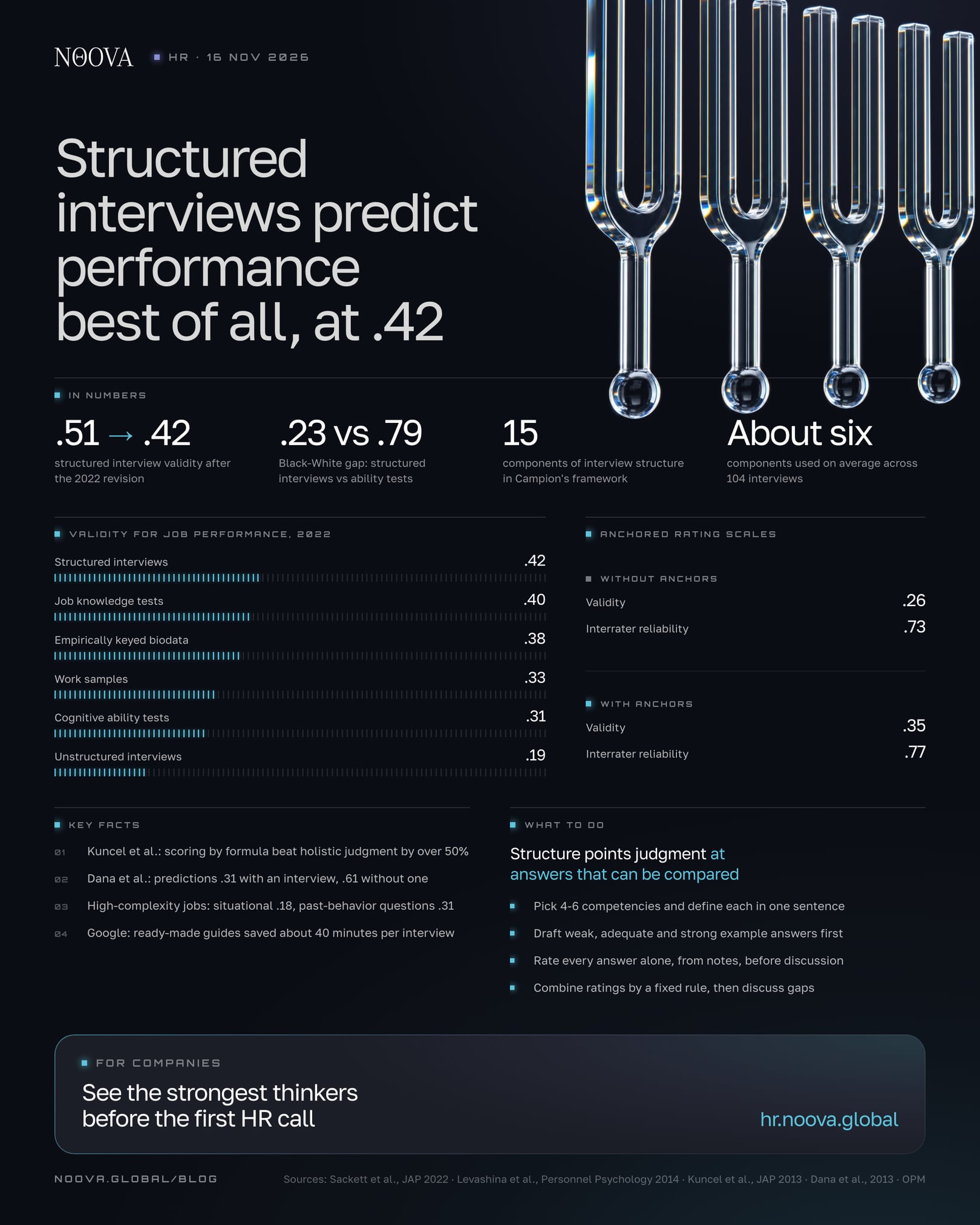
Structured interview questions are the same job-based questions for every candidate, scored on set scales. They rank first in a 2022 meta-analysis at .42.

Structured interview questions are the same job-based questions, asked of every candidate in the same order and scored against a written scale. They are the best single predictor of job performance in the most careful recent review: in Sackett and colleagues (2022), structured interviews reached a mean validity of .42, while unstructured interviews reached .19. This guide is for hiring managers and recruiters who run interviews. It covers what makes an interview structured, what the evidence says, a question bank by competency, and how to score answers so two interviewers reach the same number.
What makes structured interview questions structured
An interview is structured when both the questions and the scoring are fixed before the first candidate walks in. A list of good questions alone does not count.
The standard map comes from Michael Campion and colleagues (1997), summarised in the Levashina, Hartwell, Morgeson and Campion review (2014). They listed 15 components in two groups. Content covers what you ask: questions based on a job analysis, the same questions for everyone, limits on follow-up, better question types, enough questions, control over outside information, and candidate questions held until the end. Evaluation covers how you judge: rate each answer, use anchored scales, take detailed notes, use several interviewers, keep the same interviewers across candidates, no discussion between interviews, training, and combining scores by formula rather than gut feel.
Real interviews use far fewer. Across 104 interviews described in research from 1997 to 2010, the review counted about six components on average. So "we do structured interviews" can mean almost anything. The useful question is which components you actually run.
The US Office of Personnel Management puts the core in one line: every candidate gets the same predetermined questions in the same order, and every answer is judged on the same rating scale and the same standards.
How well structured interviews predict job performance
Structured interviews predict job performance better than any other single method studied, though less well than older numbers suggested. That is the headline of the 2022 revision.
For two decades, the reference table was Schmidt and Hunter (1998). It put structured interviews at .51. Sackett, Zhang, Berry and Lievens argued that earlier meta-analyses overcorrected for range restriction (the narrower spread of scores among people already hired), which inflated many estimates by .10 to .20. After their recalculation, structured interviews came first at .42, ahead of job knowledge tests (.40), empirically keyed biodata (.38), work samples (.33) and cognitive ability tests (.31). Unstructured interviews fell from .38 to .19.
Two details matter for practice. First, the spread is wide. The standard deviation of the structured interview estimate is .19, and the lower 80% credibility value is .18, so a poorly built structured interview can predict little. Second, the gap between groups is smaller. The mean Black-White difference was d = .23 for structured interviews and d = .79 for cognitive ability tests.
A summary for SIOP by HumRRO researchers draws the conclusion the authors themselves suggest: structured interviews could become the "focal predictor" that other methods are compared against. The paper also notes that the top predictors are all job-specific. Questions that sample the actual work tend to beat measures of general traits.

Behavioral and situational structured interview questions
Most structured interview questions come in two types. Behavioral questions ask what a candidate did in a past situation. Situational questions describe a job scenario and ask what the candidate would do.
Both work. The 2014 review reports similar interrater reliability, .79 for situational and .76 for past-behavior questions (Taylor and Small, 2002). Behavioral questions predicted slightly better: uncorrected validities of .31 against .25 in one meta-analysis, .31 against .26 in another. The gap grows for complex jobs. In Huffcutt and colleagues (2004), situational questions fell to .18 for high-complexity jobs, while past-behavior questions held at .31.
The two types also seem to measure different things. Situational questions lean toward job knowledge and reasoning; behavioral questions lean toward experience. The review's advice is to use both. We cover each type in its own guide: behavioral interview questions and situational interview questions.
A third type is worth adding for specialist roles: job knowledge questions, where the answer can be checked against what the work requires.
A bank of structured interview questions by competency
Write questions from the competencies the job needs, not from a generic list. OPM's training deck on structured interviews recommends 4-6 competencies per interview, open-ended wording, and superlatives such as "most", "last" or "worst" that push the candidate toward one specific event. The examples below follow that pattern. Adapt the context to your job analysis.
Problem solving
Behavioral: "Tell me about the hardest problem you solved in the last year where the first answer turned out to be wrong. What did you notice, and what did you change?"
Situational: "Two weeks before launch, the data shows that one key assumption behind the plan is false. The team wants to ship anyway. What do you do in the first two days?"
Working with others
Behavioral: OPM's own example asks the candidate to describe dealing with people who were difficult, hostile or distressed: who was involved, what they did, and what happened.
Situational: OPM pairs it with a scenario. An angry client says a check sent five days ago never arrived and nobody will help. How would you handle it?
Planning and priorities
Behavioral: "Describe the last time you had more work than time. What did you drop, how did you decide, and how did the people affected react?"
Situational: "Your manager and a senior client both ask for urgent, conflicting work due tomorrow. Walk me through what you do."
Learning and judgment
Behavioral: "Tell me about the worst decision you made at work in the past two years. How did you find out it was wrong?"
Situational: Google's re:Work guide uses a business case: a competitor starts charging $5 a month for a product like yours. How would you assess it, and what would you recommend?
That last group says a lot about how someone checks their own thinking. Catching your own error early is a skill in its own right, close to what researchers call metacognition.
How to score structured interview questions with anchored scales
Scoring is where most structured interviews quietly fall apart. Every question needs a rating scale with written examples of weak, adequate and strong answers, prepared before the first interview.
These are anchored rating scales. The interviewer matches the answer to the closest written anchor instead of forming a general impression. In a meta-analysis of 19 past-behavior interview studies (Taylor and Small, 2002, in the 2014 review), interviews with anchored scales reached a validity of .35 and interrater reliability of .77. Without them the figures were .26 and .73. A further study found that a five-point scale with an anchor at every point made ratings more resistant to disability bias than a scale with anchors only at the ends. Our free interview scorecard template builds such a scale for the competencies you pick and copies it to Google Sheets.
OPM's deck suggests one scale for all competencies, typically 3 to 7 levels, with at least three labelled. Subject matter experts first write, alone, how a person at each level would answer, then agree on the most typical example. For the "hardest problem" question above, a five-point scale might read:
- 1: Describes a problem but no own action, or blames others for the wrong first answer.
- 3: Names the wrong first answer and a fix, with little on how they noticed.
- 5: Explains the signal that showed the first answer was wrong, why they trusted it, what they changed, and what they now do differently.
Then combine scores by rule. A meta-analysis by Kuncel and colleagues (2013) found that combining candidate data by formula beat holistic judgment, by more than 50% in predicting job performance, even when the judges knew the job well. Average or weight the ratings first. Discuss after.
Follow-up questions, notes and panels in a structured interview
Plan your follow-up questions too. Unplanned probing turns a structured interview back into a conversation.
Campion's framework ranks probing from strictest (none allowed) to loosest (no guidance at all). The review found that limited probing was about as common as no probing in recent research, and cites a study in which probing increased faking on both question types. OPM's practical answer is a list of approved probes for each question, built around situation, action and result: "Who was involved?", "What was your role?", "What was the outcome?" Its deck also tells interviewers to ask for clarification when a candidate says "we did" and to avoid probes that hint at the right answer.
Notes should record what the candidate said, not what the interviewer thought of them. OPM's sequence after each interview is simple: panel members read their notes aloud, each rates every question alone against the anchors, and only then do they discuss gaps to reach consensus. Its list of errors to watch includes the halo effect, "similar to me" ratings, leniency and central tendency, such as giving every answer a 3 on a 5-point scale.
Structure also narrows group gaps. In a 31-study meta-analysis (Huffcutt and Roth, 1998, reported in the same review), high-structure interviews showed smaller mean ethnic differences in ratings (d = .23) than low-structure ones (d = .32).
Why interviewers resist structure
Most interviewers believe they are good at reading people, and the evidence says that belief is the problem. Google's re:Work guide names it directly: interviewers think they are good at interviewing, so they see little reason to change.
The cleanest test is a study by Dana, Dawes and Peterson (2013). Students predicted classmates' grade point averages from background data, with or without an unstructured interview. In one condition the interviewee answered at random. Interviewers felt just as confident after random answers as after real ones. Predictions made with an interview correlated .31 with actual grades; predictions made without one correlated .61. In a third study, 57% of 169 students said they would rather have a random interview than none at all.
The interview did not just fail to help. It diluted the good information. Structure does not remove judgment; it points judgment at answers that can be compared.
Structure costs less time than people expect. Google reports that ready-made questions, guides and rubrics saved about 40 minutes per interview, and that rejected candidates who had a structured interview were 35% happier with the experience.
Some teams add a structured assessment before the interview to decide who gets one. NOOVA HR uses a 20-minute voice dialogue to show the strongest thinkers for middle and senior roles before the first HR call; a person still makes every decision.
A checklist for building structured interview questions
- Pick 4-6 competencies from the job, and write one sentence defining each.
- Write one behavioral and one situational question per competency, with the same wording for every candidate.
- Draft weak, adequate and strong example answers for each question before the first interview.
- List two or three approved follow-up probes per question and ban the rest.
- Train every interviewer on the anchors with two practice answers rated together.
- Have each interviewer rate every answer alone, from notes, before any discussion.
- Combine ratings by a fixed rule, then discuss only the questions where raters disagree by two points or more.
- Compare interview scores with six-month performance for the first cohort and drop questions that predict nothing.
Sources
- Revisiting Meta-Analytic Estimates of Validity in Personnel Selection, Sackett, Zhang, Berry and Lievens, Journal of Applied Psychology, 2022
- Is Cognitive Ability the Best Predictor of Job Performance? O'Shea and Fox Luscombe, SIOP TIP
- The Structured Employment Interview: Narrative and Quantitative Review of the Research Literature, Levashina, Hartwell, Morgeson and Campion, Personnel Psychology, 2014
- Structured Interviews, US Office of Personnel Management
- Structured Interviews, training presentation, US Office of Personnel Management
- A guide to structured interviewing for better hiring practices, Google re:Work
- Belief in the unstructured interview: The persistence of an illusion, Dana, Dawes and Peterson, Judgment and Decision Making, 2013
- Mechanical versus clinical data combination in selection and admissions decisions, Kuncel, Klieger, Connelly and Ones, Journal of Applied Psychology, 2013


