Situational Interview Questions That Predict Performance, With Examples and Scoring Guides
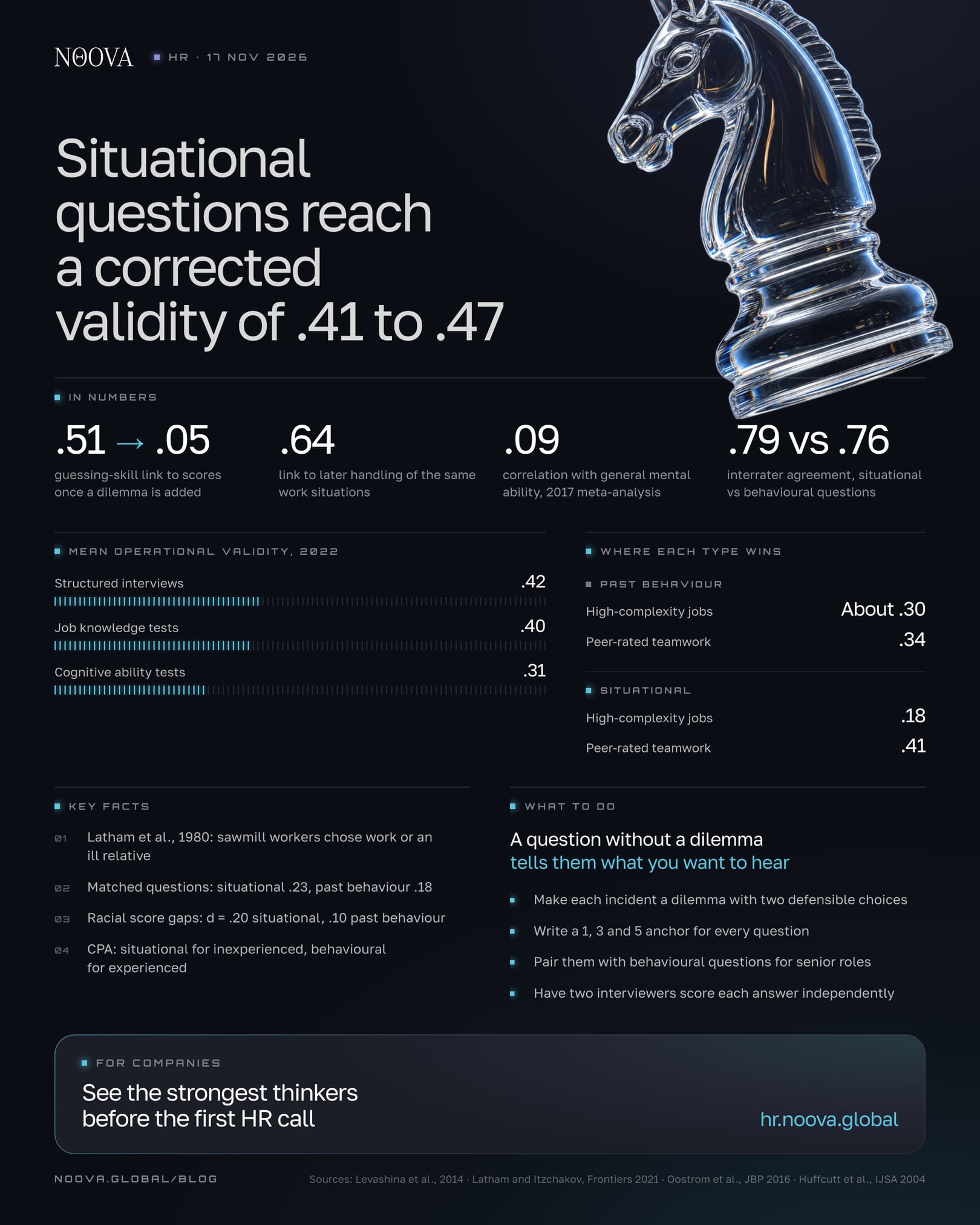
Situational interview questions ask what a candidate would do in a job dilemma. Three meta-analyses put their corrected validity at .41 to .47.

Situational interview questions put a candidate in a realistic job dilemma and ask what they would do. Asked the same way of everyone and scored against a written guide, they predict job performance well: three meta-analyses put their mean corrected validity between .41 and .47, which makes it one of the most predictive interview techniques. This guide is for the person on the interviewer's side of the table. It covers what situational questions measure, where they beat and lose to behavioural questions, how to write them, examples by competency and a scoring guide you can copy.
What situational interview questions are
A situational question describes a moment the job really contains and asks "what would you do?" The format was introduced by Gary Latham and colleagues in a 1980 paper in the Journal of Applied Psychology, and it rests on a simple idea from goal-setting theory: what people intend to do predicts what they do.
The questions are not invented in a meeting. They start from critical incidents, real examples of effective and ineffective behaviour that people in the role have seen. The US Office of Personnel Management's structured interview training shows the conversion step by step. An incident ("a coworker dealt calmly with a distressed client whose check was late") becomes a question: an angry client arrives at your desk, says your office sent her an overdue check five days ago, she has bills to pay and nobody will help. How would you handle it?
The original version has one more ingredient: a dilemma. In the 1980 study, as Levashina and colleagues' 2014 review recounts, sawmill workers were asked to choose between turning up for work and caring for an ill family member. Two reasonable goals, one choice. That tension is what separates a situational question from a hypothetical one with an obvious right answer.
How well situational interview questions predict performance
Situational questions predict job performance about as well as any interview format, and better than most other hiring tools. The three meta-analyses that pooled the studies put mean corrected validity at .41 to .47. Validity here is the correlation between interview scores and later performance ratings; "corrected" means adjusted for imperfect ratings and for the narrowed range of people who were hired.
Uncorrected numbers are smaller and easier to read honestly. As the Levashina review summarises them, Latham and Sue-Chan (1999) reported a mean observed validity of .35, and Taylor and Small (2002) found .25 for situational questions and .31 for past-behaviour ones.
The wider frame has shifted too. Sackett, Zhang, Berry and Lievens (2022) argued that older meta-analyses overcorrected for range restriction and recalculated the main selection methods. Structured interviews came out on top, with a mean operational validity of .42, ahead of job knowledge tests (.40) and cognitive ability tests (.31). They also showed wide spread around that mean. A good structured interview is the best single bet you have. A careless one is not.
Two more facts help in practice. Interviewers agree with each other about as well on situational questions as on behavioural ones, .79 against .76 in Taylor and Small's data. And situational answers barely track general mental ability: a 2017 meta-analysis of matched questions found a correlation of only .09. You are not running an IQ test with extra steps.

Situational vs behavioural questions: where each wins
Neither question type wins outright; they measure different things and fail in different places. Behavioural questions ask what a candidate did ("tell me about a time"), on the premise that past behaviour predicts future behaviour. Our guide to behavioral interview questions covers that side.
The comparison data, mostly gathered in the Levashina review:
- Average validity. Past-behaviour questions edge ahead in pooled studies (.31 against .25-.26 uncorrected). A later meta-analysis of questions written to measure the same attributes found the reverse, .23 against .18, as reported by Latham and Itzchakov (2021).
- Job complexity. In Huffcutt and colleagues' 2004 meta-analysis of 54 studies and 5,536 people, situational validity fell from .27 for low-complexity jobs to .18 for high-complexity ones. Past-behaviour questions held at about .30 for both.
- Senior roles. A 2001 study of military officers and district managers found situational questions "much less predictive" in these higher-level jobs.
- Group differences. Past-behaviour interviews showed smaller score gaps between racial groups than situational ones (d = .10 against .20) in an earlier meta-analysis cited by Levashina.
- Experience. Situational questions do not need a work history. The Canadian Psychological Association's fact sheet recommends them for inexperienced applicants and behavioural questions for experienced ones.
What each one measures differs as well. Across the studies Levashina's team reviewed, situational questions mostly captured job knowledge, knowing what a good move looks like. Past-behaviour questions mostly captured experience. That is why the review's practical advice is to stop arguing about which is superior and use both. A 2005 study of team-playing behaviour by Klehe and Latham found situational questions predicted peer-rated teamwork at r = .41 and past-behaviour questions at .34, with the situational ones adding prediction on top.
So the rule of thumb: lean on situational questions for graduate, entry-level and career-change hiring, and for problems the candidate cannot have met yet. Lean on behavioural questions for senior, complex roles. For most roles, mix them.
Why the dilemma in a situational interview question matters
A situational question without a dilemma tells the candidate what you want to hear. With one, it forces a real choice and shows how the person weighs competing goals.
Latham and Itzchakov tested this directly in four experiments published in Frontiers in Psychology in 2021. The question was whether smart candidates simply guess what the interviewer is looking for, a skill researchers call "ability to identify criteria". On questions without a dilemma, that guessing skill correlated .51 with interview scores in a sample of 148. On questions with a dilemma, the correlation dropped to .05. Telling people what was being assessed raised scores only on the no-dilemma questions.
Oostrom and colleagues (2016) found the other half of the picture. In a two-day selection simulation with 101 students, situational interview scores correlated .64 with how people later handled the matching work situations. Part of that link ran through reading the situation correctly. Reading what a situation demands is part of the job, so this is not a flaw. It does mean a transparent question measures little beyond it.
The practical point: make both options defensible. "A client asks for a discount you are not allowed to give" is a policy quiz. "Your best client asks for a discount that would push the quarter's margin below target, and your manager is on leave" is a dilemma.
How to write situational interview questions in six steps
Writing good situational questions takes a few hours of work with people who know the job, and it is the part most teams skip. OPM's process, condensed:
- Pick four to six competencies from a job analysis. OPM notes structured interviews typically assess 4-6 unless the role is unusual or very senior.
- Collect critical incidents. Ask two or three strong performers and a manager for real moments where the job went well or badly, and what the person did.
- Check the fit. A second group reads each incident and names the competency it shows. Drop the ones they cannot place.
- Rewrite incidents as dilemmas. Keep the real details (names of systems, deadlines, numbers), remove anything that hints at the answer, and add a competing goal.
- Write allowed probes in advance. OPM's examples for situational questions: "What is the first thing you would say or do?", "What factors would affect your course of action?", "How do you think your action would be received?"
- Pilot the questions on a few current employees before candidates see them, and drop any question where everyone gives the same answer.
Situational interview questions: examples by competency
These examples follow the pattern above: a concrete moment, two defensible goals, an open "what would you do". Adapt the details to your own critical incidents; a borrowed question tests a borrowed job.
Prioritisation. "It is Thursday afternoon. Your manager asks you to finish a board summary by Friday 9 am. An hour later, a key client reports that a report you sent them yesterday has a wrong figure in it. You have time for one of the two today. What do you do?"
Teamwork. "Two people on your project disagree about the launch date. One is your most experienced colleague, the other owns the client relationship. Both ask you, privately, to back their date at tomorrow's meeting. What do you do before and during the meeting?"
Integrity. "You notice that a well-liked colleague has been rounding up their hours on the timesheet by about half an hour a day. Your team is under review for budget cuts. What do you do?"
Customer handling. "A long-standing customer calls, upset that a refund promised by your colleague has not arrived. Policy says refunds over a set amount need sign-off that takes three days. The customer says they will leave today if it is not sorted. What do you do?"
Learning on the job. "You join a team and find the main reporting process takes two days a week and could be automated. The person who built it is senior and proud of it. You are in week three. What do you do?"
Leadership (use with care for senior roles). "One of your strongest performers misses two deadlines in a month and seems withdrawn. A peer manager tells you the team resents what looks like special treatment. What do you do this week?"
For senior hires, pair each of these with a behavioural question on the same competency, given the complexity data above. Our structured interview questions guide has a wider question bank.
How to score situational interview answers
Score every answer on its own anchored scale, written before the first interview. An anchored scale gives a short example of a poor, an acceptable and an excellent answer for each question, so interviewers match what they heard to a written standard instead of a feeling.
The evidence for anchors is consistent. In Taylor and Small's meta-analysis of past-behaviour interviews, studies with anchored scales showed higher validity (.35 against .26) and higher interrater reliability (.77 against .73) than studies without them. A study on disability bias, reviewed by Levashina's team, found a five-point scale with an anchor at every point resisted bias better than one anchored only at the ends.
OPM's method: subject matter experts each write how a person at each level would answer, then agree on the most typical answer per level. Use three to seven levels and label at least three. For the prioritisation question above, a five-point guide might read:
- 1: picks one task and ignores the other, or does both badly without telling anyone.
- 3: fixes the client error first because it is already live, and tells the manager the summary may slip.
- 5: checks the size of the client error, sends the client a short holding note with a time, asks the manager which deadline can move, and gives both people a specific plan.
Levashina's review points to a design choice worth making on purpose. Some guides reward a single right action; others reward the reasoning, the trade-offs considered and why the alternatives were rejected. If you want to measure judgement, anchor on reasoning.
Three habits keep the scores clean. Rate each answer right after it is given, not at the end. Take notes on what was said, not on impressions; OPM's guidance is notes that summarise content and could justify the rating on appeal. And have at least two interviewers rate independently before they discuss.
Situational questions are, at bottom, a structured way to hear someone think through a problem out loud. If that is what you need to see across many candidates, NOOVA HR runs a 20-minute AI voice dialogue that shows the strongest thinkers for middle and senior roles before the first HR call, with a person always making the decision.
A checklist for your next situational interview
- Choose four to six competencies from the job, not from a generic list.
- Collect five real critical incidents from people who do the job well.
- Rewrite each incident as a dilemma with two defensible choices.
- Write a 1, 3 and 5 anchor for every question before the first candidate.
- Pair situational questions with behavioural ones for senior or complex roles.
- Ask every candidate the same questions in the same order, with probes chosen in advance.
- Have two interviewers score each answer independently, then compare.
Sources
- The Structured Employment Interview: Narrative and Quantitative Review of the Research Literature, Levashina, Hartwell, Morgeson and Campion, Personnel Psychology, 2014
- Why Do Situational Interviews Predict Performance?, Oostrom, Melchers, Ingold and Kleinmann, Journal of Business and Psychology, 2016
- The Effect of a Dilemma on the Relationship Between Ability to Identify the Criterion and Scores on a Validated Situational Interview, Latham and Itzchakov, Frontiers in Psychology, 2021
- The impact of job complexity and study design on situational and behavior description interview validity, Huffcutt, Roth, Conway and Klehe, International Journal of Selection and Assessment, 2004
- Comparison of situational and behavior description interview questions for higher-level positions, Huffcutt et al., Personnel Psychology, 2001
- Structured Interviews, training presentation, US Office of Personnel Management
- Psychology Works Fact Sheet: Hire Better Job Applicants Using a Structured Job Interview, Canadian Psychological Association
- Is Cognitive Ability the Best Predictor of Job Performance?, on Sackett, Zhang, Berry and Lievens (2022), SIOP TIP


