Behavioral Interview Questions: How to Ask, Probe and Score Them
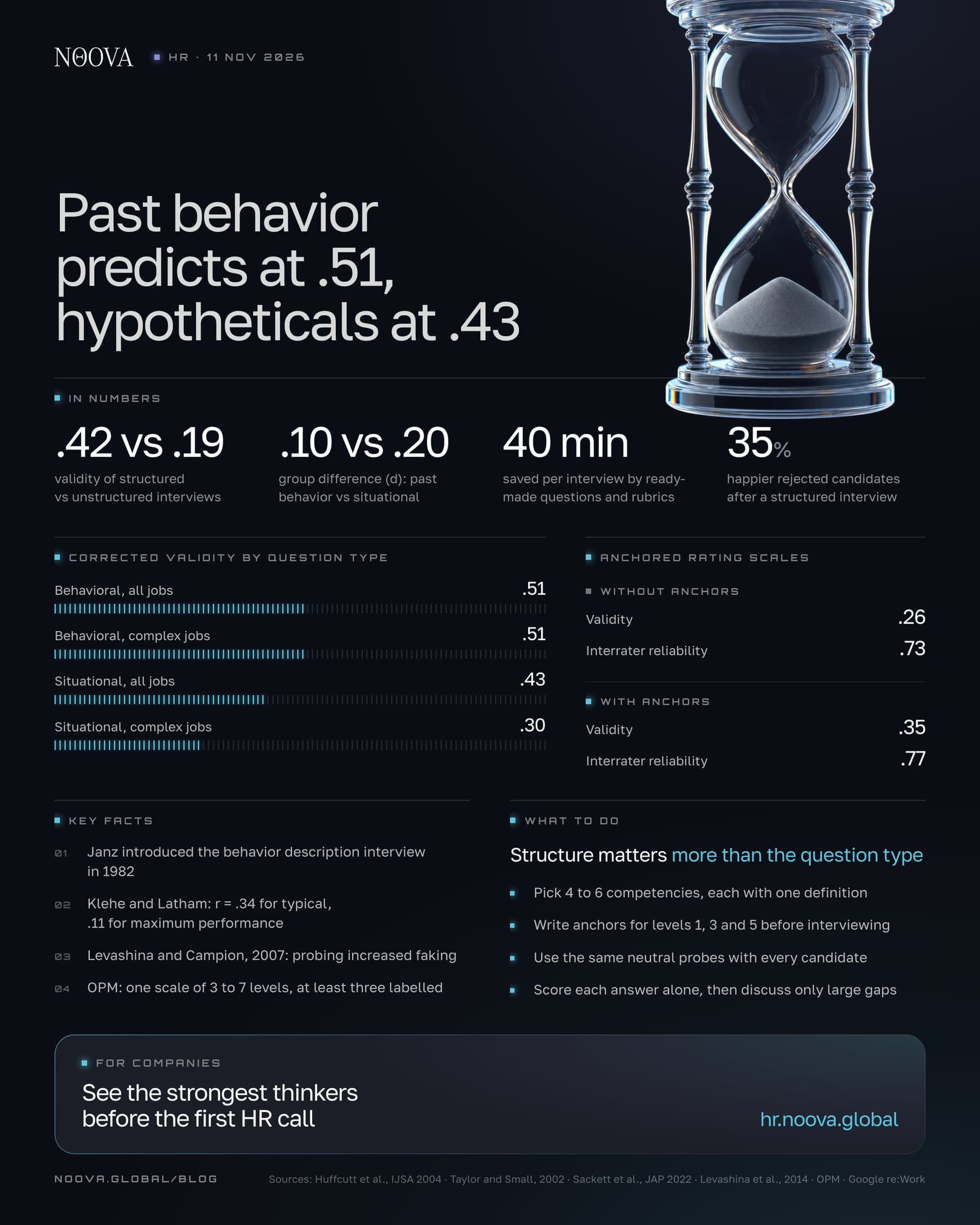
Behavioral interview questions ask what a candidate actually did. In a 54-study meta-analysis they predicted job performance at .51 corrected validity.

Behavioral interview questions ask candidates to describe what they actually did in a past situation that resembles the job: "Tell me about a time you had to win over a stakeholder who disagreed with you." In a meta-analysis of 54 studies, interviews built from these questions predicted job performance at a corrected validity of .51, against .43 for hypothetical "what would you do" questions. The question is the easy part. The validity comes from what surrounds it: the competency behind it, the probes you plan, and the scale you score on. This guide covers all four, with examples by competency.
What behavioral interview questions are
A behavioral interview question asks for one specific episode from the candidate's past and what they did in it. The premise is behavioral consistency: how someone handled similar situations before is the best evidence you have of how they will handle them on your team.
The format has a clear origin. Janz introduced the patterned behavior description interview in 1982, two years after Latham and colleagues published the situational interview. Levashina and colleagues' 2014 review calls these two the most popular types of structured interview question.
The structure every good answer needs is usually taught as STAR. The US Office of Personnel Management's interviewer training asks each question to draw out three things:
- Situation or task: the context, who was involved, what was at stake.
- Action: exactly what this person did.
- Result: what happened because of it.
Candidates are coached on STAR too. The Oregon Department of Consumer and Business Services tells applicants to say "I" rather than "we" and to describe one event in detail instead of generalising. That is useful for you to know. A polished STAR story is a sign of preparation, not of competence, and your probes have to get underneath it.
Behavioral interview questions versus situational questions
Behavioral questions predict job performance slightly better than situational ones on average, and the gap widens for complex jobs. The two formats also measure different things, so the best interviews use both.
Three meta-analyses line up. Taylor and Small (2002) found uncorrected mean validities of .31 for past-behavior questions and .25 for situational ones. Huffcutt, Roth, Conway and Klehe (2004) found almost the same, .31 and .26, which rise to .51 and .43 after the usual corrections. A validity of .51 means a fairly strong relationship between interview scores and later performance ratings.
Job complexity is where the formats split. In the Huffcutt data, situational interviews for high-complexity roles (managers, physicians, engineers) dropped to .18 uncorrected, .30 corrected. Behavioral interviews held at .31, .51 corrected, at every level of complexity. The authors' explanation is practical: hypothetical scenarios struggle to capture the messy detail of senior work, and a five-point scale with brief anchors cannot separate sophisticated answers. When the candidate brings the situation, the complexity comes with it.
Situational questions still earn their place. Mean corrected validities for situational interviews sit between .41 and .47 across meta-analyses, and they work for candidates without directly relevant history. Studies reviewed by Levashina's team suggest that, written for the same competency, situational questions lean toward job knowledge and cognitive ability, while behavioral questions lean toward experience and some personality traits. Their review proposes combining both. Our guide to situational interview questions covers the other half.

Structure matters more than the question type
The difference between behavioral and situational questions is small next to the difference between a structured interview and a chat. Sackett and colleagues' 2022 revision of the selection research, which corrected earlier meta-analyses for overstated range restriction, ranks structured interviews as the top selection procedure: mean operational validity .42, against .19 for unstructured interviews.
The same paper adds a warning. Structured interviews also showed a large residual standard deviation of .19, so a poorly built one can land far below the average. Asking "tell me about a time" does not make an interview structured. Same questions for everyone, planned probes, anchored scores and independent ratings do. Our post on structured interview questions goes through that machinery in full.
How to write behavioral interview questions
Start from the job, not from a list of famous questions. OPM's eight development steps begin with job analysis and the competencies a person needs on day one, and its training says a structured interview typically assesses 4 to 6 competencies unless the job is unusual or very senior.
Then collect critical incidents: real examples of notably good and bad performance in the role, from people who do or manage it. Each incident becomes a question that invites the candidate's own version of that moment. OPM's writing tips are short: tie every question to one competency from the job analysis, keep it open-ended, clear and free of jargon, and use superlatives such as "most", "last", "worst" or "best".
The superlative does more work than it looks. "Tell me about conflict on your team" invites a summary of the candidate's philosophy. "Tell me about the last time you disagreed with your manager on a decision" invites a story, and a story can be checked. OPM also has a second group of experts read each question cold and name the competency it measures. If they cannot, rewrite it.
Behavioral interview questions by competency: examples
Each example below has a lead question and one planned probe. The competency names what you score; the probe targets the part of STAR that candidates most often skip.
Problem solving. "Tell me about the most complex problem you had to diagnose in the last year." Probe: "What did you rule out, and how?"
Interpersonal skills (OPM's own example). "Describe a situation in which you dealt with individuals who were difficult, hostile, or distressed." Probes: "Who was involved? What specific actions did you take? What was the outcome?"
Influence without authority. "Tell me about the last time you changed the mind of someone more senior than you." Probe: "What did you say first, and how did they respond?"
Ownership. "Describe a project that was failing when you took it over." Probe: "Which decision was yours alone?"
Learning from mistakes. "Tell me about the worst call you made at work in the past two years." Probe: "What would you do differently now?" This last probe also shows how a person reflects on their own reasoning, which is metacognition in plain view.
Prioritising. "Tell me about a week when you could not finish everything you had committed to." Probe: "What did you drop, and who did you tell?"
Ask the same lead questions, in the same order, of every candidate for the role. That is the first rule on OPM's list of standardised features, and the easiest to break when a candidate is charming.
How to probe answers without leading the candidate
Plan your probes, use them for everyone, and never hint at the answer you want. Probing is where structured interviews quietly turn unstructured.
OPM's guidance is specific. Decide in advance whether probes are allowed, write the list per question, and avoid leading probes. Narrow in on the candidate's own role, especially when they say "we did" or "our group". Do not challenge statements by word or expression. Its example probes follow STAR: "What factors led up to this situation?", "What was your role?", "Is there anything you would have done differently?"
The research gives a reason for that caution. Levashina and Campion (2007), summarised in the 2014 review, found that probing increased faking for both behavioral and situational questions; applicants read the follow-up as a cue to what mattered. The review's practical advice: use planned, neutral probes, probe equally across applicants, keep the same time limit, and probe only when an answer is clearly incomplete or off track.
Verifying probes are the exception worth adding. "How many people were on the team? What was the number before and after?" makes an invented story harder to sustain, because details have to stay consistent.
How to score behavioral interview answers
Score each answer on a scale with written examples at each level, rate it before you talk to anyone, and only then compare. Anchored rating scales are the best-supported single piece of interview scoring.
Taylor and Small's meta-analysis of 19 past-behavior studies is the clearest number. With anchored scales, validity was .35 and interrater reliability .77; without them, .26 and .73, as reported by Levashina's team. The same review cites Maurer (2002), where raters without job expertise matched experts once they had behaviorally anchored scales, and Reilly and colleagues (2006), where a five-point scale with an anchor at every point resisted disability bias better than one anchored only at the ends.
OPM recommends one scale for all competencies, typically 3 to 7 levels, with at least three labelled. The anchors come from experts who each write how a person at every level would answer, then agree on the most representative examples. OPM's published example for interpersonal skills runs from 1 (handles situations with little or no tension) through 3 (moderate tension) to 5 (a high degree of tension, such as defusing an emotionally charged meeting with external stakeholders).
For the "worst call" question above, a five-point scale might read:
- 1: No real example, or the mistake belongs to someone else.
- 3: A real mistake, own share named, a sensible fix, little change in how they decide.
- 5: A real mistake, own reasoning error identified precisely, a concrete change in practice, evidence it worked.
Rate on your own, then meet. OPM's guidance on structured interviews has panel members rate individually and discuss only to resolve significant scoring discrepancies. Take detailed notes during the answer; you will not remember the action step accurately by the afternoon. Google reports in its re:Work guide that ready-made questions and rubrics save interviewers an average of 40 minutes per interview, and that rejected candidates who had a structured interview were 35% happier than those who did not.
Where behavioral questions fall short
Behavioral questions measure what someone has already done, which is both their strength and their limit.
They favour candidates with relevant history. A graduate or a career changer may have the ability and no matching episode, which is where situational questions or examples from any part of life help. They reward rehearsal, since STAR coaching is everywhere. They also tend to predict typical rather than best-effort performance: in Klehe and Latham's 2006 study, cited in the 2014 review, past-behavior questions predicted typical performance (r = .34) but not maximum performance (r = .11), while situational questions predicted both.
There is a fairness point in their favour. In Huffcutt and Roth's 1998 meta-analysis of 31 studies, also covered in the review, past-behavior interviews showed smaller group differences in ratings than situational ones (d = .10 against .20).
And they show reasoning only indirectly, through how a story is told after the fact. If you need to see how someone thinks in real time for senior roles, that calls for a different instrument. NOOVA HR uses a 20-minute voice dialogue to show the strongest thinkers before the first HR call, with a person making every decision.
A checklist for your next behavioral interview
- Pick 4 to 6 competencies from the job, each with one written definition.
- Write one behavioral lead question per competency using "last", "most" or "worst".
- Add a situational question for any competency junior candidates cannot have practised yet.
- List two neutral probes per question and use them with every candidate.
- Write anchored examples for levels 1, 3 and 5 of each question before the first interview.
- Take notes on the action step in the candidate's words, not your summary.
- Score each answer alone, then compare ratings and discuss only large gaps.
Sources
- The Impact of Job Complexity and Study Design on Situational and Behavior Description Interview Validity, Huffcutt, Roth, Conway and Klehe, International Journal of Selection and Assessment, 2004
- The Structured Employment Interview: Narrative and Quantitative Review of the Research Literature, Levashina, Hartwell, Morgeson and Campion, Personnel Psychology, 2014
- Revisiting Meta-Analytic Estimates of Validity in Personnel Selection, Sackett, Zhang, Berry and Lievens, Journal of Applied Psychology, 2022
- Why Do Situational Interviews Predict Performance?, Oostrom, Melchers, Ingold and Kleinmann, Journal of Business and Psychology, 2016
- Structured Interviews, interviewer training, US Office of Personnel Management
- Structured Interview: Example Question and Rating Scale, US Office of Personnel Management
- Structured Interviews, assessment methods, US Office of Personnel Management
- The STAR method, Oregon Department of Consumer and Business Services
- A guide to structured interviewing, Google re:Work