Cognitive Ability Tests in Hiring: What They Predict and How to Use One Well
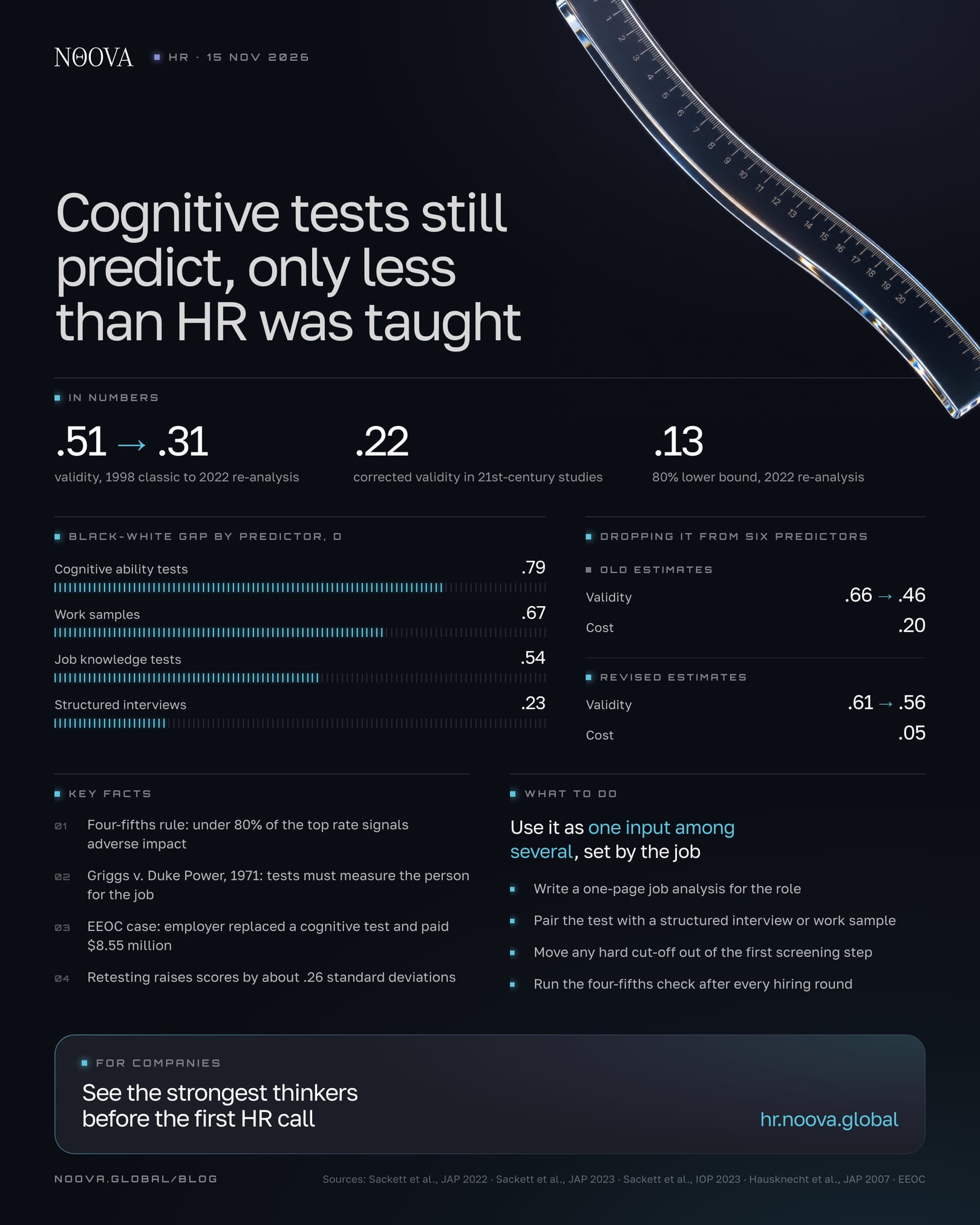
A cognitive ability test predicts job performance less than once thought: .31 in a 2022 re-analysis, down from the classic .51, and .22 in newer data.

A cognitive ability test measures how well someone reasons, learns and solves new problems, and it still predicts job performance, only less than HR was taught. The classic estimate was a validity of .51. A 2022 re-analysis by Sackett and colleagues cut it to .31, and a 2023 study of 21st-century data found .22. This guide is for people who hire: how these tests work, what the new numbers mean, where the legal risk sits, and how to use one well.
What a cognitive ability test measures
A cognitive ability test is a timed set of problems with right answers. Typical items ask you to complete a number series, spot the rule in a pattern of shapes, solve a word problem or draw a conclusion from a short text. The EEOC lists the usual targets as reasoning, memory, perceptual speed, arithmetic and reading comprehension.
Scores on these different item types correlate with each other. Psychologists call the shared part general cognitive ability, or general mental ability (GMA): roughly, how fast and accurately a person picks up new material and works with it. Most hiring tests report one overall score and sometimes subscores for verbal, numerical and abstract reasoning.
Two things a cognitive ability test does not measure: what a candidate already knows about the job, and how they behave when nobody is timing them. It captures maximum performance on a short, unfamiliar task. That is a real signal. It is also a narrow one.
How well cognitive ability tests predict job performance
Cognitive ability tests predict job performance moderately, at a validity of about .31 in the 2022 re-analysis, and the estimate has fallen twice in four years. For a generation, the reference point was a 1998 review by Schmidt and Hunter, which put the validity of cognitive ability tests at .51 and made them the centre of most selection advice. Validity here is a correlation between test scores and later job performance ratings, on a scale from 0 to 1.
In 2022 Sackett, Zhang, Berry and Lievens re-examined the corrections behind those numbers in the Journal of Applied Psychology. Meta-analyses adjust raw correlations for "range restriction": people who were hired already scored above the cut, so the observed correlation in that group understates the one in all applicants. Sackett's team found that the standard adjustments assumed far more restriction than the studies actually had. The result was systematic overcorrection.
Their revised figures for the main predictors:
- Structured interviews: .42 (was .51)
- Job knowledge tests: .40 (was .48)
- Work sample tests: .33 (was .54)
- Cognitive ability tests: .31 (was .51)
- Unstructured interviews: .19 (was .38)
The authors say directly that the drop for cognitive ability came mainly from the revised range-restriction estimate, not from new data. They also report the spread: an SD of .14 around the .31, so in some settings the validity is much lower.
Then came newer data. A 2023 meta-analysis by Sackett, Demeke, Bazian, Griebie, Priest and Kuncel used only 21st-century studies: 153 samples and 40,740 people. Their corrected validity for general cognitive ability was .22. The authors conclude that cognitive ability is related to job performance, at a smaller size than earlier estimates.

The validity debate is not settled
Not everyone accepts the lower number, and you should know the argument before you quote it. In the 2023 issue of Industrial and Organizational Psychology that discussed the re-analysis, several commentaries pushed back; one is titled "It takes more than meta-analysis to kill cognitive ability". The disagreement is about method, so expect the exact figure to keep moving.
Their own reading is measured. In their words, cognitive ability is "no longer the stand-out predictor that it was in the prior work". They also note it still matters for training outcomes and for maximum performance, the kind a person delivers when stakes are high and attention is full.
So a fair summary for a hiring manager: a cognitive ability test is a useful predictor of the middle rank, about as good as a work sample, clearly weaker than a structured interview, and far better than an unstructured chat.
Adverse impact: the cost of a cognitive ability test
The main risk of a cognitive ability test is adverse impact. That is the legal term for a selection step that screens out a protected group at a much higher rate, whatever anyone intended.
Cognitive ability tests have the largest group gap among the stronger predictors. In Sackett et al. (2022), the average Black-White difference is d = .79, meaning the group means sit about four-fifths of a standard deviation apart. For structured interviews the same figure is .23, for job knowledge tests .54, for work samples .67. The 2023 follow-up calls cognitive ability "the predictor with the largest White-Black mean difference".
This is the validity-diversity trade-off, and the new numbers change its arithmetic. In the authors' model of a six-predictor system, removing cognitive ability under the old estimates cost .20 of validity (from .66 to .46). Under the revised estimates it costs .05 (from .61 to .56). A test that once looked indispensable now buys much less, and the diversity cost stays the same.
Employment testing law: Griggs and the four-fifths rule
In the US the rules for employment tests go back to Griggs v. Duke Power Co. (1971). Duke Power required a high school diploma and two aptitude tests, one of which claimed to measure general intelligence. Neither had been shown to relate to the jobs, and both screened out Black applicants at far higher rates. The Supreme Court ruled against the company: tests must "measure the person for the job and not the person in the abstract". It named business necessity as the touchstone.
That logic now sits in three places you should know:
- The four-fifths rule. Under the Uniform Guidelines on Employee Selection Procedures, a selection rate for any race, sex or ethnic group below four-fifths of the rate for the highest group is generally treated as evidence of adverse impact. If 50% of one group passes your test and 35% of another does, the ratio is 70% and the flag goes up. The guidelines may not last: since October 16, 2026 the White House review office has had an EEOC final rule that rescinds the Uniform Guidelines, as we covered in EEO-1 reporting. Disparate impact liability stays in Title VII either way, so keep running the check.
- Job-relatedness. If a test has adverse impact, the EEOC expects you to show it is "job-related and consistent with business necessity", which means evaluating skills "as related to the particular job in question", not general ability for its own sake.
- Less discriminatory alternatives. Even a valid test can lose if an alternative predicts as well with less adverse impact. In one EEOC case, a written cognitive test of verbal, numerical and spatial reasoning used for apprenticeships kept excluding Black applicants despite a 1991 validation. The employer replaced it and paid $8.55 million.
Disability law adds one more duty. Tests must measure the skill, not the impairment, and you must provide reasonable accommodation. The EEOC page cites a case where applicants with learning disabilities needed a reader or an audio version of a hiring test.
Outside the US the detail differs, but the principle of job-relatedness travels well. If you cannot explain why the job needs the ability your test measures, you are exposed.
How to use a cognitive ability test well
Use a cognitive ability test as one input among several, set by the job and checked on your own applicants. Five practices follow from the research above.
Start with a job analysis. Write down which tasks require learning new material quickly or reasoning through unfamiliar problems. That document is your answer to "why this test" from a candidate, a works council or a regulator.
Combine it with job-specific measures. Sackett's team found that composites still reach high validity: across combinations of one to five predictors, the average was .47 with the revised numbers against .51 with the old ones. A structured interview and a work sample test bring validity with less adverse impact, so the cognitive ability test can carry a smaller weight.
Avoid a hard cut-off early in the funnel. A strict pass mark on the first step applies the full group gap to everyone who follows. Weighting the score inside a composite, later in the process, is gentler and keeps information from other measures in play.
Watch your own numbers. Track pass rates by group at every step and run the four-fifths check. Sackett's team also recommend comparing predictors on the low end of their credibility intervals as well as on the mean. For cognitive ability tests the 80% lower bound in the 2022 re-analysis is .13.
Set a retest policy and use parallel forms. According to Hausknecht and colleagues, 25-50% of applicants in some settings get retested. Their meta-analysis of 50 studies, 107 samples and 134,436 people found scores rise by about .26 standard deviations on a retest. The gain was larger with coaching and when the same form was used again.
How candidates react to ability testing
Candidates rate cognitive ability tests as middling on fairness. A SIOP white paper summarising the research reports that a meta-analysis across 17 countries grouped methods into three tiers. Interviews and work samples came out highest. Cognitive tests sat in the middle with résumés, references and personality inventories. The same pattern held across cultures.
The fix is mostly communication. The paper's list of what candidates want includes an explanation of the method, a chance to show what they know, job-related content, and timely, informative feedback. Telling a candidate why the role needs fast reasoning, and what the score will and will not be used for, costs one paragraph.
A test score also leaves out how a person thinks about their own thinking. Whether they notice an error, doubt the right assumption, or change strategy is metacognition, and a 20-minute timed test rarely shows it. Some teams now look at reasoning in conversation instead. NOOVA HR, for example, runs a 20-minute voice dialogue instead of hours of tests, and a person always makes the decision.
A checklist for using a cognitive ability test this quarter
- Write a one-page job analysis naming the tasks that need fast learning or new reasoning.
- Ask your test provider for validity evidence for jobs like yours, not a single headline coefficient.
- Pair the test with a structured interview or a work sample and give it a modest weight.
- Move any hard cut-off out of the first screening step.
- Run the four-fifths check on pass rates by group after every hiring round.
- Offer accommodations by default and say how to request them in the invitation.
- Set a written retest rule with a waiting period and a parallel form.
- Tell every candidate why the test is used and what happens with the score.
Sources
- Revisiting meta-analytic estimates of validity in personnel selection, Sackett, Zhang, Berry and Lievens, Journal of Applied Psychology, 2022
- A Contemporary Look at the Relationship Between General Cognitive Ability and Job Performance, Sackett et al., Journal of Applied Psychology, 2023
- Revisiting the design of selection systems in light of new findings regarding the validity of widely used predictors, Sackett et al., Industrial and Organizational Psychology, 2023
- Retesting in Selection: A Meta-Analysis of Practice Effects for Tests of Cognitive Ability, Hausknecht et al., Journal of Applied Psychology, 2007
- Employment Tests and Selection Procedures, U.S. Equal Employment Opportunity Commission
- 29 CFR 1607.4, Uniform Guidelines on Employee Selection Procedures, Legal Information Institute
- EO 12866 review: Rescission of Uniform Guidelines on Employee Selection Procedures, RIN 3046-AB43, received 16 October 2026, OIRA
- Griggs v. Duke Power Co., 401 U.S. 424 (1971), Legal Information Institute
- What We Know about Applicant Reactions on Attitudes and Behavior, Bauer et al., SIOP White Paper Series, 2012
- It takes more than meta-analysis to kill cognitive ability, Kulikowski, Industrial and Organizational Psychology, 2023


