Interview Questions to Ask Candidates, Sorted by What Each One Measures
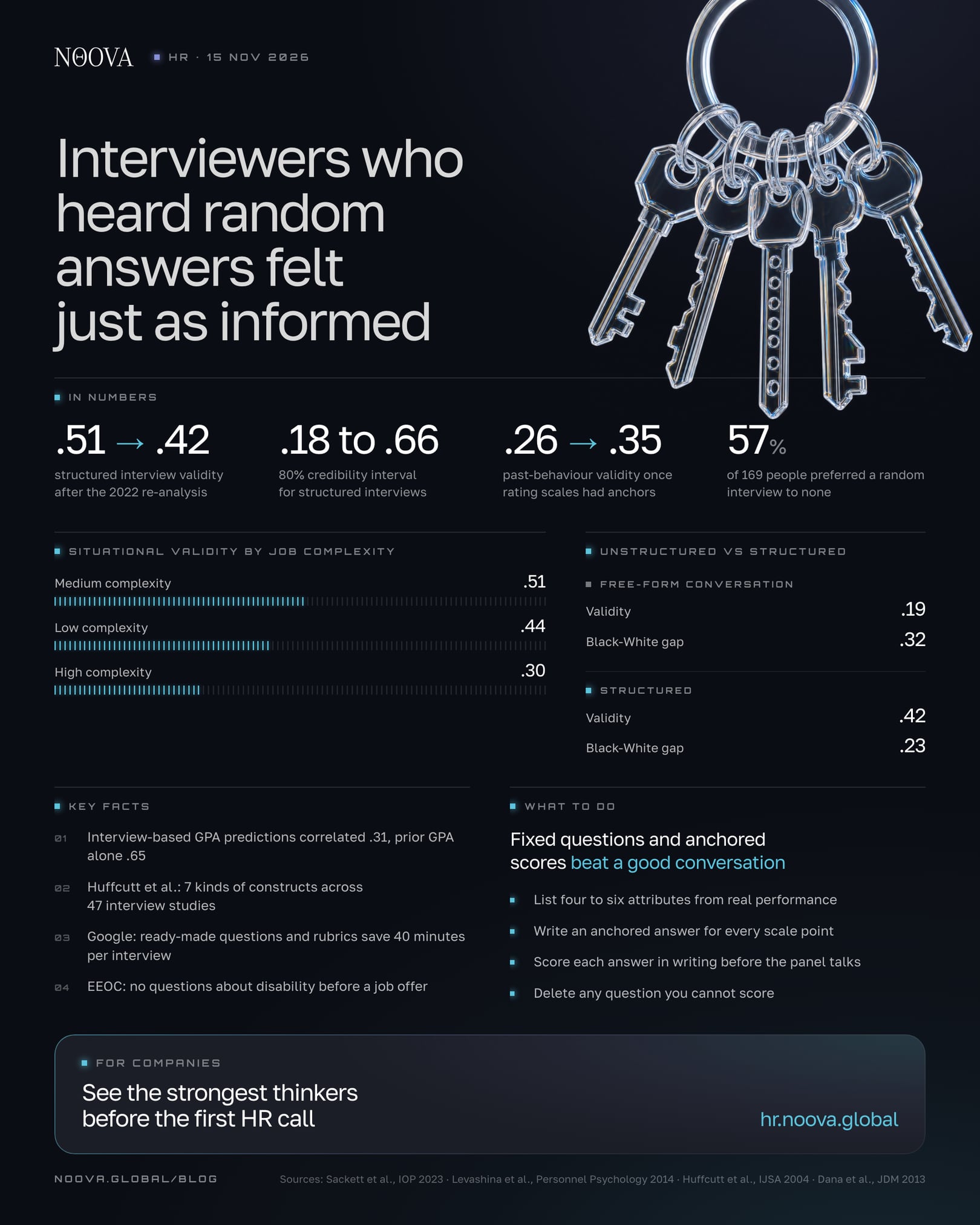
Good interview questions to ask candidates are set in advance and scored on anchors. Built that way, interviews predict job performance at .42, not .19.

The best interview questions to ask candidates are written before the interview, asked of everyone in the same order, and scored against anchored example answers. Built that way, interviews reach a mean validity of .42 for job performance in the largest recent re-analysis, against .19 for a free-form conversation (Sackett, Zhang, Berry and Lievens, 2023). Validity here is the correlation between the interview score and later performance on the job: 0 means no prediction, 1 means perfect. This guide is for the interviewer. It sorts questions by what each one measures, shows how to follow up without losing the structure, and how to score what you hear.
Interview questions to ask candidates start from what you need to measure
Write the attributes first and the questions second. A question is only good relative to something the job requires, so a list of "great interview questions" copied from elsewhere measures whatever its author had in mind.
The interview is a method, not a test of one thing. Huffcutt and colleagues (2001) coded 338 ratings from 47 real interview studies and built a taxonomy of 7 kinds of constructs an interview can assess. Interviewers rated basic personality and applied social skills most often, then mental capability, then job knowledge and skills. The authors suggest structured interviews predict better partly because they aim at the constructs more closely tied to performance.
The US Office of Personnel Management builds questions from job analysis and from critical incidents: real examples of notably good or bad performance in the role. Google's structured interviewing guide starts the same way, with a short list of attributes such as role-related knowledge, problem solving and leadership.
Once you have four to six attributes, pick the question type that measures each one best:
- Past-behaviour questions ("Tell me about a time...") show what the person has done. A review by Levashina and colleagues (2014) found they mainly capture experience and some personality facets.
- Situational questions ("Imagine that...") show how the person reasons about a job problem. The same review found they mainly capture job knowledge or cognitive ability.
- Job knowledge questions and work samples show whether the person can do the technical part. For hands-on tasks, a work sample test usually tells you more than any question.
Why the same questions beat a good conversation
A conversation feels more informative than a script, and the data says the feeling misleads. The 2022 re-analysis by Sackett and colleagues corrected an error in how earlier meta-analyses adjusted for range restriction. Almost every predictor lost validity. Structured interviews dropped from .51 to .42 and still came first of all common selection methods. Unstructured interviews fell from .38 to .19, below contextualised personality measures.
The spread matters as much as the mean. The 80% credibility interval for structured interviews runs from .18 to .66. The authors write that the validity should be read as ".42, plus or minus .24". Two companies can both say they run structured interviews and get very different results, depending on how well they built them.
Structure also narrowed group gaps in their table. The standardised Black-White difference in scores was .23 for structured interviews and .32 for unstructured ones.
The most uncomfortable evidence comes from Dana, Dawes and Peterson (2013). In their first study, 76 students interviewed a peer and then predicted the peer's grade point average, with the prior GPA in front of them. In one condition the interviewee secretly answered at random after a break. The interviewers' predictions correlated with actual grades at .31, against .65 for the prior GPA alone. Interviewers who heard random answers rated the interview as at least as informative as those who heard true ones. In a later study, 57% of 169 people preferred a random interview to no interview at all.
Interviewers make sense of almost anything. Fixed questions and anchored scores are the guard against that talent.

Past-behaviour questions to ask candidates
Past-behaviour questions should carry most of the weight for experienced and senior hires. OPM notes that behaviour description interviews have shown higher validity for complex professional and managerial jobs, and the meta-analytic data agrees.
Huffcutt, Roth, Conway and Klehe (2004) analysed 54 studies with 5,536 people. Past-behaviour interviews held steady across job levels, at .48 to .51 corrected validity. Situational interviews did well for low and medium complexity jobs (.44 and .51) but dropped to .30 for high-complexity jobs such as managers, physicians and engineers. That high-complexity cell rested on only six studies, so treat it as a strong hint rather than a law.
Examples by what they measure:
- Problem solving: "Tell me about the hardest analytical problem you solved in the last year. What did you try first, and what made you change course?"
- Judgement with incomplete data: "Describe a decision you made before you had all the facts. What did you know, what did you assume, and how did it turn out?"
- Learning from error: "Tell me about a call you got wrong. When did you notice, and what do you do differently now?" This one probes metacognition, the ability to monitor your own thinking.
- Disagreement: "Tell me about a time you disagreed with your team on the approach. What did you do?" Levashina and colleagues use a question like this as an example for measuring agreeableness.
- Ownership: "Walk me through a project that slipped. What was your part in it?"
- Influence: "Tell me about a time you changed the mind of someone more senior. How did you do it?"
Each question asks for one specific episode, not a habit. "How do you usually handle conflict" invites a theory of yourself; "tell me about a time" asks for evidence. For a full bank by competency and the STAR format, see our guide to behavioral interview questions.
Situational questions: what the candidate would do next
Situational questions describe a realistic dilemma from the job and ask what the candidate would do. They suit people with little directly relevant history, such as graduates or career changers, because they do not depend on having lived the situation.
Their validity is real but a little lower on average. In Taylor and Small's 2002 meta-analysis, as summarised by Levashina and colleagues, the mean uncorrected validity was .25 for situational and .31 for past-behaviour questions. Interrater reliability was almost the same, at .79 and .76. One primary study they cite (Klehe and Latham, 2006) adds a twist: situational questions predicted maximum performance, what someone can do when trying hard, while past-behaviour questions predicted only typical performance.
Good situational questions have a real tension in them, with no answer that is obviously right. Three examples:
"You find out two days before launch that a number in the client deck is wrong, and your manager is on a plane. What do you do?"
"Two senior colleagues give you opposite instructions on the same task. Walk me through your next hour."
"Your first analysis supports the decision everyone already wants. What would you check before sending it?"
The last one rewards a candidate who looks for disconfirming evidence, which is hard to fake on the spot. More examples and scoring guides are in our post on situational interview questions.
Follow-up questions without breaking the structure
Plan your follow-ups in advance and ask the same ones of everyone. Unlimited probing gives each interviewer a different interview to score.
Campion and colleagues (1997) described four levels of control over probing: none allowed, limited or preplanned, unlimited, and no guidance. When Levashina and colleagues analysed 14 recent studies, limited probing appeared as often as no probing at all. They note that interviewer agreement was higher when probing was not allowed in an early study, and that probing increased faking in another. Their open proposition is that planned probing helps validity more than both extremes, but the research on it is still thin.
In practice, write two or three probes under each question. Google's guide does the same: each question has an opening prompt and predetermined follow-ups that test the candidate's reasoning. Probes that work for most questions:
"What exactly did you do, as opposed to the team?" "What was the result, in numbers if you have them?" "What would you do differently now?"
Probes that ask for specifics and verification also make inflated stories harder to sustain. Levashina and colleagues propose exactly that, though as a hypothesis to test rather than a settled finding.
How to score candidates' answers with anchored rating scales
Score each answer on its own, right after you hear it, on a scale where every point has a written example.
Anchored rating scales describe what a weak, adequate and strong answer sounds like for each question. In Taylor and Small's analysis of 19 past-behaviour interview studies, interviews with anchors reached a validity of .35 and interrater reliability of .77, against .26 and .73 without them. A study by Reilly and colleagues (2006), also reviewed by Levashina, found that a five-point scale with every point anchored resisted disability bias better than one anchored only at the ends.
Google's rubrics use four levels (poor, borderline, solid, outstanding) with an illustrative answer for each. For the "call you got wrong" question, a poor answer names no real mistake or blames others. A borderline one names a mistake but no change. A solid one names the mistake, when it was noticed and a concrete change. An outstanding one also explains what signal was missed and how the person now watches for it.
Three habits protect the scores. Take notes on what the candidate said, not on your impression. Rate independently before any discussion; OPM's panels rate individually and then meet to resolve large gaps. And do not talk about candidates between interviews, one of the 15 components of structure in Campion's framework.
Structure pays for itself. Google reports that ready-made questions and rubrics save on average 40 minutes per interview, and that rejected candidates who had a structured interview were 35% happier than those who did not. These figures come from Google's own guide, not from a peer-reviewed study.
Interview questions to stop asking candidates
Drop any question you cannot score. If there is no anchor for a good answer, the question measures rapport, and rapport is where the bias in the Dana study lives.
Drop questions about protected characteristics. The EEOC states that employers are explicitly prohibited from asking about disability before a job offer, and advises that questions which could reveal race, religion, national origin or age should generally be avoided. "Where are you from originally" and "when did you graduate" fall into that zone even when meant kindly.
Use "tell me about yourself" as a warm-up, not a scored item. Then move to the script.
If you hire for middle and senior roles and want a read on how candidates reason before you spend panel time, NOOVA HR runs a 20-minute voice dialogue that shows the strongest thinkers before the first HR call. A person still makes every decision.
A checklist for writing your interview questions this week
- List four to six attributes the role needs, taken from real examples of good and bad performance.
- Write one past-behaviour or situational question per attribute, favouring past behaviour for senior roles.
- Add two or three planned follow-up probes under each question.
- Write an anchored example answer for every point on a four- or five-point scale.
- Ask every candidate the same questions in the same order.
- Score each answer independently and in writing before the panel discusses anyone.
- Delete any question you cannot score or that touches a protected characteristic.
Sources
- Revisiting the design of selection systems in light of new findings regarding the validity of widely used predictors, Sackett, Zhang, Berry and Lievens, Industrial and Organizational Psychology, 2023
- The Structured Employment Interview: Narrative and Quantitative Review of the Research Literature, Levashina, Hartwell, Morgeson and Campion, Personnel Psychology, 2014
- The impact of job complexity and study design on situational and behavior description interview validity, Huffcutt, Roth, Conway and Klehe, International Journal of Selection and Assessment, 2004
- Identification and Meta-analytic Assessment of Psychological Constructs Measured in Employment Interviews, Huffcutt, Roth, Conway and Stone, Journal of Applied Psychology, 2001
- Belief in the unstructured interview: The persistence of an illusion, Dana, Dawes and Peterson, Judgment and Decision Making, 2013
- Structured Interviews, US Office of Personnel Management
- A guide to structured interviewing for better hiring practices, Google re:Work
- Prohibited Employment Policies/Practices, US Equal Employment Opportunity Commission


