Work Sample Test: What It Is, How Well It Predicts and How to Build One
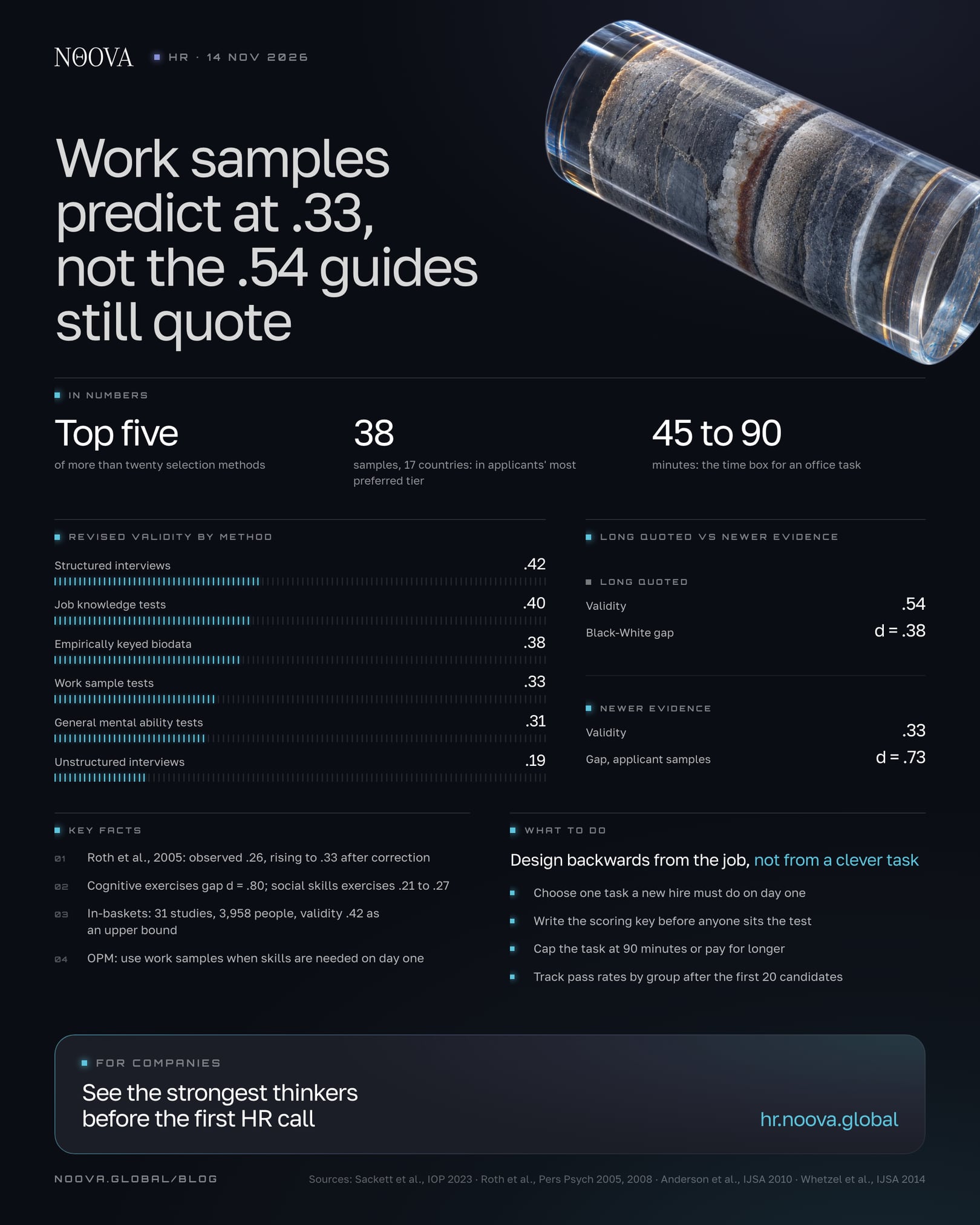
A work sample test has candidates do a slice of the real job. Its validity is about .33 in the latest meta-analytic revision, among the top five methods.

A work sample test asks a candidate to do a small, real piece of the job under standard conditions, then scores the result against a fixed key. It is one of the better tools you can use: in the most recent large revision of selection research, Sackett and colleagues put its validity at .33, in the top five of more than twenty methods. That is lower than the .54 most hiring guides still quote. This guide explains what a work sample test is, what the old and new evidence says, how to design and score one, and where it can go wrong on fairness.
What a work sample test is
A work sample test is a structured exercise that copies the tasks of the job closely enough that doing the test well means doing the work well. The US Office of Personnel Management describes work samples as tests where applicants perform tasks or work activities that mirror what employees do on the job.
The classic examples were manual. Early work samples tested carpentry, welding or electrical work. Office versions came later: role plays with a trained actor, in-basket exercises, writing tasks, data cleaning, a short analysis with a memo at the end. An in-basket is a simulated inbox of memos, emails and a calendar, and the candidate decides what to do with each item.
Researchers call this the "sample" approach to selection, as opposed to the "sign" approach. A sign test measures a trait you believe predicts the job, such as reasoning ability or conscientiousness. A sample test skips the inference and watches the behaviour itself.
Two families are worth separating. A summary from the Quality Improvement Center for Workforce Development distinguishes general work samples, for people who already have the skills, from trainability tests, where the candidate first gets a short lesson and is then tested on what they picked up. If your new hires will be trained for months, the second kind is the honest one.
Work sample test validity: the old number and the new one
Validity here means the correlation between test scores and later job performance, usually supervisor ratings. For decades the headline figure for work samples was .54, the highest of any method in Schmidt and Hunter's 1998 review of 85 years of selection research. The number came with a story: if you want to know whether someone can do the job, watch them do it.
The first correction came in 2005. Roth, Bobko and McFarland went back to the classic studies and found the older narrative review behind the high figure "plagued by many methodological problems". After pooling all the usable data, the observed correlation between work samples and job performance was .26. Corrected for the unreliability of performance ratings, it rose to .33, roughly a third below the figure the field had relied on.
The second correction was broader. In 2022 Sackett, Zhang, Berry and Lievens showed that earlier meta-analyses had overcorrected for range restriction, a statistical adjustment for the fact that you only see the job performance of people who were hired. In their 2023 follow-up they list the revised figures side by side with the old ones. For work samples the drop was .21, from .54 to .33.
So two independent routes land on about .33. That is a modest correlation in absolute terms. It is also a good one for hiring, where almost nothing predicts performance strongly.

How work samples compare with other hiring methods
Work samples are no longer the single best predictor, but they sit in the top group. In the revised table from Sackett and colleagues, the order at the top is:
- Structured interviews: .42
- Job knowledge tests: .40
- Empirically keyed biodata: .38
- Work sample tests: .33
- General mental ability tests: .31
- Unstructured interviews: .19
The authors draw one general lesson from the list. Methods built from a careful job analysis that sample job behaviour, directly as in a work sample or indirectly as in a structured interview, beat broad measures of psychological traits on average. If you are choosing between a generic test and an exercise built from your own job, the evidence leans toward the exercise. Our guide to structured interview questions covers the method at the top of the list.
Specific forms of work samples tell the same story. A systematic review of in-basket exercises%20In-basket%20validity.pdf) by Whetzel, Rotenberry and McDaniel (2014) pooled 31 studies and 3,958 people and found an operational validity of .42. That estimate uses the older range-restriction corrections, so read it as an upper bound. Two details from the same review are useful for design: generic and job-specific in-baskets predicted about equally well (.41 and .42), and objective and subjective scoring showed no meaningful difference.
There is one hard limit. Work samples measure what a person can already do. Sackett and colleagues note that they do not fit entry-level hiring where skills are learned after hire, and the OPM says the same: use them when applicants must have the competencies on day one.
How to design a work sample test in six steps
A good work sample test is designed backwards from the job, not forwards from a clever task. The steps below follow the logic of the US Uniform Guidelines on Employee Selection Procedures, which require that a content-valid procedure be "a representative sample" of the job's behaviours, based on a job analysis.
1. List the critical tasks. Ask two or three strong performers and their manager what the person does in a normal week and which tasks separate good from average. Write them down as observable actions: "reconciles a supplier statement", "writes the weekly risk note".
2. Pick one or two tasks that matter on day one. Choose tasks the new hire must do without training, that take a meaningful share of the job, and that someone can finish in a short session.
3. Build realistic materials. Use a cleaned version of real inputs: a messy spreadsheet, three customer emails, a draft contract. The closer the materials are to the job, the more the test tells you and the more candidates trust it.
4. Set a time box and say what is allowed. Aim for 45 to 90 minutes for an office task. Long unpaid take-home projects drive good candidates away and blur what you are measuring. If the task runs longer, pay for it.
5. Write the scoring key before anyone takes the test. Decide what a strong, adequate and weak answer looks like for each part. The next section covers how.
6. Pilot it on current staff. Run it with a few people already in the role. If your best performers do not score well, the test is measuring something other than the job.
As an example, for a finance operations analyst the critical task list might show that month-end reconciliation separates people more than anything else. The test becomes a 60-minute reconciliation of a seeded ledger with four planted errors, plus a five-line note to the controller. Each planted error is a scoring item, and the note is rated on a short anchored scale.
Scoring a work sample test so two raters agree
Scoring decides whether a work sample is a test or an impression. The OPM notes that assessors have to observe and sometimes rate performance, which brings back the problem the method was meant to avoid: two people seeing the same work differently.
Three habits keep scores consistent. Score the output against a checklist of things that must be present, such as errors found, steps taken or deadlines met, wherever the task allows it. Where judgement is unavoidable, use a rating scale with a short written example for each level, so "4" means the same to every rater. And have raters score independently before they talk, then discuss only large gaps.
Score each part separately before you form an overall view. A candidate who finds every error but writes an unreadable note is a different hire from one who writes a polished note about half the errors. Collapsing both into "good" throws that difference away.
Add a short debrief at the end. Ask the candidate to walk through what they did and which part they are least sure of. It shows how they reason about their own work, a skill researchers call metacognition, and it is hard to fake.
Fairness, adverse impact and the law
Work samples are often described as fair to everyone. The evidence is more mixed than that. The OPM page says that generally little or no difference is found between groups, while noting that it depends on what the test assesses. Applicants do like them: in a meta-analysis of 38 samples from 17 countries, Anderson, Salgado and Hulsheger placed work samples and interviews in the most preferred tier of ten selection methods.
Score gaps are another matter. Adverse impact means a selection method passes one group at a clearly lower rate than another, and in the US it can trigger a legal challenge. Roth, Bobko, McFarland and Buster (2008) found that the widely quoted Black-White difference on work samples, d = .38, was distorted by range restriction and by counting tests that were not really work samples. In job applicant samples the difference was d = .73. The revised table from Sackett and colleagues lists .67.
The same study shows where the gap comes from. Exercises that rated cognitive and job knowledge skills showed a mean difference of d = .80. Exercises that rated social skills showed .21 to .27. A work sample loaded with reading, calculation and recall behaves much like a cognitive test; our post on the cognitive ability test covers those trade-offs. One built around how a person handles a client, a colleague or a conflict behaves differently.
The legal point follows the same line. Under the Uniform Guidelines, a work sample can be defended by showing it is a representative sample of the job, but that content strategy is not appropriate for broad traits such as intelligence, judgment or leadership. Keep the test close to the actual work and keep the job analysis on file.
Work samples when candidates have AI
A take-home task now arrives with an AI assistant attached. If the job allows AI, that is fine: the work sample should allow it too, because that is what the job looks like. What changes is what you score. The draft is cheap; the choices around it are not.
Three adjustments help. Run the core part live or on a call, even for 20 minutes. Ask the candidate to explain one decision in the output and defend it against a simple counterexample. And score the judgement calls in the task, such as which error mattered most, rather than the polish of the text.
Some teams also look at reasoning before the work sample stage. NOOVA HR runs a 20-minute voice dialogue that shows how a candidate thinks before the first HR call, and a person always makes the decision. Used that way, a work sample confirms what someone can do, and a reasoning signal tells you who is worth that hour.
A checklist for building your first work sample test
- Ask two top performers which three tasks separate good from average in the role.
- Choose one task a new hire must do on day one without training.
- Build the materials from cleaned real inputs, not invented puzzles.
- Write a scoring key with an example answer for each rating level before anyone sits the test.
- Pilot the test on three current employees and check that your best people score well.
- Cap the task at 90 minutes, or pay candidates for anything longer.
- Add a 10-minute debrief where the candidate explains one decision and their least certain step.
- Track pass rates by group after the first 20 candidates and review the task if a gap appears.
Sources
- Revisiting the design of selection systems in light of new findings regarding the validity of widely used predictors, Sackett, Zhang, Berry and Lievens, Industrial and Organizational Psychology, 2023
- A meta-analysis of work sample test validity: Updating and integrating some classic literature, Roth, Bobko and McFarland, Personnel Psychology, 2005
- Work sample tests in personnel selection: A meta-analysis of Black-White differences in overall and exercise scores, Roth, Bobko, McFarland and Buster, Personnel Psychology, 2008
- Applicant reactions in selection: Comprehensive meta-analysis into reaction generalization versus situational specificity, Anderson, Salgado and Hulsheger, International Journal of Selection and Assessment, 2010
- In-basket validity: A systematic review, Whetzel, Rotenberry and McDaniel, International Journal of Selection and Assessment, 2014%20In-basket%20validity.pdf)
- Work Samples and Simulations, US Office of Personnel Management
- 29 CFR 1607.14, Uniform Guidelines on Employee Selection Procedures, technical standards for validity studies, Cornell Legal Information Institute
- Umbrella summary: Work sample tests, Thompson and Paul, Quality Improvement Center for Workforce Development, 2020


