AI Interview: What It Is, What Gets Scored and Which Laws Apply
An AI interview is a job interview that software runs or scores. In a field test of 70,884 applications, AI voice interviews made offers 12% more likely.

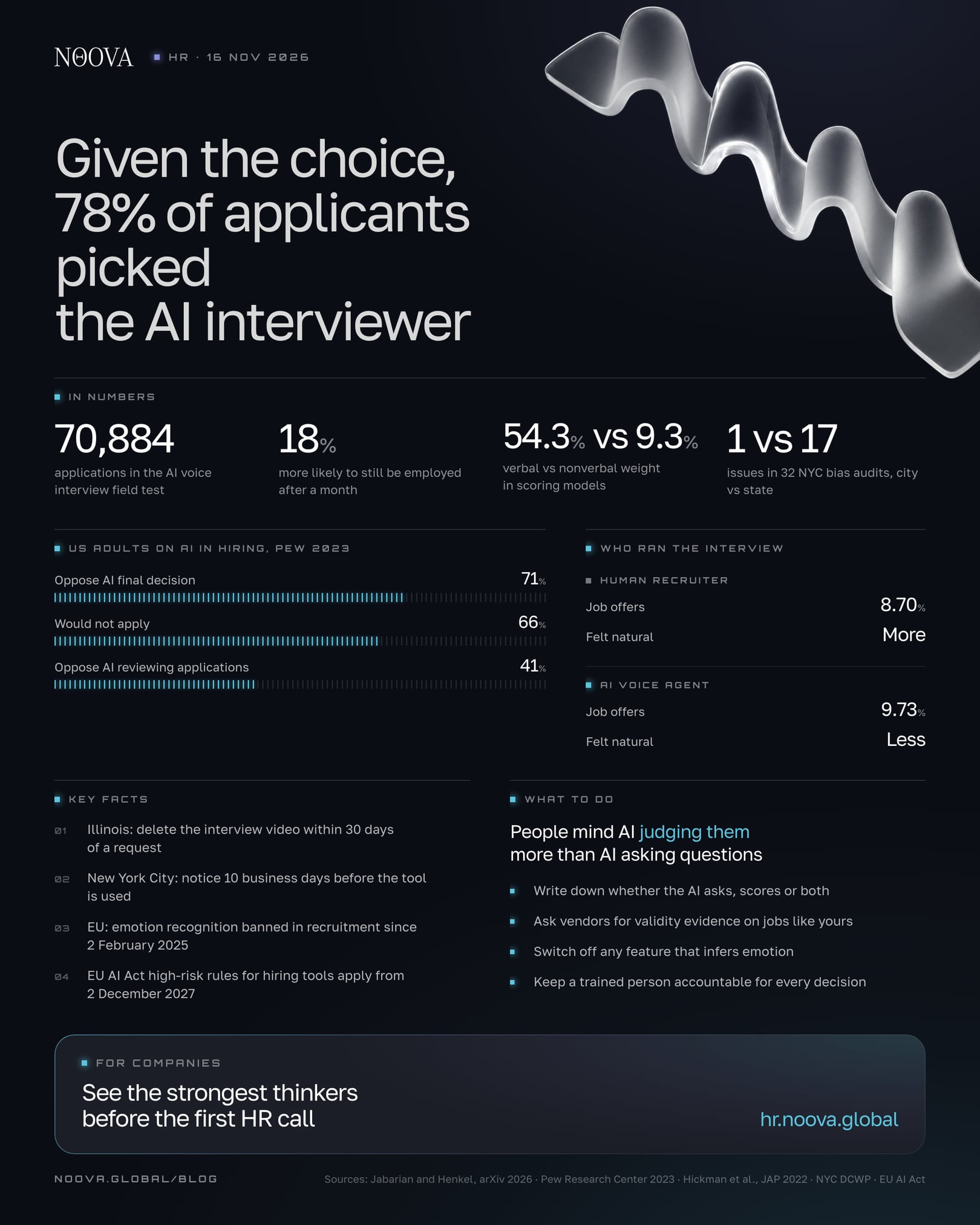
An AI interview is a job interview in which software asks the questions, scores the answers, or does both, usually before anyone at the company talks to you. In a field experiment with 70,884 applications for customer service jobs in the Philippines, applicants interviewed by an AI voice agent were 12% more likely to receive a job offer than those interviewed by recruiters. Surveys point the other way: 66% of US adults say they would not want to apply to an employer that uses AI to help decide who gets hired. This guide covers the formats, what gets scored and what should not be, what research says about validity and candidate reactions, and the rules in Illinois, New York City and the EU, from both sides of the screen.
What an AI interview is: software that asks, scores or both
Every interview does two jobs: it collects information about the candidate and judges it. An AI interview hands one or both jobs to software, and which one matters more than the label.
There are three common set-ups. An AI agent asks and a recruiter judges, as in the experiment above. People write the questions, the candidate records answers, and a model scores them: the classic automated video interview. Or software both asks and scores, and the recruiter sees a ranked list.
The rules attach mostly to judging. New York City's law covers tools that "substantially assist or replace discretionary decision-making", in the words of the city's FAQ; Illinois regulates AI analysis of recorded video interviews. So the first question for candidates and employers is the same: which job is the software doing?
The three AI interview formats: video, chat and voice
AI interviews come in three formats, which differ in how live they feel.
- One-way video. Questions appear on screen, a timer runs, and you record each answer. Nobody is there in real time. The employer sets the preparation time, the answer length and whether you may re-record.
- Chat. A text conversation with a chatbot that usually handles screening questions (availability, location, licenses, experience) and scheduling, sometimes with open questions scored later.
- Voice. A live spoken conversation with an AI agent by phone or in the browser. It follows an interview guide but can ask follow-up questions in the moment.
A fourth set-up looks ordinary: a person interviews you while software drafts a score.
Voice is the newest format, and the one with a large randomized field test behind it. In the 70,884-application study, the AI agent and the recruiters used the same interview guide. Transcripts showed that the AI kept closer to the topic order, covered a more consistent number of topics and used more standardized wording, while still asking follow-ups. The authors, Brian Jabarian and Luca Henkel, call this "controlled variance".

What gets scored in an AI interview, and what does not
An AI interview can score three layers: what you say, how your voice sounds, and what your face does. Researchers call them verbal, paraverbal (pitch, loudness, speech rate) and nonverbal behavior.
One of the most detailed independent tests is by Hickman and colleagues in the Journal of Applied Psychology (2022). They built models that scored Big Five personality traits from mock video interviews of 1,073 people in three samples, plus 99 people interviewed twice to check reliability.
The target a model learns to copy decides whether it works. Models trained on people's self-reported personality showed little evidence of reliability or validity. Models trained on interviewers' ratings did better, with consistent relations to other measures, though their reliability was mixed. Words carried most of the signal: in the conscientiousness models, verbal behavior took 54.3% of the regression weights and nonverbal behavior 9.3%. Job performance and group differences were not tested, and a SIOP research brief repeats the authors' advice to proceed cautiously.
The law now settles part of what must not be scored. The EU AI Act has prohibited AI that infers emotions in the workplace since 2 February 2025, except for medical or safety reasons, and the European Commission's guidelines on prohibited practices state plainly that using emotion recognition during the recruitment process is prohibited. Illinois requires employers to explain what general types of characteristics the AI uses, and New York City's notice must name the qualifications and characteristics the tool will assess.
What research says about AI interview validity
Validity is how well scores predict what the employer cares about, usually job performance. For AI interviews the answer has two parts: the structure is well supported, the scoring layer much less so.
An AI interview asks every candidate the same job-related questions in the same order, which is the core of a structured interview. In the 2022 revision by Sackett, Zhang, Berry and Lievens, structured interviews had the highest mean validity of any selection method, .42, with a wide spread around it. Our guide to structured interview questions explains why structure helps.
The field evidence for AI asking the questions is recent and promising. In the Jabarian and Henkel experiment, applicants assigned to the AI voice agent got offers in 9.73% of cases, against 8.70% with human recruiters. They were 18% more likely to start the job and 18% more likely to still be employed after a month, and the measured productivity of hires did not differ. Recruiters made every decision. The limits: one recruitment firm, entry-level jobs in one country, a working paper, and one author later took an unpaid role at the partner firm, as the paper discloses.
The scoring layer has thinner public evidence. When Raghavan, Barocas, Kleinberg and Levy reviewed 18 vendors of algorithmic pre-employment assessments in 2019, six offered video interview analysis. The vendors' websites generally did not make clear whether or how they validated their models, and only 7 explicitly discussed compliance or adverse impact, meaning lower pass rates for a protected group. The question for an employer is the same today: show me the evidence for jobs like mine.
How candidates react to being interviewed by software
Candidates tend to dislike AI interviews in surveys and lab studies, yet in a large field test most of them chose one.
A meta-analysis by Blacksmith, Willford and Behrend (2016) pooled 12 studies with 1,557 people and found that technology-mediated interviews drew lower interviewer ratings (d = -.41) and lower applicant reactions (d = -.36) than face-to-face ones, all before modern AI. In a pre-registered experiment by Langer, König and Papathanasiou (2019), 123 participants watched either a highly automated or a videoconference interview. The automated one lowered acceptance through less social presence and lower perceived fairness.
In the Pew Research Center survey, 66% of US adults would not want to apply to an employer that uses AI to help make hiring decisions, and 71% opposed AI making the final decision. Opposition to AI reviewing applications was lower, at 41%, and 47% thought AI would be better than people at treating all applicants the same way.
The field data is gentler. In the Philippines experiment, 78% of applicants offered a choice picked the AI interviewer. Their likelihood of recommending the firm was almost identical across groups, though they rated the AI interview as less natural, and those who chose the AI had lower language and analytical scores.
Our reading: people mind software judging them more than software asking them questions, especially when nobody explains the judging. That is also where the law focuses.
AI interview laws: Illinois, New York City and the EU
Three rule sets matter most for AI interviews today. Illinois regulates AI analysis of video interviews, New York City requires bias audits and advance notice, and the EU treats AI that evaluates candidates as high-risk and bans emotion recognition. Other US states are adding rules; we covered Connecticut's AI hiring law separately.
Illinois: consent before the camera
The Artificial Intelligence Video Interview Act, in force since 2020, applies when an employer asks applicants to record video interviews and uses AI to analyze them. Before the interview, the employer must tell each applicant that AI may be used, explain how it works and what general types of characteristics it uses, and get consent; AI may not evaluate anyone who has not consented. The employer may share videos only with people whose expertise or technology the evaluation needs. On request, the employer must delete the video within 30 days and have everyone who received copies delete them too, backups included.
Employers that rely solely on AI analysis to decide who gets an in-person interview must also report demographic data on applicants who did and did not advance, and on those hired, to the state's Department of Commerce and Economic Opportunity each year. In its June 2026 report, the department said it received no such data for the 12 months ending November 30, 2025.
Since January 1, 2026, a separate amendment to the Illinois Human Rights Act makes it a civil rights violation to use AI in ways that discriminate in hiring and other employment decisions, even unintentionally, and requires notice when AI is used for those purposes.
New York City: a bias audit and 10 business days' notice
Local Law 144, enforced since July 5, 2023, bars employers from using an automated employment decision tool unless it had a bias audit within one year before use. Per the city's FAQ, an independent auditor must calculate selection or scoring rates and impact ratios by sex, race and ethnicity, and their intersections, and a summary of the results must be public. Candidates who live in the city must get notice 10 business days before the employer uses the tool, naming the qualifications and characteristics it will assess and explaining how to request a reasonable accommodation.
Enforcement has been weak so far. A December 2025 audit by the New York State Comptroller, summarized by DLA Piper, found that the city agency identified 1 compliance issue in 32 published bias audits, where the state auditors found at least 17 potential issues, and that 75% of test calls about the law to the 311 hotline were misrouted. Penalties run up to $1,500 per violation per day.
EU AI Act: high-risk, with emotion recognition banned
The EU AI Act lists AI systems used for recruitment or selection as high-risk, naming those used "to analyse and filter job applications, and to evaluate candidates" in Annex III. Employers that use such systems must assign human oversight to people with the competence, training and authority to exercise it, and must tell the people affected that a high-risk system is being used on them, under Article 26.
The start date moved in 2026. A simplification package given final approval by the Council on 29 June 2026 applies the high-risk rules to stand-alone systems, hiring tools included, from 2 December 2027. Slovenia's regulator notes that the amending regulation entered into force on 27 July 2026. The ban on emotion recognition did not move: it has applied since 2 February 2025.
The candidate's side: what you can ask and refuse
Before you press record, you can ask what is scored, who decides, and how long the recording is kept. Where the laws above apply, the employer has to answer part of that in writing.
In Illinois, AI may not evaluate your video without your consent, and you can ask the employer to delete the video. In New York City, the notice must arrive 10 business days ahead and tell you how to ask for an accommodation. In the EU, emotion recognition is already banned from recruitment, and from 2 December 2027 employers must tell you when they use a high-risk system on you.
If you have a disability, a speech difference or an unreliable connection, ask for an accommodation or another route early and in writing. Our guide to AI interview practice covers how these interviews run and how to practice without tricks.
The employer's side: what to check before you buy
An employer adding an AI interview should buy evidence rather than a demo, and keep a person accountable for each decision.
Start from the job: questions drawn from a job analysis, the same for everyone. Then ask the vendor what exactly is scored, what the model was trained to predict, and what validity evidence exists for jobs like yours; Hickman's results show that a model trained on the wrong target can look sophisticated and predict little. Ask whether any feature infers emotion from the face or voice, and switch it off before you assess anyone in the EU.
Check outcomes by group at every stage. US practice uses the four-fifths rule: if one group's selection rate is below four-fifths of the highest group's rate, the employer may be at risk, as Raghavan and colleagues put it. Our guide to pre-employment tests explains the arithmetic, and the evidence on hiring bias shows why good intentions do not settle it. Responsibility stays with you: New York's FAQ puts the duty to have a bias audit done on the employer, not the vendor, and Mobley v Workday shows that a vendor can end up in court too.
Write the notice before you need it: what is scored, who decides, how long recordings are kept, how to ask for an accommodation. In the Philippines experiment the AI collected information, people decided, and the paper found no evidence of applicant backlash. NOOVA HR follows the same split: a 20-minute AI voice dialogue shows the strongest thinkers before the first HR call, with no automated verdicts, and a person always decides.
A checklist for employers and candidates facing an AI interview
- Write down which job the AI does in your process: asking, scoring or both.
- Ask the vendor for validity evidence on jobs like yours and for the list of scored features.
- Switch off any feature that infers emotion from a face or a voice.
- Compare selection rates by sex, race and ethnicity at every stage against the four-fifths rule.
- Send candidates a plain notice of what is scored, who decides and how to ask for another route.
- Delete recordings on request within 30 days and set a default retention period.
- Keep a trained person accountable for every advance or reject decision.
- Ask, as a candidate, what is scored and who decides before you press record.
Sources
- Voice AI in Firms: A Natural Field Experiment on Automated Job Interviews, Jabarian and Henkel, arXiv, 2026
- AI in Hiring and Evaluating Workers: What Americans Think, Pew Research Center, 2023
- Automated Video Interview Personality Assessments: Reliability, Validity, and Generalizability Investigations, Hickman et al., Journal of Applied Psychology, 2022
- Research brief of Hickman et al.'s 2022 automated video interview personality assessments, SIOP
- Is cognitive ability the best predictor of job performance, SIOP TIP, on Sackett et al. (2022)
- Technology in the Employment Interview: A Meta-Analysis and Future Research Agenda, Blacksmith, Willford and Behrend, Personnel Assessment and Decisions, 2016
- Highly automated job interviews: Acceptance under the influence of stakes, Langer, König and Papathanasiou, International Journal of Selection and Assessment, 2019 (preprint)
- Mitigating Bias in Algorithmic Hiring: Evaluating Claims and Practices, Raghavan, Barocas, Kleinberg and Levy, arXiv, 2019
- Illinois Seeks to Impose Restrictions on the Use of Artificial Intelligence in Job Interviews, Hunton Andrews Kurth
- 2026 Artificial Intelligence Video Interview Act Report, Illinois Department of Commerce and Economic Opportunity
- Illinois Steps Up AI Regulation in Employment, Ogletree Deakins, 2024
- Automated Employment Decision Tools, NYC Department of Consumer and Worker Protection
- Automated Employment Decision Tools: Frequently Asked Questions, NYC DCWP, 2023
- Critical audit of NYC AI hiring law signals increased risk for employers, DLA Piper, 2026
- EU AI Act, Annex III: High-Risk AI Systems
- EU AI Act, Article 5: Prohibited AI Practices
- EU AI Act, Article 26: Obligations of Deployers of High-Risk AI Systems
- Commission publishes guidelines on prohibited AI practices defined by the AI Act, European Commission
- Artificial intelligence: Council gives final green light to simplify and streamline rules, Council of the EU via EEAS, 2026
- Digital Omnibus on Artificial Intelligence, AKOS (Slovenian regulator)


