AI Interview Practice: How to Prepare for an AI Interview
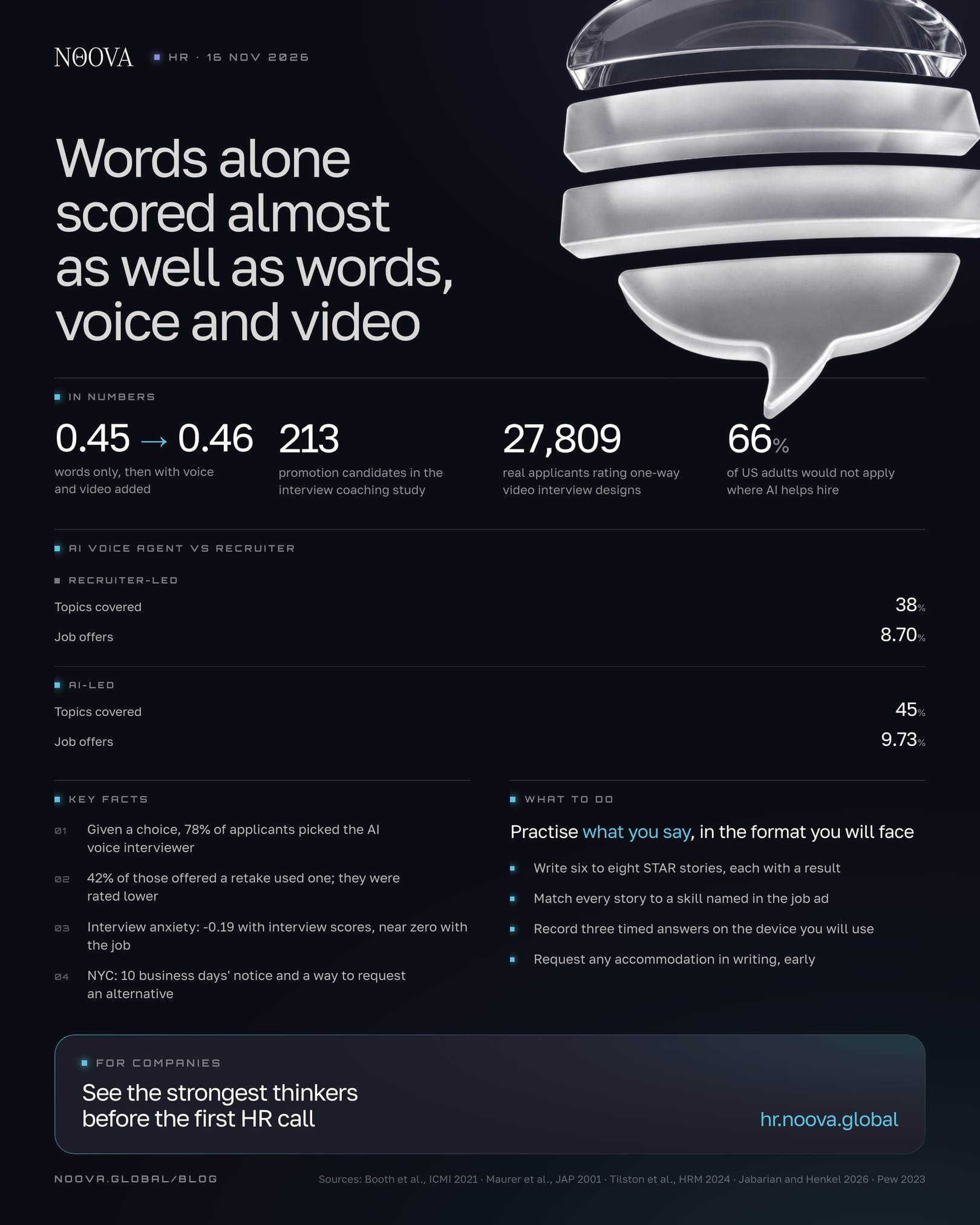
AI interview practice should train what you say. In a study of 733 video interviews, words alone predicted ratings almost as well as words, voice and video.

AI interview practice works best when it copies the real format and trains what the scoring leans on most: the content of your answers. In a study of 733 recorded mock interviews, a model that read only the candidates' words predicted trained raters' hireability scores almost exactly as well as one that also used their voice and video (Booth et al., 2021). Its rank correlation with the ratings was 0.45; adding sound and image lifted it to 0.46. This guide is for candidates with an AI interview coming up. It covers how the formats run, what gets scored, what helps by the evidence, a practice routine for the week before, and how to ask for an accommodation or an alternative.
How an AI interview runs
An AI interview is a screening step in which software asks the questions and records or transcribes your answers for scoring or review. It comes in three common formats, each with questions set in advance for the role. Our explainer on what an AI interview is covers the employer's side.
One-way video. Researchers call it an asynchronous video interview. A question appears on screen, a countdown gives you time to think, then the camera records for a fixed time. The employer sets the dials: preparation time, maximum answer length, number of questions, and whether you may re-record. Data from 27,809 real applicants at 33 companies in 11 countries showed that more preparation time and the option to re-record went with more favourable reactions, while more questions went with less favourable ones (Tilston et al., 2024).
Live voice. An AI agent talks with you by phone or in the browser, works through a list of topics and reacts to what you say. The largest test so far is a field experiment with 70,884 applications for entry-level customer service jobs in the Philippines (Jabarian and Henkel, 2026). Human recruiters read the interviews and made every hiring decision. AI-led interviews covered 45% of the target topics on average, against 38% for interviews led by recruiters, and ended in more job offers: 9.73% against 8.70%. Given a choice, 78% of applicants picked the AI, although they rated it as less natural. It is a working paper, not yet peer-reviewed.
Chat. A text conversation asks screening questions, and the advice below on answer content applies unchanged.
Some voice formats look at how you reason rather than at your job history. NOOVA HR, for example, runs a 20-minute AI voice dialogue that measures thinking, and a person always makes the decision.
What an AI interview scores, and what it does not
The safest assumption is that the substance of your answers carries most of the weight, and the research backs it. AI interviews borrow the logic of the structured interview: the same questions for everyone, with every response, in the words of the US Office of Personnel Management, "evaluated using the same rating scale and standards for acceptable answers". Structured interviews came out as the top-ranked selection procedure in the 2022 revision of the validity research by Sackett and colleagues. Our guide to structured interview questions shows how they look from the interviewer's chair.
When software does the scoring, words beat appearance. The Booth team trained models on three channels: verbal (the words), paraverbal (the sound of the voice) and visual. The voice and image channels did worse on their own. Combining them with the words bought almost no accuracy and, without extra safeguards, increased gender bias.
Claims about reading personality from video are weaker still. Hickman and colleagues (2022) built automated personality scores from 1,073 mock video interviews. Scores trained to match interviewers' judgements showed mixed reliability but consistent validity evidence. Scores trained to match people's own questionnaire answers showed little evidence of either. You cannot steer a model like that by acting a personality, and you do not need to.
The camera itself has a cost. A meta-analysis of 12 studies with 1,557 people found that interviews by phone or video drew lower ratings than face-to-face ones (d = -.41, a moderate gap measured in standard deviations) and less favourable reactions from applicants (d = -.36). That is a plain reason to rehearse in the medium you will face.

What helps in an AI interview, by the evidence
Three things have evidence behind them: organised answers, specific and honest examples, and sensible use of the format's settings.
In a study of 213 candidates for police and fire department promotions, attending a voluntary interview coaching session was linked to higher scores on a situational interview, after controlling for job knowledge and motivation (Maurer et al., 2001). Study groups and role-play predicted scores beyond the coaching. Part of the link ran through organisation: coaching and preparation went with strategies that organised the answers, and better-organised answers scored higher. The candidates chose whether to attend, so motivation may explain part of the effect.
The common tool for organising an answer about your past is STAR: situation, task, action, result. The Oregon Department of Consumer and Business Services adds three rules for candidates: describe one specific event, say "I" rather than "we", and state the results without waiting to be asked. Our behavioral interview questions guide shows the interviewer's side.
Honest self-promotion pays. In three experiments by Lukacik and Bourdage, stating your skills, credentials and achievements attractively and truthfully predicted higher ratings, while truthful accounts of past negative events went with lower ones. Spend the answer on what you did and what changed, not on what went wrong.
Preparation time and retakes help, but only a little. In the same experiments, 60 seconds of preparation instead of 20 and the option to re-record both raised ratings, with tiny effects (η² = 0.002 for preparation time, where 0 means no effect). Of the people offered a retake, 42% submitted at least one, and those who did received lower subjective performance ratings. Use a retake to fix a real failure, like a frozen screen, not to polish a decent answer.
An AI interview practice routine for the week before
Five short sessions are enough to make the format familiar. Each one copies a part of the real interview.
Day 1: read the invitation closely. Note the format, the number of questions, the preparation and answer limits, whether retakes are allowed, and the deadline. If a detail is missing, ask the recruiter. In New York City the notice must also list the qualifications and characteristics the tool will assess; elsewhere, the job ad usually names them.
Day 2: build a story bank. Write six to eight specific episodes from work, study or volunteering. Put each in STAR form with a result you can state in one sentence, and a number where one is true. Map each episode to a skill in the job ad. Hypothetical questions ("what would you do if...") draw on the same bank; our guide to situational interview questions shows how they are scored.
Day 3: answer on camera against a timer. Use the limits from the invitation. Record three answers on the device you will use on the day, and look at the lens rather than at your own face.
Day 4: watch back and score yourself. Before you watch, rate each answer from 1 to 5. Then check for one event per answer, your own actions and a stated result, and compare what you see with your rating. The gap between how an answer felt and how it looks is metacognition at work, and narrowing it is the point of practice.
Day 5: run a full rehearsal. Use the same room, light, microphone, browser and connection. Answer all the questions in one sitting, with no pauses you would not get on the day.
Interview nerves and what they predict
Nerves cost something in the interview, and next to nothing on the job. A meta-analysis cited by Schneider, Powell and Bonaccio (2019) put the correlation between interview anxiety and interview performance at -0.19. In their own study of 307 applicants for residence assistant jobs, 154 of whom were hired, anxiety had near-zero correlations with later job performance. Being nervous in front of a camera says little about how you will do the work. Rehearsal will not remove the nerves, but it takes the surprise out of the format, which is the part you can control.
Why tricks and answer-feeding tools are a bad bet
Keyword lists, scripts read off the screen and tools that whisper answers during a live interview all aim at a scoring model you cannot see. The evidence above says such models mostly respond to the substance of what you say, and honest self-promotion beats acting a part. A tool that feeds you answers in the real interview is cheating. If it works, it wins you a job chosen for someone else's answers, and the next round will ask you to expand on examples that are not yours. Using an AI chatbot as a mock interviewer before the day is a different thing: it gives you fresh questions and a timer, and the answers stay your own.
Accessibility and the right to ask for an alternative
You can ask for an accommodation, and in some places the employer must let you ask for an alternative to the automated step. Wariness of AI in hiring is common. In a Pew Research Center survey of 11,004 US adults, 66% said they would not want to apply for a job with an employer that uses AI to help make hiring decisions, and 71% opposed AI making the final hiring decision.
United States. Under the Americans with Disabilities Act, employers must provide requested reasonable accommodations unless doing so would cause undue hardship, according to federal guidance on AI in hiring. The guidance warns that facial and voice analysis can screen out qualified people with autism or speech impairments. Its example: if an online interview program does not work with a blind applicant's screen reader, the employer must provide an accommodation such as an accessible version. The guidance is not binding in itself; the law it explains is. Illinois also has rules for AI-analysed video interviews, covered in what an AI interview is.
New York City. Local Law 144 requires employers that use an automated employment decision tool to notify candidates who live in the city at least 10 business days before use. The notice must allow you to request an alternative selection process or accommodation.
Ask early and in writing. Say what you need: more time, captions, a text format or a live interview with a person. Keep a copy of the notice and of your request.
Your rights in an AI interview under EU law
In the EU, data protection law already limits fully automated hiring decisions, and the AI Act adds duties from 2027. The GDPR gives you the right not to be subject to a decision based solely on automated processing that significantly affects you, and its Recital 71 names "e-recruiting practices without any human intervention" as an example. Where an exception applies, you keep at least the right to human intervention, to give your point of view and to contest the decision.
The EU AI Act lists AI used to evaluate candidates as high-risk in Annex III. Its duties for employers using such systems, including telling you that one is in use (Article 26), apply from 2 December 2027 after a 2026 delay, as the Future of Privacy Forum sets out. Article 86 adds a right to a clear and meaningful explanation of the AI system's role in a decision that significantly affects you.
A checklist for your AI interview practice
- Read the invitation for the format, time limits, retakes and deadline.
- Write six to eight STAR stories, each ending in a stated result.
- Match every story to a skill named in the job ad.
- Record three timed answers on the device you will use on the day.
- Rate each answer before you watch it, then check it against STAR.
- Rehearse once in the real room, with the real light and microphone.
- Request any accommodation or alternative in writing, well before the deadline.
Sources
- Bias and Fairness in Multimodal Machine Learning: A Case Study of Automated Video Interviews, Booth et al., ICMI 2021
- Automated video interview personality assessments: Reliability, validity, and generalizability investigations, Hickman et al., Journal of Applied Psychology, 2022
- Reactions to asynchronous video interviews: The role of design decisions and applicant age and gender, Tilston et al., Human Resource Management, 2024
- Does Design Matter? The (Limited) Effects of Six Asynchronous Video Interview Design Features, Lukacik and Bourdage, International Journal of Selection and Assessment, 2025
- Voice AI in Firms: A Natural Field Experiment on Automated Job Interviews, Jabarian and Henkel, arXiv working paper, 2026
- Interviewee coaching, preparation strategies, and response strategies in relation to performance in situational employment interviews, Maurer et al., Journal of Applied Psychology, 2001
- Revisiting meta-analytic estimates of validity in personnel selection, Sackett et al., Journal of Applied Psychology, 2022
- Technology in the Employment Interview: A Meta-Analysis and Future Research Agenda, Blacksmith, Willford and Behrend, Personnel Assessment and Decisions, 2016
- Does interview anxiety predict job performance and does it influence the predictive validity of interviews?, Schneider, Powell and Bonaccio, International Journal of Selection and Assessment, 2019
- Structured Interviews, US Office of Personnel Management
- The STAR method, Oregon Department of Consumer and Business Services
- AI in Hiring and Evaluating Workers: What Americans Think, Pew Research Center, 2023
- Algorithms, Artificial Intelligence, and Disability Discrimination in Hiring, ADA.gov
- NYC Administrative Code § 20-871, Requirements for automated employment decision tools
- General Data Protection Regulation (EU) 2016/679, Article 22 and Recital 71, EUR-Lex
- EU AI Act, Annex III and Articles 26 and 86, artificialintelligenceact.eu
- The AI Act Implementation Timeline: What Changes Under the AI Omnibus?, Future of Privacy Forum, 2026


