Skills Based Hiring Works Only When You Change How You Measure
Skills based hiring means judging what candidates can do. Dropping degree rules alone changed fewer than 1 in 700 US hires in 2023, per Harvard research.

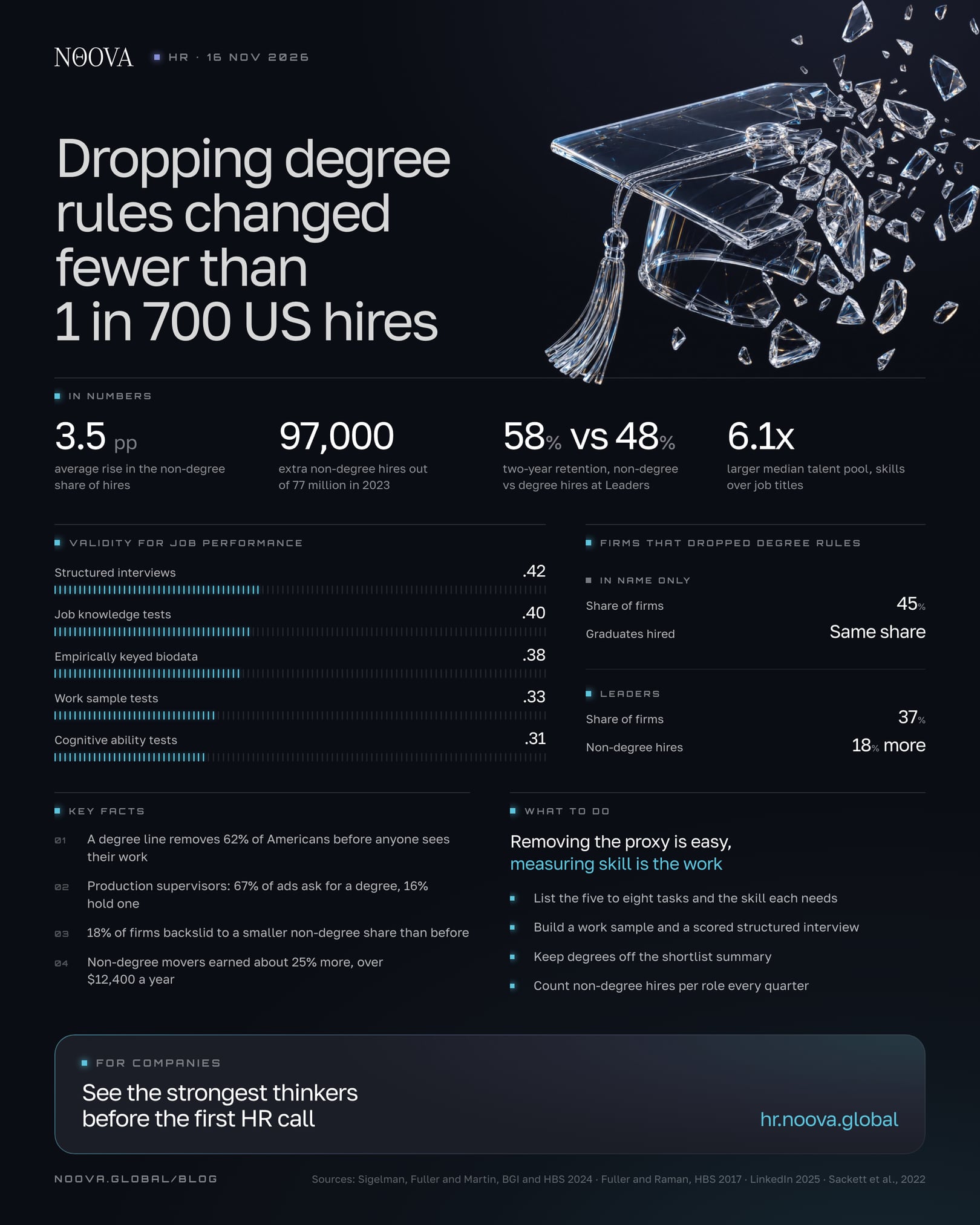
Skills based hiring means choosing people by what they can demonstrably do rather than by proxies such as a degree or a previous job title. Most employers have adopted the first half of that sentence and skipped the second. A 2024 study by the Burning Glass Institute and Harvard Business School found that removing degree requirements from job ads changed the outcome for fewer than 1 in 700 US hires in 2023. This post covers what the data says about adoption and results, why the gap exists, and how to run skills based hiring so it changes who you actually hire.
Skills based hiring: the short definition
Skills based hiring replaces a filter with a measurement. Instead of asking "does this person have a bachelor's degree, or have they held this exact title before", you ask "can this person do the work, and how do we know".
The proxies were never useless. A degree says something about persistence and general preparation. A previous job title says the person survived in a similar role. The problem is that both say it loosely, and both exclude large groups of people who could do the job. The Burning Glass Institute report notes that 62% of Americans lack a four-year degree, so a degree line in a job ad removes roughly two-thirds of adults before anyone has looked at their work.
The degree line also crept into jobs that had not changed. In Dismissed by Degrees, a 2017 study of 26 million job postings and 600 business and HR leaders, Joseph Fuller and Manjari Raman found that 67% of production supervisor postings asked for a college degree, while only 16% of people already doing the job had one. Two-thirds of the employers surveyed agreed that a degree requirement made jobs harder to fill. Researchers call this "degree inflation": the credential asked for rises while the work stays the same.
So skills based hiring has two parts. Removing the proxy is the easy part. Putting a real measure of skill in its place is the work.
What the research says about adoption
Adoption is wide on paper and thin in practice. The 2024 report by Matt Sigelman, Joseph Fuller and Alex Martin is the most careful look at the gap, because it tracks actual hires rather than announcements.
The researchers followed 11,300 roles at large US firms (a role here is one occupation at one employer) that dropped a degree requirement between 2014 and 2023. They linked the job ads to career histories of about 65 million US workers, so they could see who was hired before and after the change.
What they found:
- The number of roles dropping degree requirements each year rose almost fourfold from 2014 to 2023.
- After a role dropped the requirement, the share of non-degree hires rose by about 3.5 percentage points on average. That is roughly 4 more non-degree hires per 100.
- Only 3.6% of roles in their data dropped the requirement at all, so the net change across all roles was 0.14 percentage points.
- In total, the authors estimate about 97,000 extra non-degree hires in 2023, out of 77 million US hires that year.
The average hides three very different groups of firms. The authors call 37% of them "Skills-Based Hiring Leaders": these firms hired 18% more non-degree workers into the affected roles in the following years. Another 45% changed their postings "In Name Only" and kept hiring the same share of graduates. The last 18% were "Backsliders": they made early gains, then drifted back, and in the long run hired a smaller share of non-degree workers than before.
Industry did not decide which group a firm landed in. The report found every sector in all three groups, with tech firms overrepresented among the In Name Only cluster.

Why dropping degree requirements is not skills based hiring
Removing a requirement from an ad changes who applies. It does not change who gets picked, because the decision is made later, by people, under pressure.
The Burning Glass Institute report says this plainly. A hiring manager is not comparing a candidate with an abstract job description but with the other candidates in the pool. "Even when a degree is no longer required, it is still a heuristic hiring managers are likely to use," the authors write. When a vacancy is expensive and the manager will live with the choice, the old proxy feels like safety.
A 2026 follow-up points the same way from another angle. In Credential Fluency, the Burning Glass Institute and OneTen analysed more than 1,000 major US employers. Companies that removed degree requirements saw only a 2 percentage point increase in the share of hires holding non-degree credentials such as industry certifications. The authors' conclusion: shifting hiring practice "demands operational infrastructure" on top of a policy.
The pattern is familiar to anyone who has run a hiring process. If the screen, the interview and the final debrief still run on gut feel, gut feel will find its proxies. Schools, brand-name employers and polished CVs fill the space the degree line left.
What skills based hiring delivers when firms follow through
Where firms changed their process as well as their ads, the results were good for both sides. The clearest numbers are about retention.
At the Leader firms in the 2024 study, non-degree workers hired into roles that used to require a degree had a two-year retention rate of 58%, against 48% for their degree-holding colleagues. That is 10 percentage points, or about 20% better retention. For roles where replacing someone costs months of recruiting and ramp-up, that gap matters more than the size of the applicant pool.
The workers gained too. Non-degree workers who moved into these roles saw an average salary increase of about 25%, over $12,400 a year, compared with their previous job.
The size of the pool is the other promise, and here the evidence is a model rather than an outcome. The LinkedIn Economic Graph Research Institute's 2025 report compared two ways of building a talent pool across 56 countries. One counts people who held the same job title in the last five years. The other counts people whose recent roles share at least half of the target job's top skills. The skills view gave a median 6.1x larger pool for a typical job, and 15.9x in the United States. Treat this as a ceiling on who you could consider. It says nothing about how many of those people would perform well, which is exactly the part you have to measure.
The Burning Glass Institute estimates that at least 250,000 more US jobs a year could open to non-degree workers in roles such as construction managers and web developers, where many people already doing the work have no degree. In 2024, 39% of construction manager postings still asked for one.
What predicts performance better than a degree
The case for skills based hiring rests on a simple claim: some ways of assessing people predict job performance much better than others. Decades of meta-analysis (studies that pool many studies) back this up.
The most recent large re-analysis is by Sackett, Zhang, Berry and Lievens, published in the Journal of Applied Psychology in 2022. They argued that earlier estimates had over-corrected for a statistical problem called range restriction (when you only see performance data for people who were hired, the link between test and performance looks weaker than it is, and older studies adjusted for this too generously). Their revised figures, as summarised by HumRRO researchers in SIOP's TIP, put the structured interview at the top:
- Structured interviews: .42
- Job knowledge tests: .40
- Empirically keyed biodata (scored questions about past experience): .38
- Work sample tests: .33
- Cognitive ability tests: .31
These numbers are correlations with job performance. A value of .42 is far from perfect, but in personnel selection it is strong. Each method on this list asks the candidate to show something: answer the same job-related questions as everyone else, solve a real task, demonstrate knowledge. None of them asks where the candidate studied.
That is the practical meaning of "measure skills". The tools already exist and have been studied for decades. The work sample test and the structured interview are the two most useful places to start, because both can be built in-house for a specific role.
The US federal government shows what a process change looks like
The biggest skills based hiring programme in the US is now a legal requirement, not a pledge. The Chance to Compete Act of 2024 (Public Law 118-188) requires federal agencies to use skills and competency based technical assessments in hiring.
According to the Office of Personnel Management's July 2026 implementation plan, agencies had long relied on self-assessment questionnaires, where applicants rate their own experience and those ratings drive the ranking. OPM's own verdict is that this approach "did not consistently provide an accurate measure" of demonstrated skills.
The changes are concrete. Since September 30, 2025, agencies may use self-assessment questionnaires only to check minimum qualifications, not to rate and rank candidates, with exceptions for seasonal work and lower grades. The law defines a technical assessment as a position-specific tool, based on job analysis, that lets the candidate demonstrate job-related skills. OPM lists examples: situational judgment tests, reasoning assessments, job knowledge tests, work samples, structured interviews and structured reviews of CVs and writing. On March 25, 2026, OPM expanded its shared USA Hire assessments from 138 to 412 occupational series.
The lesson for a private employer is in the order of the steps. Job analysis first, then the assessment, then a rule that the old self-reported proxy can no longer rank candidates. The degree line is the last thing to worry about once the measurement is in place.
How to do skills based hiring so it changes who you hire
The firms that made skills based hiring work changed four things: what they define, what they measure, who decides and what they track. Here is that sequence for a single role.
Write down the skills, from the work. Start with a short job analysis: the five to eight tasks that make up most of the job and the skills each one needs. Ask the people who do the work well, as well as the person who wrote the last ad. The free skills matrix template shows which of those skills your current team already covers and which the next hire has to bring. If a task genuinely needs a licence or a degree, keep the requirement. Doctors and lawyers stay as they are; the Burning Glass Institute report is about the large middle ground where degree and non-degree workers already do the same job.
Pick a measure for each skill. For each skill, decide how a candidate will show it: a short work sample, a job knowledge question, a structured interview question with a scoring guide. Self-ratings and keyword matches in a CV are not measures. OPM dropped self-assessment questionnaires for ranking for exactly this reason.
Give the hiring manager scores, not impressions. The 2024 report locates the failure at the hiring manager's decision, so that is where the new evidence has to arrive. Score each candidate on each skill before the debrief, have interviewers rate independently, and discuss the scores. A degree that is no longer required should not appear on the shortlist summary at all.
Track hires, not postings. The difference between Leaders and Backsliders in the 2024 study is follow-through. Count the share of hires without a degree, or from outside the usual feeder schools and titles, for each role every quarter. Compare their performance reviews and retention with everyone else's. If nothing moves, your process is In Name Only, whatever the job ad says.
Thinking skills are the hardest part of this sequence to measure, because they show up in how someone reasons rather than in a portfolio. Short conversational assessments have become one way to look at them. NOOVA HR runs a 20-minute voice dialogue that maps reasoning into metrics before the first HR call, and a person always makes the hiring decision. Whatever tool you use, hold it to the same test as the rest: it should measure a skill the job needs, and you should check whether its scores track later performance in your own data.
What skills based hiring will not fix
Skills based hiring improves the evidence you decide on. It does not remove judgment, and it brings risks of its own.
An assessment can be biased too. A badly designed test can screen out groups as efficiently as a degree requirement did, so check pass rates by group, and drop or fix items that do not relate to the job. Structured methods help because everyone gets the same questions and the same scoring guide, which leaves less room for impressions.
Measurement also costs time. A work sample takes longer to build than a degree filter, and someone has to score it. The Leader firms paid that cost. The In Name Only firms announced the policy and avoided it, and their hiring did not change.
And the pool-size numbers are a ceiling. A 6.1x larger pool is a larger pile of people to assess, not a larger pile of good hires. The gain comes only when your assessment can tell the strong candidates from the rest.
A checklist for skills based hiring in one role this quarter
- Pick one role where many current high performers have no degree or came from a different job title.
- List the five to eight tasks that make up most of that job and the skill each one needs.
- Remove any degree or title requirement the tasks do not need, and keep the ones they do.
- Build one short work sample and one structured interview with a scoring guide for the core skills.
- Have interviewers score candidates independently before the debrief, and keep degrees off the shortlist summary.
- Count hires without a degree for that role each quarter and compare their retention with everyone else's.
- Check pass rates on every new assessment by group, and fix items that screen people out without a job reason.
Sources
- Skills-Based Hiring: The Long Road from Pronouncements to Practice, Sigelman, Fuller and Martin, Burning Glass Institute and Harvard Business School, February 2024
- Report: Employers don't practice what they preach on skills-based hiring, HR Dive, February 2024
- Dismissed by Degrees: degree inflation is undermining US competitiveness, Harvard Business School news release, October 2017
- Credential Fluency: The Hiring Advantage in the Race for Skills, Rao, Weathers and Martin, Burning Glass Institute and OneTen, March 2026
- Skills-Based Hiring: Increasing Access to Opportunity, LinkedIn Economic Graph Research Institute, March 2025
- Is Cognitive Ability the Best Predictor of Job Performance, O'Shea and Fox Luscombe, The Industrial-Organizational Psychologist (SIOP), on Sackett et al., 2022
- Chance to Compete Act of 2024: Governmentwide Implementation Plan for Transition to Technical Assessments, US Office of Personnel Management, July 2026


