Cognitive Flexibility: What It Is, How It Is Measured and Whether You Can Train It
Cognitive flexibility is switching rules and views as things change. Training it lifts the trained skill (g = 0.44) but barely transfers (g = 0.11).

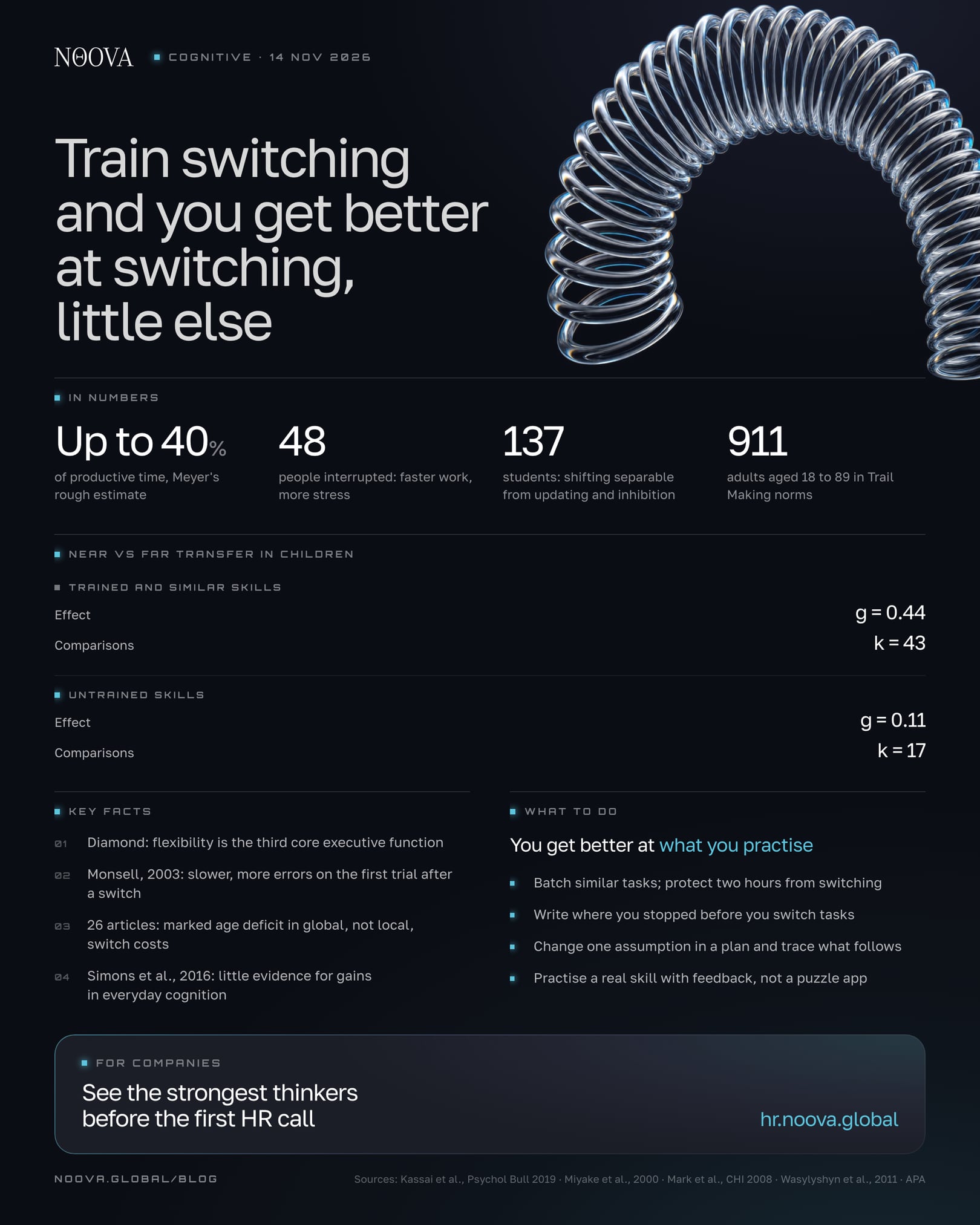
Cognitive flexibility is the ability to drop one rule, task or point of view and pick up another when the situation changes. It is trainable in a narrow sense: a 2019 meta-analysis in Psychological Bulletin found that executive function training in children improved the trained skills (g = 0.44 across 43 comparisons) but showed no convincing spread to untrained ones (g = 0.11). This post explains what cognitive flexibility is, how psychologists measure it, what switching costs you at work, what training and ageing do to it, and what to practise this week.
What cognitive flexibility means
Cognitive flexibility is changing course in your head: a new rule, a new task, a new way of seeing the same problem. Psychologists also call it set shifting or mental flexibility.
In her widely cited 2013 review in the Annual Review of Psychology, Adele Diamond lists it as the third of three core executive functions, the mental skills that let you control what you do instead of running on habit. The other two are inhibition (stopping the automatic response) and working memory (holding information in mind while you use it). Flexibility builds on both. To see a problem from a new angle, you have to suppress the old angle and hold the new one in mind long enough to use it. That is also why, in Diamond's account, flexibility matures later in childhood than the other two.
Diamond's examples are ordinary. Seeing a disagreement from the other person's side. Trying a different method when the first one stalls. Admitting you were wrong when new information arrives. Its opposite is rigidity, and most of us know a meeting where rigidity cost a week.
A 2021 review in Nature Reviews Neuroscience by Lucina Uddin puts it more tightly: the mental ability to switch between thinking about two different concepts. It separates this from behavioural flexibility, changing what you do when the rewards around you change.
Task switching: the lab version of cognitive flexibility
Researchers study cognitive flexibility mostly through task switching, and the core finding is simple: people are slower and make more errors on the first trial after a switch. Stephen Monsell's 2003 review in Trends in Cognitive Sciences00028-7) calls this the switch cost.
A typical experiment shows a digit and asks you to judge it as odd or even on some trials and as high or low on others. When the task repeats, you are quick. When it changes, you slow down. Give people time to prepare and the cost shrinks, but it does not disappear. Monsell attributes the leftover cost to two things: the old task's settings lingering, and the time it takes to load the new ones.
The American Psychological Association's summary of experiments by Joshua Rubinstein, David Meyer and Jeffrey Evans describes the same two steps in plain terms. Goal shifting is deciding to do the other thing now. Rule activation is switching off the old task's rules and switching on the new ones. In their four experiments, the cost grew as the tasks got more complex and was larger for unfamiliar tasks.

How cognitive flexibility is measured
Cognitive flexibility is measured with tasks that change the rule on you and record how fast and how accurately you follow. Three are standard.
- Wisconsin Card Sorting Test: you sort cards by colour, shape or number, the tester tells you only "right" or "wrong", and the rule changes partway through. The score is how quickly you notice and adapt.
- Trail Making Test: part A asks you to connect numbers in order; part B makes you alternate between numbers and letters. The extra time on part B is the switching load.
- Task switching paradigms: the odd-even and high-low design above, run on a computer, with switch costs measured in milliseconds.
The Trail Making Test has large norms. Tombaugh (2004)00039-8) tested 911 community-dwelling adults aged 18 to 89 and found that performance fell with age and with fewer years of education, which is why a raw score means little without the right comparison group.
Cognitive flexibility also turns out to be its own skill, not general cleverness in disguise. In Miyake and colleagues' 2000 study of 137 students, shifting, updating working memory and inhibition were moderately correlated but clearly separable. Performance on the card sorting test related most strongly to shifting. A later review by Friedman and Miyake (2017) adds that these executive functions are not the same as general intelligence.
The honest caveat: each test captures a slice. A person can be quick at switching digit judgements and still hold on to a failing strategy in a real project. Lab tasks measure the mechanism; they do not measure every place you might need it.
Switching at work costs time and calm
At work the cost of switching shows up less in seconds and more in strain. The per-switch cost in the lab is small; the APA summary puts it at sometimes just a few tenths of a second. Those tenths add up when you switch all day.
You will often see a bigger number quoted. Meyer has said that the mental blocks created by shifting between tasks can cost as much as 40 percent of someone's productive time. The APA reports it as his estimate. The experiments themselves measured seconds, not workdays, so treat the 40 percent as an expert's rough figure.
A cleaner workplace study comes from Gloria Mark, Daniela Gudith and Ulrich Klocke (CHI 2008). They gave 48 people an office email task and interrupted them by phone or instant message every two minutes or so. The surprise: interrupted people finished faster, with no drop in quality. The price was paid inside. They reported more stress, higher frustration, more time pressure and more effort. Openness to experience and a lower need for personal structure predicted who handled the interruptions at lower cost.
So a flexible person is not someone who switches freely all day. It is someone who can switch when the situation demands it, and who protects the hours when it does not.
What training cognitive flexibility can and cannot do
Training cognitive flexibility reliably improves the trained task and similar tasks; gains on unrelated tasks and in daily life are small or absent in most of the evidence. The early results were brighter than the later meta-analyses.
Karbach and Kray (2009) trained children aged 8 to 10, young adults aged 18 to 26 and older adults aged 62 to 76 on task switching. All three groups improved on similar switching tasks, children and older adults most. The authors also reported far transfer to other executive tasks and to fluid intelligence, a result that drew wide attention.
Larger syntheses are more sober:
- In older adults, Karbach and Verhaeghen (2014) pooled 49 articles with 61 samples of people over 60. Training helped the trained task and near transfer; far transfer was smaller, though significant in some comparisons.
- In children, the Kassai et al. (2019) meta-analysis found near transfer of g = 0.44 but no convincing far transfer (g = 0.11, k = 17). The authors question training single executive skills in isolation.
- The review Do "Brain-Training" Programs Work? (Simons et al., 2016) examined the studies cited by brain-training companies. It found strong evidence for gains on trained tasks, weaker evidence for closely related tasks, and little evidence for everyday cognition. None of the studies met all of its best-practice standards.
Uddin's review points the same way. One task-switching training study found limited transfer to similar flexibility tasks and no gains in untrained executive domains a year later. Plain aerobic or resistance exercise shows little or no executive benefit, while cognitively demanding activity such as martial arts does better. The claimed bilingual advantage is contested, with no consensus either way.
The practical reading: you get better at what you practise. If you want to become more flexible at reframing a business problem, practise reframing business problems, with feedback, not a phone game about coloured shapes. The same rule runs through our post on cognitive load: the mind improves on the material it actually works on.
Cognitive flexibility and ageing
Cognitive flexibility follows an inverted U across life: it rises through childhood, peaks in early adulthood and declines in late life, according to Uddin's review. Diamond notes the same arc for task switching.
The decline is not uniform, and the details matter. A 2011 meta-analysis by Wasylyshyn, Verhaeghen and Sliwinski pooled 26 articles with 36 independent groups and split switching into two costs. The global cost compares blocks where you juggle two tasks with blocks where you do only one. The local cost compares a switch trial with a repeat trial inside the mixed block. Older adults showed a marked deficit on the global cost and no specific deficit on the local one.
In plain words: the act of switching itself holds up fairly well. What gets harder is keeping two task sets ready at once. A 2023 update by Chen and Hsieh again found no switch-specific age impairment in local costs, with older adults slower across conditions, and flagged heterogeneity and publication bias in the literature. Expect more of the general slowing, less of a specific switching failure.
For anyone older who manages complex work, that suggests a design choice rather than a verdict: fewer parallel threads, cleaner handovers between them.
Flexible thinking you can see in a conversation
Outside the lab, cognitive flexibility shows in how someone handles a changed premise. Give a strong candidate or colleague a new fact halfway through their argument and watch what happens. The flexible thinker updates the conclusion and says which step changed. The rigid one defends the old conclusion with new words.
That link to self-monitoring is close to metacognition: you cannot switch strategy if you have not noticed the current one is failing. It is also why a spoken dialogue tells you more than a single score. If you want to see how your own thinking moves under a changed question, NOOVA measures it in a 20-minute voice dialogue instead of hours of tests.
A checklist for practising cognitive flexibility this week
- Batch similar tasks into blocks and give yourself two protected hours with no switching.
- Write one sentence on where you stopped before you switch tasks, so the restart costs less.
- Restate one current problem from a stakeholder's point of view before you propose a fix.
- Change one assumption in a plan you like and work out what else would have to change.
- Ask a colleague for the strongest case against your approach and change one thing because of it.
- Pick one real skill you want to be more flexible at and practise it with feedback, not a puzzle app.
- Notice the next time you defend a conclusion after its premise changed, and say so out loud.
Sources
- Executive Functions, Adele Diamond, Annual Review of Psychology, 2013
- Cognitive and behavioural flexibility: neural mechanisms and clinical considerations, Lucina Uddin, Nature Reviews Neuroscience, 2021
- Task switching, Stephen Monsell, Trends in Cognitive Sciences, 200300028-7)
- Multitasking: switching costs, American Psychological Association
- The unity and diversity of executive functions, Miyake et al., Cognitive Psychology, 2000
- Unity and diversity of executive functions: individual differences as a window on cognitive structure, Friedman and Miyake, Cortex, 2017
- Trail Making Test A and B: normative data stratified by age and education, Tombaugh, Archives of Clinical Neuropsychology, 200400039-8)
- The Cost of Interrupted Work: More Speed and Stress, Mark, Gudith and Klocke, CHI 2008
- How useful is executive control training? Karbach and Kray, Developmental Science, 2009
- Making working memory work: a meta-analysis of executive-control and working memory training in older adults, Karbach and Verhaeghen, Psychological Science, 2014
- A meta-analysis of the near- and far-transfer effects among children's executive function skills, Kassai et al., Psychological Bulletin, 2019
- Do "Brain-Training" Programs Work? Simons et al., Psychological Science in the Public Interest, 2016
- Aging and task switching: a meta-analysis, Wasylyshyn, Verhaeghen and Sliwinski, Psychology and Aging, 2011
- The effect of age on task switching: updated and extended meta-analyses, Chen and Hsieh, Psychological Research, 2023


