AI Job Applications Are Flooding Employers, Says Indeed's CEO
AI job applications are swamping employers: on November 11 Indeed's CEO said one candidate's agent may send 100 or even 1,000. What it means for hiring.

AI job applications have reached a volume that Indeed now offers to filter out for employers. On November 11, 2026, Hisayuki Idekoba, CEO of Indeed's parent company Recruit Holdings, told analysts that large employers are flooded with applications sent by AI agents, and that "a single candidate might submit 100 or even 1,000 applications" (earnings call transcript). Several clients have asked Indeed to run their entire careers page to keep the bots out, he said, and it has started. Below: what he said, the numbers behind Indeed's quarter, why mass applications break the usual hiring funnel, and what to change.
What Indeed's CEO said about AI job applications
The remark answered a Goldman Sachs analyst who asked about personal AI agents, such as Meta's Muse, that search for jobs on a person's behalf. Idekoba's view: search is the easy part, and "the real challenge lies on the job application side."
On applications he was blunt: "especially for large enterprises, job applications driven by AI agents are flooding in", and "many companies are really struggling to deal with this."
His proposed fix is a change in how job boards charge. Indeed is testing "cost-per-interview or cost-per-qualified-application" models. In his example, an employer sets requirements, such as holding a particular license, and pays a fee only when an applicant who meets them applies. Indeed's own AI screening would do the sorting.
One caveat on the words. The call was held in Japanese, and Recruit notes that its English Q&A was translated with an AI tool and then edited. Investing.com's transcript renders the same answer as applications "by AI agents, so 100 or 1,000 per person and per case". The number is the CEO's illustration, not a measured average.
The numbers behind Indeed's quarter
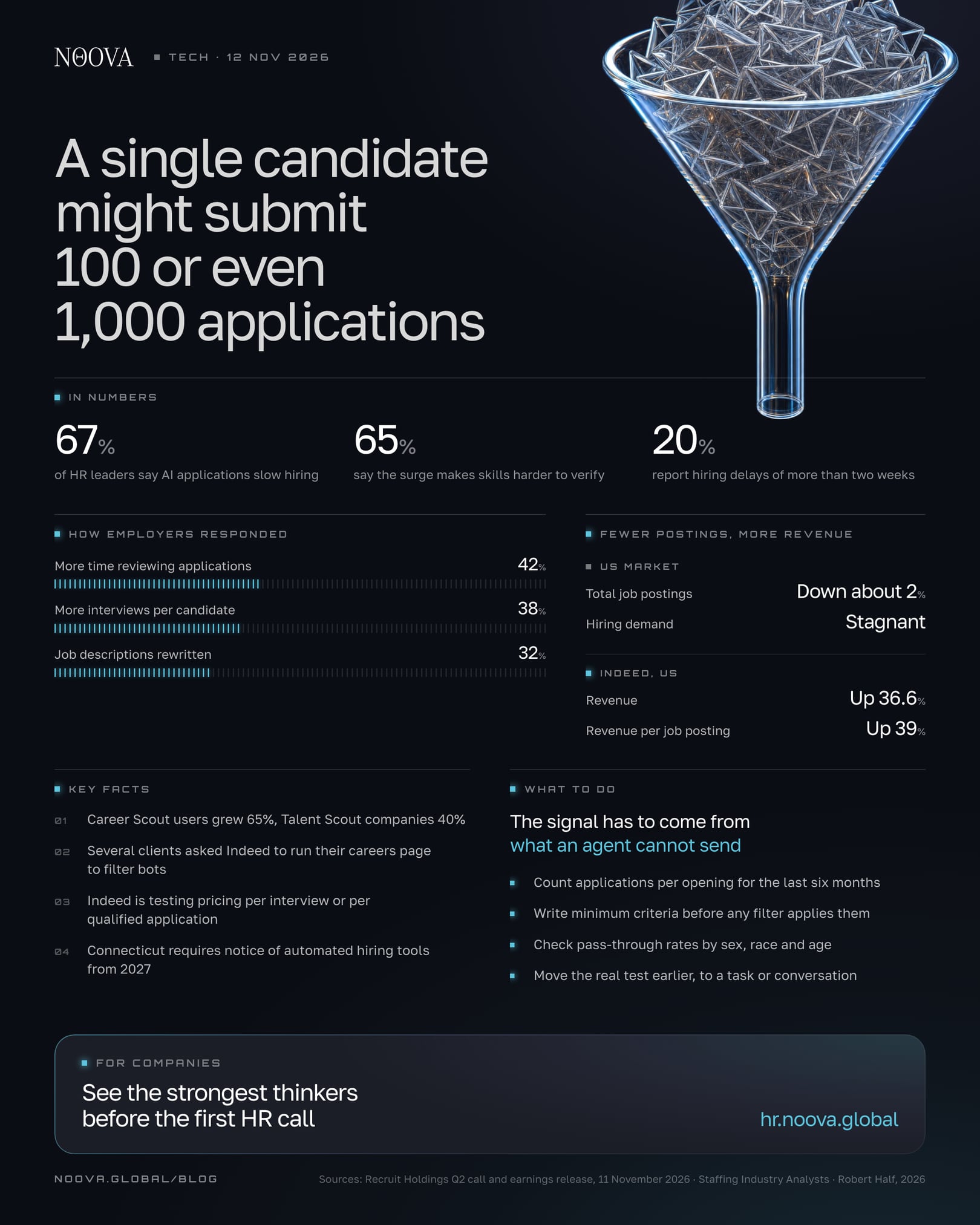
Indeed is earning more while US job postings shrink. In July to September 2026, Recruit's HR Technology segment, which holds Indeed and Glassdoor, grew revenue 27.5% year on year to $3.07 billion, Staffing Industry Analysts reports. US revenue rose 36.6% to $1.82 billion.
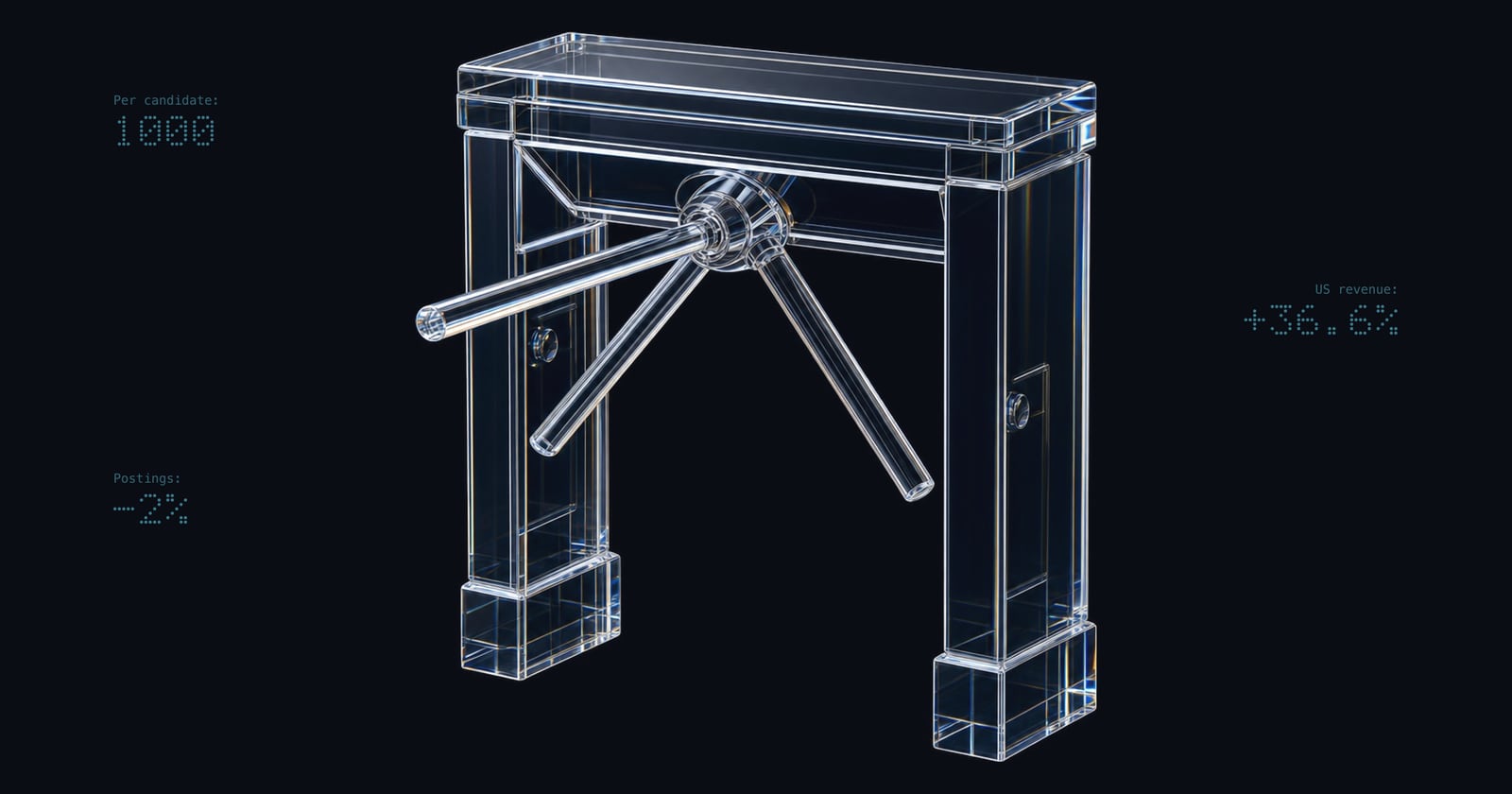
Over the same quarter the total number of US job postings fell about 2% year on year, according to CFO Junichi Arai. Revenue per job posting rose 39%. The earnings release describes the first-half US growth as coming "despite stagnant hiring demand".
The growth came from higher-priced, AI-powered products such as Premium Sponsored Jobs, bought mostly by small and medium-sized businesses. "For small businesses, an unfilled position is a matter of life or death," Idekoba said, and with Indeed's AI products time to hire "is cut dramatically". Recruit defines time to hire as the median number of days from a job posting to the first reported hire.
Agents now work both sides of the market. US users of Career Scout, Indeed's agent for job seekers, which writes resumes, runs mock interviews and helps with applications, grew 65% from the previous quarter. Companies using Talent Scout, the agent for employers, grew 40%. Both figures are Indeed's internal data.
Recruit now expects full-year HR Technology revenue of $11.9 billion, up 23.2%, against the 18.7% growth it forecast in August.
Why AI job applications break the hiring funnel
An application used to cost the candidate an evening, and that cost was a filter. When an agent can apply a thousand times, an application says little about interest and less about skill. The resumes start to read as drafts from the same few models.
Employers felt this before Indeed's call. In a Robert Half survey of more than 2,000 US hiring managers, run in November 2025, 67% of HR leaders said reviewing AI-generated applications has slowed hiring, and 20% reported delays of more than two weeks. Sixty-five percent said the surge made candidate skills harder to verify. Their responses: more time reviewing applications (42%), more interviews per candidate (38%), job descriptions rewritten to discourage generic AI answers (32%).
Indeed's answer is to filter earlier with its own AI. That moves the problem; it does not remove it. A screen that rejects applicants on set criteria is still a selection procedure, and the employer still answers for whom it screens out. That is the fight in Mobley v Workday. From October 1, 2027, the Connecticut AI hiring law also requires a written notice to candidates before an automated tool materially influences a hiring decision.
What we think
When every applicant can produce a polished document at no cost, the document stops measuring anything. The signal has to come from what an agent cannot send on someone's behalf: how the person reasons through a real problem, live, in their own words.
That is the bet behind NOOVA HR: a 20-minute voice dialogue that shows a candidate's thinking in metrics before the first HR call, with a person always making the decision. Other methods work too, from structured behavioral interviews to short work samples. What stops working is keyword-matching resumes that an agent wrote for a filter that another agent built.
The pricing idea deserves attention as well. If job boards charge per qualified applicant, the definition of "qualified" becomes one of the employer's most important hiring decisions. It should be written down, tested for adverse impact and owned by a named person.
A checklist for employers facing AI job applications
- Count applications per opening for the last six months, so you know your real volume.
- Write down the minimum criteria for each role before any filter, human or AI, applies them.
- Ask your job board and applicant tracking system which applicants their AI screening rejects, and by what rules.
- Check pass-through rates by sex, race and age at every automated step.
- Move the real test earlier, to a short structured task or conversation instead of a resume read.
- Tell candidates which steps use AI, ahead of Connecticut's 2027 notice rule.
- Name one person accountable for every automated rejection rule.
Sources
- Recruit Holdings Q2 FY2026 earnings call transcript, 11 November 2026
- Consolidated Financial Results for the Six Months Ended September 30, 2026, Recruit Holdings, 11 November 2026
- Investor Relations, Recruit Holdings
- Recruit Holdings posts record-high revenue in Q2, HR Tech surges, Staffing Industry Analysts, 11 November 2026
- Earnings call transcript: Recruit Holdings posts strong Q2 2026 growth, shares slip, Investing.com, 11 November 2026
- Robert Half survey: 67% of HR leaders report AI-generated applications are slowing hiring, Robert Half, 10 March 2026